
- Topics
- Feature
- Opportunities & Events
- About
- Hindi Portal
- Data
- Topics
- Feature
- Opportunities & Events
- About
- Hindi Portal
- Data
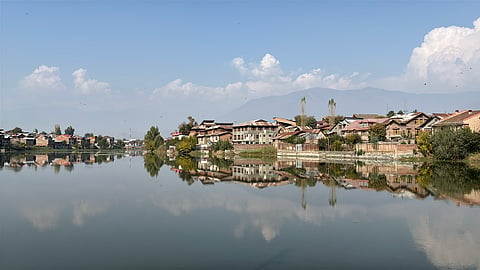
The calm waters of Khushal Sar perfectly mirror the houses and distant mountains, symbolizing the lake's rebirth.
Wahid bhat

The smell came before sunrise. Abdul Rahim, now 58, would wake to it, a sour, heavy stench drifting through his window long before the call for prayer. He had lived by Khushal Sar all his life, and for years the lake had been his clock.
The ripples woke him at dawn, and its silence hinted at the arrival of winter. He remembered when the water was blue and full of lilies. Over time, it turned into a swamp of plastic and muck.
But one morning in early winter 2020, Rahim heard something he hadn’t in decades, the faint cry of a coot cutting through the mist. He stepped outside with his stick, walked past a drain spilling grey water, and stopped at the bank.
Between floating bottles and weeds, a small patch of clear water glimmered in the weak light. He stood still for a long time, watching the reflection. “I thought maybe I was dreaming,” he says. “I hadn’t seen water like that since I was a boy.”
A few days later, he saw young men in shikaras pulling garbage from that same patch. One of them waved and asked if he wanted to help. Rahim hesitated, then waded in. The water was cold, thick with silt. He picked up a rusted tin can and dropped it into a sack. “It was strange,” he says. “For the first time, the lake felt alive again.”
That morning became a story the neighbourhood still tells, an old man stepping into the water that had once been his home, helping strangers clean what everyone had given up on. It was the first sign that Khushal Sar, long buried under neglect, might just breathe again.
But even as the city celebrates this fragile recovery, bulldozers now line the banks. They signal another chapter: demolitions, displacement, and the long fight to reclaim Srinagar’s vanishing wetlands.
Abdul Rahim, a local resident, sits by Khushal Sar, remembering its decline and witnessing its recent revival.
Photo credit: Wahid Bhat
A lake cut off connections
Before the roads and concrete came, Khushal Sar was a waterway that connected Dal, Gil Sar, and Anchar lakes. Shikaras carried fish, lotus stems, and passengers through its winding channels. “We could row from here to Dal without stepping out." says local resident Ghulam Hassan. “The water was clear enough to see fish.” That waterway is gone. What remains today is both loss and possibility, a lake reborn but still surrounded by threats.
An excavator actively removes accumulated waste from the lake, a significant step in Khushal Sar's ongoing restoration efforts.
Photo credit: Wahid Bhat
The decline began half a century ago, with a single decision that changed Srinagar’s geography. That network began to collapse in the 1970s, when the Nallah Mar canal, once a key inflow, was filled to build a road. The lake was cut off and slowly turned into a stagnant basin.
“What used to be blue water turned black,” recalls Mohammad Shafi Malik, a 58-year-old resident. “The smell made life unbearable.” As Srinagar expanded, the pressure intensified. The city generates nearly 500 tonnes of waste daily, with nearly 62% organic and around 7% plastic, which is a significant portion entering its water bodies. Officials estimate that about 465 million litres of untreated sewage flow into the city’s water bodies daily, including all the lakes.
By 2018, Khushal Sar’s depth had dropped to two feet. Solid waste buried its natural springs. The lake’s total area shrank from 0.96 square kilometres in 1965 to 0.6 square kilometres, a 40 percent loss. “It had become a dead zone,” says Professor Shakil Romshoo, Head of Earth Sciences at the University of Kashmir. “Urban wetlands act as sponges that absorb floodwaters. When they disappear, flooding becomes inevitable, as we saw in 2014.”
Across Srinagar, nearly 9,000 hectares of wetlands have vanished since 1911. “Concrete replaced floodplains,” says Professor Irfan Rashid, who studies land-use change. “The result is more silt, less water, and higher flood risk.” For Hassan, the loss was personal. “This lake fed us,” he says. “When it died, so did our work.”
In late 2020, a small group of residents began cleaning the lake themselves. Armed with shovels, boats, and sacks, they started removing years of accumulated waste. “The lake looked like a landfill,” says Mushtaq Ahmad, one of the first volunteers.
Around the same time, environmentalist Manzoor Ahmad Wangnoo spoke about the need for “ehsaas—a sense of responsibility" during a public discussion on Srinagar’s lakes. The idea resonated. What followed was not a formal campaign but a growing community effort. Students, shopkeepers, and boatmen joined in. Over months, they removed thousands of tonnes of waste.
Local residents gather near Khushal Sar lake, discussing the ongoing community-led efforts and challenges in its revival.
Photo credit: Wahid Bhat
The movement, later known as Mission Ehsaas, soon drew institutional support. The Srinagar Municipal Corporation began lifting waste, and dredging operations were introduced. But residents say the shift was not just administrative—it was social. Mosques urged people not to litter. Schools spoke about the lake. Families began monitoring dumping.
“It became a shared responsibility. We stopped waiting and blaming the government and started fixing what we had ruined,” says Mushtaq. By 2022, the lake’s depth had increased to six feet. The water began to clear. The smell faded. “The oar moves freely now. It feels like a lake again," Mushtaq added. Fishermen returned, and lotus stems grew again. For Rahim, the change was quiet but profound. He returned to the banks each morning, watching children clean the water. “When I see them, I feel like the lake is teaching us how to start again,” he said.
Even Abdul Rahim, who once thought the lake was gone forever, began visiting the banks each morning. He would sit quietly, watching children pull bottles from the shallows. “When I see them,” he said, “I feel like the lake is teaching us how to start again.”
By the next year, the lake no longer looked like a dump. The water, once black and motionless, began to move again. Fishermen returned to the shallows, and children played by the edges. The sound of oars replaced the buzz of mosquitoes. Khushal Sar was breathing again, slowly and cautiously, and nature seemed to notice first.
One winter morning, Sahil Wani, a 25-year-old birdwatcher, stood on the Gil Kadal bridge. He raised his binoculars and froze. “I saw a flock of pintails land,” he says. “My father told me he last saw them here in the 1980s.”
The birds were back. Hundreds of mallards, teals, and gadwalls returned to Khushal Sar after forty years of silence.
Across Kashmir, nearly 1.3 million migratory birds visit wetlands each winter. But changing weather patterns are altering their behaviour. “They now arrive later and leave earlier,” says Naseem. “Warmer winters confuse their migration. Some species that once stayed in Hokersar now go farther north.”
For Sahil Wani, watching them at Khushal Sar feels like witnessing history. “When they came back, people began looking at the lake differently,” he says. “The birds made us believe the change was real.”
At dusk, as shikaras glide through fading light, Sahil often sits by the bank, one watching the sky, the other the water. The hum of flies that once hung over the lake has been replaced by the cry of birds.
The map shows Khushalsar lake in Srinagar. It highlights the lake's size and shape within the city. This area was once full of life and is now coming back.
Photo credit: Wahid Bhat
As the water cleared, life returned. One winter morning, 25-year-old birdwatcher Sahil Wani stood on a nearby bridge and spotted a flock of pintails landing on the lake. “My father told me he last saw them here in the 1980s,” he says. Soon, more birds followed, like mallards, teals, and gadwalls—returning after decades.
Across Kashmir, around 1.3 million migratory birds visit wetlands each winter, though changing climate patterns are altering their behaviour. Warmer winters have begun shifting migration timelines. But at Khushal Sar, their return became a visible sign of recovery. “When the birds came back, people believed the change was real,” Sahil says.
Sahil Wani, a 25-year-old birdwatcher, on Khushal Sar lake, which has been brought back to life by its residents.
Photo credit: Wahid Bhat
Even as the lake was being revived, another process unfolded along its edges. In November 2021, the district administration demolishing illegal constructions built on reclaimed wetland. Bulldozers arrived before dawn. In the first phase, 25 houses were removed. By mid-2022, over 95 structures had been demolished.
Officials described the drive as necessary. The then Deputy Commissioner Mohammad Aijaz Asad says, “We have to restore the lake in public interest. Encroachments have suffocated the water body. Reclamation is non-negotiable.” The goal was to restore Srinagar’s historic water network and reduce flood risk, linking Dal, Gil Sar, Khushal Sar, and Anchar. “These channels once drained excess rainwater. Restoring them could prevent another 2014 flood,” says an Irrigation Department engineer.
But the demolitions exposed a deeper conflict. For some, restoring the lake meant losing their homes. The tension reflects a long-standing gap in urban planning—where environmental restoration often comes after decades of unregulated growth, leaving communities to bear the consequences.
Khushal Sar’s revival has renewed focus on Kashmir’s wider wetland crisis. A century ago, the valley had over twenty major wetlands forming a natural flood system. Today, many have shrunk or disappeared under roads, housing, and waste, weakening how the land drains and regulates water.
Government data shows over 7,600 kanal of wetlands have been lost to illegal construction, leaving Srinagar far more vulnerable to flooding.
The crisis has reached the courts. In November 2024, the Jammu and Kashmir High Court flagged a “serious lapse” in the government’s failure to submit a status report on wetlands. It sought details on Anchar Lake and the Amir Khan Nallah, calling their neglect “a matter of public importance".
Rahim sometimes sits by the bank. “When I was a boy, this lake fed us. Then it died. Now maybe it will live longer than us,” he says.
“The floods were not just a natural event. We built over our water bodies and called it development. The city grew 12 times in population and 23 times in area, and we erased our sponges,” says environmentalist Anzar Khroo.
Urban expansion and unchecked construction have destroyed floodplains that once absorbed excess rain. The filling of channels, combined with untreated sewage and weak enforcement, has accelerated decline. “We replaced floodplains with concrete,” says Professor Rashid. “Now rain has nowhere to go.” His words echo across Srinagar’s lanes every time a storm floods the streets.
An excavator is parked on the bank, playing a vital role in dredging and clearing the lake's polluted edges.
Photo credit: Wahid Bhat
When systems fail the wetlands
A study by the University of Kashmir found that urbanisation around Khushal Sar, especially after the filling of the Mar Canal has reduced its water-holding capacity and severed its link with Dal and Anchar. “Every encroachment here weakens the city’s natural drainage,” notes Professor Romshoo. During the 2014 floods, nearby neighbourhoods were among the worst hit.
An excavator on a floating platform dredges Khushal Sar, removing silt and debris to restore the lake's depth.
Photo credit: Wahid Bhat
The impacts extend beyond water. Floods are more frequent, winters warmer, and rainfall erratic. Fish stocks have declined, and lotus farming has withered. “Every vanishing wetland means fewer fishers, fewer birds, fewer livelihoods,” says Professor Romshoo. Scientists warn wetland loss is also disrupting Kashmir’s climate by reducing natural carbon sinks by absorbing carbon dioxide and nitrogen, cooling the valley and regulating weather. Their destruction fuels rising temperatures and unstable snowfall patterns.
This section of Khushal Sar shows heavy pollution and neglect before the community's restoration efforts began.
Wahid Bhat
Experts attribute this to gaps in urban planning. “We hardly account for flood risk,” says a regional planner. “Departments work in silos, so wetlands slip through every plan.”
The government has initiated sewage treatment, dredging, and zoning measures. “We are expanding Srinagar’s water channel capacity by 60,000 cubic feet per second,” the officer said. “Flood-prone areas will be declared no-construction zones.”
For a valley built around water, the loss of wetlands is not just environmental, it is cultural. The lakes have always been Kashmir’s mirrors, reflecting its seasons and its soul.
For residents, though, the real test lies ahead, keeping the lake alive once the spotlight fades. Youth groups now monitor waste dumping. Community leaders organize monthly clean-up drives. Some schools have adopted nearby water channels for awareness lessons.
The vast expanse of Khushal Sar lake, once a "dead zone," now shows signs of ecological recovery.
Photo credit: Wahid Bhat
On a calm February morning, Ghulam Hassan rows through open water while Sahil stands on the shore with his camera. “This is my new classroom,” Sahil says. “Every bird that lands here proves something has changed.”
Rahim sometimes joins them, sitting quietly by the bank where he once heard the first cry of a coot. “When I was a boy, this lake fed us,” he says. “Then it died. Now maybe it will live longer than us.”
As the sun rises, the mist lifts. Pintails circle once, then settle near the reeds. The lake looks whole again. But its future will not be decided by water alone, it will depend on whether the city remembers what it chose to forget.