
- Topics
- Feature
- Opportunities & Events
- About
- Hindi Portal
- Data
- Topics
- Feature
- Opportunities & Events
- About
- Hindi Portal
- Data

There are mornings when the light still falls softly on Anchar Lake. From Soura on Srinagar’s northern edge, it appears calm and familiar, part of a wetland chain once stretching through Gilsar and Khushal Sar before meeting Dal Lake through the Amir Khan Nallah. Lotus stems thrived here, migratory birds found refuge, and the Hanji community set out in wooden boats, trusting the lake to sustain them. Anchar was more than a water body; it was a living corner of the Sindh River delta, a cradle of fish, a sanctuary for birds, and a home for traditions.
But as Srinagar expanded, the wetlands shrank. To its west, the Achan landfill rose steadily, swallowing marsh after marsh. Today, the lake that once absorbed Dal Lake’s overflow and supported thousands struggles to breathe under the weight of pollution and neglect.
Fishing families watch a once generous lake collapse around them
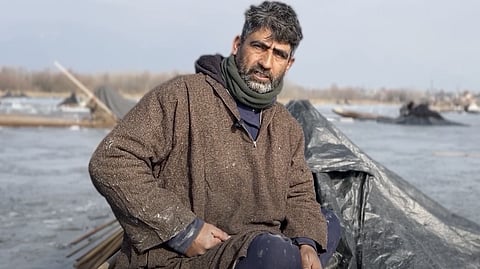
“The water is darker now. The nets return emptier. The smell of waste drifts farther each year. What was once a place of abundance is turning unrecognisable. Once, they came up brimming with nearly ten kilograms of fish a day, enough to support his family. Today, they rise empty,” says Farooq Ahmad Dar, a 49-year-old fisherman, as he hauls his nets from Anchar Lake’s sluggish waters.
“Fish have vanished completely. The few I find are diseased and black. Customers refuse them. Even my own children will not eat fish from these waters. I have a wife, three sons, and two daughters. Both my daughters are married, and my sons now work as labourers because fishing no longer feeds us. This lake once kept our family alive, but today it leaves us hungry,” Dar says, winding wet rope in his boat. Farooq Dar paddles through the polluted wetlands of Srinagar, showing how the area has changed from once clean to heavily contaminated.
Nearby, 54-year-old Nazir Ahmad Kondoo (name changed) returns with his net, Panzar rod, and fishing basket, empty for the third consecutive day. He learned fishing from his father at age fifteen and remembers the lake’s bounty clearly. “In the 1990s, I earned 1000 to 1200 a day catching Keashir gaad,” he says. “It was enough to feed a family of ten. Today, it is difficult to make ends meet.”
For generations, Kondoo’s family fished Anchar Lake. Now, that tradition is ending. His wife, Sondree, works along the lake banks to supplement their income. “I cannot afford to sit at home,” she says, pointing to floating piles of garbage. “This lake has become a workplace for survival.” She earns about 300 to 400 rupees a day, a small fraction of what fishing once provided.
Both Dar and Kondoo face the same truth: Anchar Lake, once the lifeline of thousands, is dying. In the 1990s, local fishermen supplied 800 to 1000 kilograms of fish daily to Srinagar markets. Today, the catch barely reaches 50 kilograms, most of it unsold. Along the western shore, the Achan landfill rises like a mountain of waste. Every day, trucks dump tonnes of garbage. Toxic leachate drains into water and soil, infiltrates canals, and spreads through the waterways that once supported entire communities.
Anchar Lake stretched across 19 square kilometres for centuries. Fishing families, nadru cultivators, and vegetable farmers across dozens of villages depended on its waters. It powered markets, traditions, and Kashmir’s food economy.
Today, the lake covers only seven square kilometres. Thick weeds choke the remaining water, and sewage and landfill toxins dominate its surface. Scientists estimate that 600 families once earned a living from nadru cultivation. Nearly 1,000 more depended on fishing, farming, and lake-based trade. That economy has collapsed.
Farooq Dar’s son, elder Gaffar, tends vegetable fields along Anchar’s banks. His spinach and collard greens once supplied restaurants across Srinagar. Today, customers refuse them. “They say our vegetables smell,” Gaffar explains, standing in soil poisoned by leachate. “In Lal Chowk market, traders ask where the produce comes from. If we say Anchar, they refuse to buy. My income has dropped by half in five years.”
Irrigation canals now carry toxic leachate from Achan landfill into the fields. Crops wither, livestock refuse to drink, and farmers struggle with shrinking harvests. Anchar Lake is dark and lifeless, leaving families without livelihoods.
Farooq Dar says, “For generations, our families lived by the rhythm of Anchar Lake. In winter, when the waters turn cold, we take our wooden boats and practise ‘Tchay e gard Shikar’, the shadow fishing our elders taught us. We hide under a cloth, cast a shadow on the water, and wait for the fish to come close, just as our fathers and grandfathers did.
But today, the lake no longer gives what it once did. Pollution has poisoned its heart. The fish are fewer, the water is darker, and our children may never know the pride of this tradition. What was once our way of life, culture, and bond with the lake is fading before our eyes.”
Soil tests confirm rising toxicity. Heavy metals, plastic fragments, and chemical residues contaminate fields that fed generations. Crops taste different; restaurant owners complain of a bitter flavour. Home cooks notice the change. Once-clear canals now carry black leachate. Farmers watch harvests weaken, season after season, without affordable alternatives.
The landfill’s deadly reach
Achan landfill, Srinagar’s official dump since 1986, sprawls over 123 acres and receives 550 tonnes of waste daily. Only a fraction is processed, leaving much to accumulate. The Municipal Corporation has acknowledged 11 lakh metric tonnes of legacy waste and submitted a three-year remediation plan to the National Green Tribunal, including leachate treatment, tree planting, bio-mining, a process that recovers usable materials from old waste using biological methods, and refuse-derived fuel projects. The J&K Pollution Control Committee has also initiated action against eight former municipal commissioners for violations under the Environment Protection Act.
The stench spreads for kilometres, affecting fishers and farmers. Traders at Lal Chowk refuse vegetables grown along the lake’s banks. Customers reject fish caught in Anchar Lake, forcing families to seek alternative work.
A 2022 study mapped contamination pathways from Achan across 26 hectares. Researchers tracked how leachate follows every water channel, infiltrating Anchar Lake and groundwater that villages rely on. Feroz Ahmad Bhat, assistant professor at SKUAST, explains why fish catches have plummeted. “Pesticides from nearby agriculture leak into lakes, making them hazardous for fish breeding. If the environment is not viable, production cannot increase,” he says.
Science confirms the destruction
Environmental researchers document Anchar’s decline. Nazir Ahmad Kondoo notes, “Leachates from Achan contain extremely high levels of heavy metals, plastic compounds, and pathogens. When this mixture reaches lake water, aquatic ecosystems collapse.”
Professor Shakeel Ahmad Romshoo, who is Vice Chancellor of Islamic University of Science and Technology (IUST) and a scientist specialising in Glaciology, Hydrology, and Climate Change, places Anchar within a larger regional crisis. “Anchar Lake is one of the wetlands in Kashmir that is severely deteriorated due to urbanisation, silt load, and human activity,” he says. Recovery is possible but difficult. “A conservation and management plan must be developed for each wetland, supported by government, civil society, and local communities,” he adds.
The numbers paint a stark picture. Srinagar generates 525 tonnes of waste daily. Across Jammu and Kashmir, cities produce 1,500 tonnes per day. In 2021-22, officials processed only 606 tonnes. The rest was dumped at sites like Achan.
Anchar Lake reflects the consequences. Methane bubbles on the surface, and black sludge coats the banks. Anchar Lake has shrunk from 19.4 square kilometres to 6.8. Scientists warn of complete ecological collapse within years if dumping continues. Pollution data shows contamination far beyond safe limits. Heavy metals in soil exceed international standards by 300 percent. Water samples contain plastic, chemicals, and bacteria, making irrigation dangerous.
Government vows continue; Real work does not
Officials have pledged solutions for decades. In 2017, the state cabinet approved a waste-to-energy plant for Achan. Eight years later, it remains unbuilt and the landfill continues to grow. The National Green Tribunal has repeatedly issued binding directives and imposed ₹12 crore in environmental compensation. Promises include bioremediation, leachate treatment, and tree planting, yet local residents remain sceptical. “We have heard identical promises for twenty years,” Kondoo says. “Each year brings announcements and unchanged problems. Meanwhile, our lake dies and our families face starvation.”
An official from the Srinagar Municipal Corporation, who asked not to be named, cites funding delays, technical challenges, and bureaucratic hurdles. But local communities see endless meetings and reports while the crisis worsens. The Lake Conservation and Management Authority has neglected canal cleaning. Channels that once carried fresh mountain water now flow with plastic debris and sludge. When cleaned occasionally, waste is dumped on the banks, and rain washes it back into the waterways.
When contacted, commissioner-level officials from the Srinagar Municipal Corporation first asked for more time but later did not respond to calls. They eventually declined to comment on the issue.
Communities unravel as the lake’s decline deepens
Ecological collapse devastates generations. Farooq Dar is the third generation of fishermen in his family. His father fished these waters, and his grandfather built a family trade on Anchar’s abundance. Today, he tells his sons to seek other work.
“Fishing fed three generations of my family,” Dar says. “Now I advise my sons to seek employment elsewhere. No future exists in these poisoned waters.” Young people leave villages around Anchar Lake. Some migrate seasonally for work, while others find construction jobs in cities. Traditional knowledge of fishing, nadru cultivation, vegetable gardens, and lake farming disappears with each departure.
Families once earning seasonal incomes now struggle with poverty. Women who processed and sold nadru lost their livelihood. Elderly fishermen cannot adapt and depend on relatives. The social structure of lake-dependent communities collapses alongside the ecosystem. Villages that organised life around the lake now turn away from its poisoned waters.
A regional waste crisis
Anchar’s destruction reflects broader failures in Jammu and Kashmir’s waste management. The region generated 225,000 tonnes of plastic waste over five years. Collection and recycling show uneven progress. Thirty-two material recovery facilities exist, but Srinagar’s main landfill continues to poison the lake.
Biomedical waste worsens contamination. Reports show medical and general waste often mix. Nearby hospitals are a source of concern for activists who warn untreated waste threatens the wider population. “Officials made identical promises in 2017, 2019, and 2022. Each year brings new deadlines and old problems. How long can promises feed our starving families?” questions Dar.
Standing at the edge of his poisoned fields, Dar stares across Anchar’s dark waters. “This lake gave us life for centuries,” he says quietly. “Now it brings us death. And still, they offer only words instead of action.”
With each passing year, the lake shrinks and the landfill expands, forcing families to abandon livelihoods their ancestors built. Each delay in action costs lives, futures, and Kashmir’s natural heritage. Time is running out for Anchar Lake. Time is running out for the people who once called its waters home.
Disclaimer:
The names of people have been changed because residents fear action from the administration. After officials objected to media reporting from their homes, many refused to share photos or real names. Some who had shared their pictures and information called back to withdraw the same.
This story is produced as part of the India Water Portal Regional Story Fellowship 2025.