
- Topics
- Feature
- Opportunities & Events
- About
- Hindi Portal
- Data
- Topics
- Feature
- Opportunities & Events
- About
- Hindi Portal
- Data
The Neermahal of Tripura
Thomas Malsom

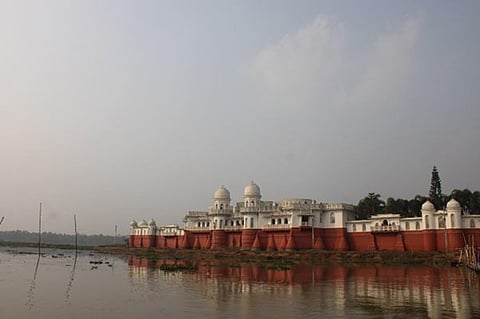
A fisherman sits still in his boat on Rudrasagar Lake, not casting his net, not rowing forward. He watches the water in silence. “No point. There are no fish,” he says softly before turning back for the day. Not far from him, the red and white silhouette of Neermahal rises from the lake, still drawing visitors who arrive by boat to visit the floating palace. From a distance, it looks unchanged, almost timeless. But up close, the water that once held it has begun to slip away.
In Melaghar, about 53 kilometres from Agartala, the story is no longer just about a palace. It is about a lake in retreat, a livelihood in decline, and a landscape where water is slowly disappearing.
Tourist boats parked at Rudrasagar Lake
Thomas Malsom
A palace that belonged to water
Known in Kokborok as “Twijilikma Nuyung,” meaning water palace, Neermahal was imagined as a structure that would live with water, not besides it. Conceived in 1930 by Maharaja Bir Bikram Kishore Manikya Bahadur and completed in 1938 with the support of the British firm Martin and Burns, it was built as a summer retreat for the royal family.
Inspired by Mughal and Rajput architecture, the palace blends domes, minarets, and arched balconies with sandstone and marble. It is divided into two parts: the Andar Mahal for private quarters and an open-air theatre for performances. But its true design lay in its relationship with the lake. It draws thousands of tourists throughout the year. One must cross Rudrasagar by boat to reach it. The journey itself makes clear that the palace does not stand besides water. It belongs to it. For generations in Tripura, Neermahal has been more than architecture. It is memory. School trips, family picnics, and photographs framed at home. A shared sense of place anchored in water.
Tourists on a boat ride on Rudrasagar Lake
Thomas Malsom
Rudrasagar: A living lake in decline
Rudrasagar Lake is more than a scenic backdrop. It is a designated Ramsar site, recognised as a wetland of international importance that supports migratory birds such as Brown headed Gull, Green Sandpiper, Siberian Stonechat, Wood Sandpiper, and Ferruginous Duck. It also sustains a fishery that is now declining and recharges groundwater for surrounding villages.
For decades, the lake shaped everyday life. Farmers around Melaghar depended on it for irrigation, while fishermen relied on its depth for their livelihood. In winter, its banks turned into grazing grounds and fields of reeds. Each August, the ‘Neermahal Water Festival,’ organised by the local body and the Tourism Department of the Government of Tripura, brought people together for three days of celebration and boat races on the lake, reflecting a close relationship between people, water, and architecture. That relationship is now weakening. As the water recedes, the ecological balance shifts, and the rhythm of life and collective joy once sustained by the lake begins to fade.
A fisherman repairing a tourist boat
Thomas Malsom
Boats on mud, and nets without catch
Along Rudrasagar Lake, change appears in quiet, visible ways. Boats lie overturned on exposed mud, while others are being repaired not for fishing but for tourism. One fisherman, working on an old wooden boat as the sun glints off his tools, explains, “This is an old boat, and this has to be fixed now. This boat will be ready to go to the lake again after four to five months.” When asked its purpose, he adds, “This particular boat is for tourist use.”
Fishing, once dependable, has become uncertain. Nearby, another fisherman, Ananda Das describes how fishermen are adapting. “We collect dried branches and place them in the lake. Fish come to hide there. We feed them, and after a few months, we catch them.” He pauses before adding, “Earlier, this worked well. Now, the fish are fewer. Sometimes it is not enough to make profit. Still, this is the best method we have now.”
Fishermen collecting tree branches to catch fish in the middle of Rudrasagar Lake
Thomas Malsom
Ankan Chakraborty, a boat captain who has just returned from fishing, shares a similar concern. “We fish day and night, but these days it is tough. The fish we get are very few, but they sell fast. Buyers wait at the shore even before we return.”
By evening, the lake grows quiet. A boatman sits in his vessel, watching the water instead of casting his net. “No point. There are no fish. So, I was just looking at the water before heading home,” he says. At a nearby tea stall, another fisherman returns early and mutters, “The lake is empty. I am going home.” What unfolds here is more than an environmental shift. As the water recedes, so do livelihoods, revealing how closely life around the lake depends on what it can no longer provide.
A fisherman returning early with his fishing hook
Thomas Malsom
A shrinking lake, a fading system
Rudrasagar once covered about 240 hectares. Its depth has fallen from around 11 metres to less than 9 metres. As water recedes, the palace loses its defining quality. It no longer floats as it was meant to. Boats struggle to reach it. The wetland itself begins to fragment.
The reasons are layered. Siltation from surrounding rivers, driven by erosion and deforestation, has reduced the lake’s depth. Floods in 1983 and 1993 brought large volumes of silt from the Gomati River. Pollution from agricultural runoff, domestic waste, pesticides, and idol immersion has increased nutrient levels, leading to the spread of water hyacinth and algae. Oxygen levels drop, and usable water shrinks.
Local resident Kaushik Chakraborty voices frustration. “The lake has become so dirty that it is hard to go near. Look at the corner. There is a water tank covered with trash. That is what we drink from. I have complained many times, but no one listens.”
Fishermen on the shore cleaning their nets after the day’s catch
Thomas Malsom
In the year 2024, a report surfaced on Tripura's historical Neermahal palace being threatened by water hyacinth infestation. According to the report, Tourism Minister Sushanta Chowdhury directed officials of the concerned department, Melaghar Municipal Council and Rudrasagar Udbastu Fisherman Sammanay Samiti, to clear the water hyacinth covering the lake. Upon asking the fisherman, they told me everything has been cleared now, and neither the lake nor the palace faces any issues from such invasive plants. But according to the news, the cleaning of the invasive plant was clear only due to it obstructing the beauty of the palace. The ecological restoration of the lake itself seems to remain secondary.
A pillar that measures the Rudrasagar Lake’s water level, showing it is far below the required level
Thomas Malsom
A palace losing its water
Maharajkumari Pragya Deb Barman, a descendant of the royal family, points to a deeper concern. “When Neermahal was built, the water level of the Rudrasagar was much higher. Now it is dangerously low. The palace was designed to float, but if the water keeps falling, the palace may collapse anytime.” She adds that the minimum safe water level should be around 10 metres. Below this, the foundation dries, boats cannot dock, and the palace loses its identity as a water palace. The paradox is stark. A structure designed around water is now threatened by its absence.
Fire, neglect, and fragility
On 4 October 2025, a dark chapter unfolded in Neermahal’s history. Flames engulfed the palace’s main gate, leaving behind charred walls and blackened carvings. The intricate wooden panels were reduced to ash. Although officials were quick to label it an ‘accident’, but maharajkumari Pragya Deb Barma later confirmed that it was not. She said, “It was a petrol bomb that was thrown at the gate. There was no security guard earlier. ” The incident exposed a painful truth that Tripura’s most iconic heritage site remains poorly guarded, underfunded and neglected. The palace that once represented royal grandeur now stands vulnerable not only to nature’s erosion but also to human apathy and violence.
Half damaged main gate of Neermahal Water Palace
Thomas Malsom
Water, livelihood, and what remains
Conservationists like Pragya Deb Barma argue that architectural restoration is meaningless without ecological revival. De-weeding and cleaning drives help temporarily, but without tackling deforestation, siltation, and waste management, the lake will continue to shrink. For the people of Melaghar, saving the lake is about more than tourism. It is about survival. Because more than 40,000 families depend on the lake by catching fish, which is their primary source of livelihood. And without Rudrasagar Lake, Neermahal will not stand strong. This means protecting Rudrasagar Lake will not only restore the livelihood of the fisherfolk but also will revive a cultural space that holds generations of memory.
One of the fishermen with his net is still hopeful of a good catch
Thomas Malsom
The future of Neermahal depends on restoring its ecological foundation
Restoring Neermahal requires a combined ecological and heritage approach centred on reviving Rudrasagar Lake. The lake has been shrinking due to siltation, pollution, and catchment degradation, all of which reduce water-holding capacity and affect biodiversity and livelihoods.
Desiltation and catchment restoration: Soil erosion from degraded forests increases sediment inflow, so afforestation and gully control in the 6,000 hectare catchment are essential to stabilise the landscape and improve water retention.
Pollution control and water quality improvement must be enforced: Studies show rising turbidity, nutrient load, and declining oxygen levels in the lake, which directly impact fish populations. This requires regulating agricultural runoff, treating domestic waste, and preventing idol immersion and chemical discharge.
Removal of invasive species like water hyacinth is critical: But it must be continuous and ecosystem-focused rather than cosmetic. These weeds reduce oxygen levels and shrink usable water space.
Hydrological restoration: This is needed by reconnecting natural inflow channels and ensuring uninterrupted drainage. Wetlands function as integrated systems, and restoring water flow is key to reviving ecological balance.
Community-based management must be strengthened: Over 2,000 households depend on the lake for livelihood, making local participation essential for sustainable conservation.
Heritage conservation of Neermahal should follow ecological recovery: Structural repairs, security, and maintenance are important, but without restoring water levels, the palace loses its identity as a water structure.
In essence, saving Neermahal means restoring water first, because without Rudrasagar, the palace cannot survive.
Fishermen paddling a fishing boat on Rudrasagar Lake
Thomas Malsom
What happens when water leaves
Neermahal still stands. Boats still arrive. Visitors still take photographs. But beneath this continuity lies a quieter change. A palace designed to float is slowly losing the water that defines it. Fishermen who once depended on the lake now wait for fish that may not come. A wetland that sustained life is shrinking into fragments. What remains is a question that extends beyond this lake. When water leaves, what stays behind is not just land. It is uncertainty, memory, and the fragile outlines of a life that once flowed with it.