
- Topics
- Feature
- Opportunities & Events
- About
- Hindi Portal
- Data
- Topics
- Feature
- Opportunities & Events
- About
- Hindi Portal
- Data
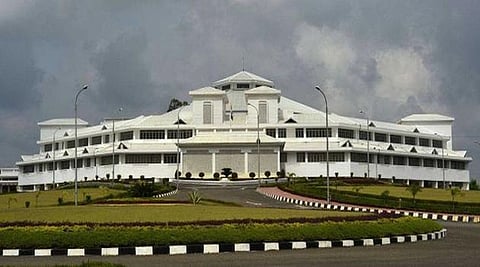
Tripura Assembly
Wikimedia Commons

In the hills of Tripura, the damage is not always visible. Rivers still flow through Baramura’s forests, and on most days the water appears unchanged. But for those who depend on it, something has shifted. The smell turns without warning. Fish die. What once sustained daily life now demands caution.
“Water is no longer our main source of life. We used to go to the stream to bathe and collect forest produce, but now we avoid it,” say Sampodo and his wife, Synem Hrangkhawl, from Tuikoinek village near Hatai Kotor in western Tripura.
Hydrocarbon extraction has expanded across these Sixth Schedule areas over decades, bringing drilling rigs, pipelines, and new technologies into ecologically sensitive terrain. Framed as development, its most serious effects unfold quietly—through contamination that enters streams, soil, and groundwater—undermining the reliability of water itself.
The vicinity of the gas thermal plant near the Assam–Agartala National Highway 8.
Thomas Malsom
Tripura’s hill tracts fall under the Sixth Schedule of the Constitution, intended to ensure Indigenous self-governance over land, forests, and resources. The Tripura Tribal Areas Autonomous District Council (TTAADC), established in 1984, governs nearly two-thirds of the state’s forest area (82.79%), following a long political struggle to protect Indigenous lands.
In practice, this protection is partial. While communities control surface land, subsoil resources including oil and gas, remain under state authority. This separation allows extraction to proceed even in protected areas.
Over the years, the Oil and Natural Gas Corporation (ONGC) has expanded operations across these regions. Environmental clearances are processed centrally, and local communities say they are rarely consulted.
According to Economic Review of Tripura 2021–2022, the state’s gas is composed of approximately 97% methane and is promoted as “clean” energy capable of supporting power generation and industrial growth. To access these reserves, ONGC has introduced technologies such as Managed Pressure Drilling (MPD), enabling operations in previously inaccessible forest interiors. As extraction expands, impacts on water systems are becoming increasingly evident.
The Deputy Chief Executive Officer of the TTAADC notes, “Although many of these forests are officially classified as reserved forests under the state, they fall within TTAADC’s administrative control. Provisions such as consent and royalties are required, but these procedures are often not followed.” The result is a persistent gap between constitutional intent and implementation.
A gas drilling site at Belbari, West Tripura.
Thomas Malsom
The Baramura–Deotamura hill range, locally known as Hatai Kotor, is one of Tripura’s key ecological zones. Rivers such as the Haora, Katakhal, Saidra, and Tuisindrai originate here, flowing through forests, farmland, and Indigenous settlements downstream.
Since multiple gas fields were discovered in 1975, the region has seen steady expansion of drilling infrastructure. What was once continuous forest is now fragmented by rigs, pipelines, and compressor stations.
Gavin Molsom, a resident, says, “Now ONGC has brought a machine that is very destructive. Even when no vehicles are moving, the earth shakes. Our houses develop cracks, no matter how strong they are. We have complained many times, but no action has been taken.”
Pollution often occurs through drilling waste, chemical discharge, and pressure releases—frequently during monsoon periods when rising water levels can obscure contamination. The effects are rarely immediate but accumulate over time.
For downstream communities, the first signs are sensory. Sampodo leads the way to the Saidra River. “This river originates from Hathai Kotor and flows through many villages, including ours,” he says. “Now we are often afraid to touch the water because of the chemicals.” He describes a recurring pattern. “ONGC personnel release waste when the river level rises, without informing villagers. Whenever it happens, we can immediately sense the change.”
The Tuisindrai River remains polluted as chemical residues are discharged upstream, near the site of the thermal power plant.
Thomas Malsom
In Hatai Kotor, drilling sites sit close to homes and farms. “Whenever they start drilling, water sources get damaged,” says Gavin Molsom. “They release a mix of kerosene and gas into the rivers. Even the smallest grass cannot survive.”
Khasi Hrangkhawl adds, “Along with the gas, there is leakage like fog or smoke inside the pipes. When they clean it, it falls to the ground.” “They have to release pressure within twenty-four hours,” Gavin says. “When those chemicals touch the ground, the grass dies immediately.”
Synem Hrangkhawl notes, “When these chemicals enter the rivers, the pollution travels downstream to villages like Hawaibari.” “There’s no fixed time,” Gavin adds. “Waste is released whenever machines go out of control. In some villages, people can no longer drink from ponds, and fish are inedible.”
One of the hydrocarbon extraction drilling sites in west Tripura.
Image: Thomas Malsom.
Resistance remains limited. “Many of these forest areas belong to the Molsom community, but our ownership isn’t reflected in state land records,” says Molsom. “We are fighting ONGC, but without documents, we cannot resist strongly.”
He adds, “We’ve received no compensation. Much of our land is classified as government forest. ONGC promised electricity for people within three kilometres, but we haven’t received it.” In some areas, the impact has extended to displacement. “In Palatana, everyone has already moved away,” says Khasi Hrangkhawl.
A Hrangkhawl woman explains, “Many people have stopped jhum cultivation. Forest areas are now drilling zones or polluted, and the soil has become infertile.”
The Tuisindrai River originates in the Baramura Hills and has long been a vital water source for nearby tribal communities. However, due to ongoing pollution, residents can no longer rely on it for their daily needs.
Thomas Malsom
Unlike deforestation, water contamination does not remain contained. Pollutants move through streams, seep into soil, and spread into groundwater, affecting areas far beyond drilling sites.
A study at an abandoned exploration site in Tripura found metals such as iron, chromium, and sulfur in soil and plant species, with reduced vegetation diversity even after operations ceased.
“The water smells like kerosene. Fish and snails are unsafe to eat,” says a woman from the Hrangkhawl community. “Earlier, we depended on fish. Now there are hardly any left.” Another resident recalls, “I saw dead fish floating and brought them home, but we couldn’t eat them because of the smell. We had to throw them away.”
Tripura’s hydrocarbon expansion exposes a structural gap: while Autonomous District Councils govern surface land, the state controls subsoil resources. For residents, this is a question of rights and consent.
“We’re not very strong, but we’re trying our best,” says Gavin. “These forests belong to our community, but that ownership isn’t recognised in state records.”
The issue is compounded by uneven implementation of laws such as the Forest Rights Act, meant to restore community ownership. At its core, the conflict is about the ability to refuse projects that reshape land, water, and livelihoods.
Another stream in a remote part of the West District has been contaminated by gas drilling activity; as a result, nearby communities no longer use its water.
Image: Thomas Malsom
From a distance, they appear unchanged. But for those who live along their banks, the relationship has shifted. Water is no longer predictable or fully trusted.
What is unfolding is not a sudden disaster, but a gradual transformation one that moves through rivers and soil, quietly reshaping ecosystems and everyday life.