
- Topics
- Feature
- Opportunities & Events
- About
- Hindi Portal
- Data
- Topics
- Feature
- Opportunities & Events
- About
- Hindi Portal
- Data
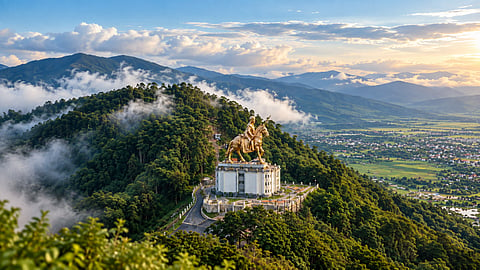
The statue of the Manipuri Polo God Marjing overseeing the Heingang Pat
Image: Usham Gagan

Driven by widespread land use changes, agricultural runoff, and shifting hydrological regimes, the alarming decline of Manipur's wetlands continues to severely degrade vital freshwater ecosystems. This degradation also threatens one of the region's most distinctive living links to its history: the Manipuri pony. The Manipuri pony has always been intricately linked to the landscape of the Imphal Valley. Its story is not only about an indigenous horse breed but also about water, wetlands, grazing grounds, land use, and the cultural history of Manipur.
Known locally as Sagol, the Manipuri pony has been an integral part of Manipuri society for centuries. The traditional game of Sagol Kangjei is closely associated with the origins of modern polo. The pony is therefore more than just an animal; it is a core part of Manipur's cultural identity.
Yet this living heritage is under serious threat. The latest population figure cited in the Food and Agriculture Organisation's (FAO) Domestic Animal Diversity Information System (DAD-IS) 2024 report is just 994 ponies. By contrast, earlier livestock censuses recorded 1,893 in 2003, 1,218 in 2007, and 1,101 in 2012. While this decline is usually discussed in terms of breeding challenges, veterinary care, and changing patterns of land use, another factor deserves equal attention: the severe loss of the natural landscape in which the pony lived.
Losing the pony carries a profound cultural cost, as the Manipuri pony is deeply woven into the spiritual and social history of the state. In Manipuri mythology, Lord Marjing—the guardian deity of the eastern hills traditionally associated with polo is depicted riding a pony. From this sacred association to its historical role in warfare, travel, festivals, community life, and Sagol Kangjei, the animal has remained integral to Manipuri society.
Its story also extended far beyond Manipur. In the nineteenth century, British officers and tea planters encountered Sagol Kangjei played by Manipuri settlers in the Silchar region. This led to the establishment of the Silchar Polo Club in 1859, followed by the Calcutta Polo Club in 1862. Manipuri players and their ponies were instrumental in spreading the game outside Manipur. Today, the Calcutta Polo Club continues to be recognised as the world's oldest surviving polo club, and the Hurlingham Polo Association explicitly acknowledges the essential contribution of Manipuri players and ponies to the history of modern polo.
The evolution from Sagol Kangjei to modern polo is therefore also the story of the Manipuri pony. Yet this rich cultural history was made possible by a specific landscape. Before it became a symbol of Manipur and travelled beyond the valley through Sagol Kangjei, it was an animal finely adapted to the wetlands, grasslands, and open spaces of the Imphal Valley.
The Manipuri pony evolved within the unique ecological conditions of the Manipur Valley. Hardy and agile, it historically roamed across open areas, wetlands, and grazing grounds that provided essential food, water, and space. In this landscape, a wetland was never simply a body of water; it was part of a larger ecosystem encompassing water, grassland, vegetation, open space, and soil. Together, these elements supported the semi-domesticated pony, allowing it to move freely between grazing and resting areas.
Two wetlands near Imphal—Lamphel Pat and Heingang Pat—illustrate this ecological relationship particularly well. Both historically served as critical habitats for the Manipuri pony, with Lamphel Pat supporting the most significant concentrations of the breed.
The scale of environmental change in these two wetlands is striking. A 2025 study published in Environmental Science and Pollution Research examined land use shifts between 1988 and 2023, revealing that Lamphel Pat lost 132.3 hectares to encroachment, while Heingang Pat lost 76.8 hectares. These losses represented 26.38 percent and 64.36 percent, respectively, of the total areas assessed. Much of the lost land was converted into built-up urban areas, agricultural fields, and aquaculture ponds. The decline in plant cover was equally severe: vegetation at Lamphel plummeted by 50.73 percent, while Heingang recorded a 12.01 percent drop. For an animal entirely dependent on natural forage and open ground, these shifts represent a direct and severe loss of habitat.
The implications are straightforward: reduced wetland area means less vegetation and grazing space, which in turn forces a greater dependence on human-dominated landscapes. This pattern is increasingly visible around Imphal, where ponies are forced onto roads, through settlements, and across busy urban areas in search of food and open ground. This movement exposes them to vehicular traffic, waste, and other hazards, while roads, buildings, and expanding infrastructure fragment their traditional movement corridors.
Land use pattern change from 1988 to 2023 in Heingang Pat
Map: Khoinaijam Sashikanta Meitei et al
Land use pattern change during 1988 to 2023 in Lamphel Pat
Map: Khoinaijam Sashikanta Meitei et al
Wetland loss is typically measured by the extent of water bodies filled in or built over. However, ecological degradation often begins much earlier. A wetland may still exist on a map while no longer functioning as a connected, living habitat. Roads, buildings, agricultural fields, and aquaculture ponds fragment these areas into isolated pockets. A small patch of grass surrounded by construction cannot provide the same ecological value as an integrated, functioning wetland ecosystem.
This distinction is critical for the Manipuri pony, an animal that requires continuous space to roam, graze, and rest. Protecting only the visible surface water will prove insufficient if the surrounding terrestrial habitat continues to erode. The experience of Lamphel and Heingang therefore offers a broader lesson for Manipur: wetland conservation must protect the entire landscape and the species that depend on it, rather than focusing solely on the water within its boundaries.
Manipuri ponies on roads around Imphal
Archival image: photographer unknown
The response need not be limited to preventing further encroachment. Manipur can begin rebuilding a landscape in which the pony and the wetland can survive together. The first step should be to map and recognise important pony habitats. This should include grazing areas, water sources, resting places, and traditional movement routes. Lamphel and Heingang can serve as important sites for integrated wetland and pony-habitat management.
Second, wetland restoration should include natural vegetation and native grasses that provide fodder. Restoration should aim to reconnect fragmented habitats wherever possible.
Third, suitable open areas around Lamphel, Heingang, and other wetlands like Yaral Pat, Waithou Pat, and Porom Pat could be developed as managed community grazing areas. This could reduce the movement of ponies onto roads and into densely populated areas.
Fourth, safe movement routes and road-crossing measures should be introduced around important pony habitats. Small interventions can reduce accidents and conflict between animals and urban traffic.
Fifth, habitat protection must be accompanied by better breeding. Genome sequencing of the Manipuri pony should form part of the conservation programme to better understand its genetic diversity and guide breeding. Combined with breeding records, veterinary care, and field monitoring, this can help protect valuable genetic lines and build a healthy, genetically diverse population.
Conservation should not stop at the remaining urban wetlands. Suitable conservation landscapes could gradually be developed in more interior parts of the valley, including Oinam, Kumbi, Moirang, and Kwakta in Bishnupur district; Tentha and Tekcham in Thoubal district; and Wabagai in Kakching district. These areas have suitable wetlands, open spaces, and traditional landscapes that could support carefully planned pony conservation.
This should not be treated as a simple relocation programme. The remaining habitats around Imphal must continue to be protected. The objective should be to create a wider network of suitable landscapes, reducing pressure on shrinking urban habitats while giving the pony a more resilient future.
Manipuri ponies inside a natural habitat
Archival image: photographer unknown
Effective conservation requires regular monitoring. A simple annual Pony Wetland Health Report could track pony numbers, available habitat, vegetation cover, grazing patterns, water conditions, and encroachment rates, supported by satellite imagery and GIS mapping. Such a framework would ensure habitat loss is flagged before a wetland undergoes irreversible degradation.
This requires structured interdepartmental cooperation among agencies handling wetlands, urban planning, animal husbandry, fisheries, and the environment. Local communities, pony owners, traditional institutions, and polo organisations must also play an active role.
The Manipuri Pony Conservation and Development Policy 2016 provides an established policy foundation. What is needed now is stronger alignment between pony conservation and wetland management. Breeding programmes and veterinary interventions are essential, but they cannot replace natural habitat restoration.
It is notable that Rejuvenating Lamphelpat Waterbody: A Sustainable Solution for Imphal City—a project initiated in 2023 and funded through external assistance at an estimated total cost of 650 crore rupees—addresses interventions such as livelihoods, flood prevention, and ecotourism but remains silent on the conservation of the Manipuri pony as a core objective.
The situation is serious, but it is not beyond repair. Patches of water, grassland, and vegetation still survive across the valleys in Manipur. They offer a chance to restore the landscape that has sustained the Manipuri pony for centuries.
I have come to see this relationship more closely through my own work. Some years ago, I worked on an initiative to encourage young girls to take up polo in a professional way. Now, through a project titled 'Manipuri Pony Heritage Conservation', my concern has grown beyond the sport. It is about ensuring that the pony has a place not only in Manipur's history but also in its future.
The pony did not survive in isolation. It was part of a living relationship between wetlands, grazing grounds, water, and people. Saving the pony, therefore, means protecting this landscape as well.
If we allow the wetlands to disappear, the pony may survive only in photographs, memories, and social media reels. Manipur still has a chance to prevent that. Saving the wetland means saving the pony. And saving the pony means preserving a living part of our heritage. The time to protect both is not tomorrow - it is now.
All views of the author are personal.