
- Topics
- Feature
- Opportunities & Events
- About
- Hindi Portal
- Data
- Topics
- Feature
- Opportunities & Events
- About
- Hindi Portal
- Data
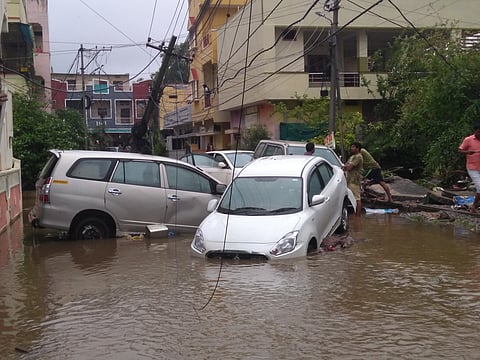
Aftermath of the 2020 Hyderabad floods in a street.
Strike Eagle via Wikimedia Commons

Every year, as governments and institutions take stock of the world’s most pressing challenges, one report is closely watched by policymakers, researchers, and civil society alike: the Global Risks Report of the World Economic Forum (WEF). The report does not predict the future or claim that crises are inevitable. Instead, it offers a structured way to understand the major risks facing the world, how they are connected, and how today’s decisions could shape multiple possible futures.
At its core, the Global Risks Report asks a simple but critical question: what events or conditions could significantly harm global economies, populations, or natural systems if they occur. To answer this, the WEF brings together the views of experts from across the world and across sectors, creating a shared picture of risk that goes beyond any single country or discipline.
The Global Risks Report 2026, now in its 21st edition, arrives at a moment of deep global uncertainty. It marks the second half of a turbulent decade shaped by wars, economic shocks, climate extremes, and rapid technological change. Drawing on insights from more than 1,300 experts worldwide through the Global Risks Perception Survey, the report examines risks across three time horizons: the immediate present in 2026, the short to medium term up to 2028, and the longer term stretching to 2036.
The report finds that risks are no longer isolated. Geopolitical confrontation, economic instability, environmental degradation, and technological disruption are unfolding simultaneously and reinforcing one another. Half of all experts surveyed expect the global outlook over the next two years to be turbulent or stormy, rising to nearly 60 percent over the next decade. Only a very small fraction foresee a calm future.
In the short term, geo economic confrontation and state based armed conflict dominate concerns. Economic risks such as inflation, debt, and market instability are also rising sharply. Over the longer term, inequality emerges as the most interconnected global risk, weakening social contracts and amplifying other crises. Environmental risks, although pushed down the priority list by immediate political and economic pressures, remain among the most severe threats over the next decade. At the same time, rapid advances in artificial intelligence and digital technologies are creating both opportunity and anxiety, with misinformation and long term AI risks rising sharply in perceived severity.
For countries like India, where water security, climate vulnerability, economic development, and social stability are closely linked, the report offers an important reminder. Global risks do not remain abstract or distant. They shape local realities, from water systems and food security to livelihoods, governance, and public health.
WEF (2026) The Global Risks Report 2026
According to the report, the world is facing a range of economic, social and political risks that are interconnected and threaten to create conflicts and instability, societal polarisation, erosion of human rights coupled with increasing environmental deterioration.
The graph below shows the current global risk landscape:
Current global risk landscape
World Economic Forum (2026) Global Risks Report, p 8.
How do environmental concerns fare in the current 2026 risk scenario
Geopolitical and geoeconomic risks dominate the outlook, with nearly one third of GRPS respondents identifying geoeconomic confrontation as the most severe risk for 2026, followed by state based armed conflict. Extreme weather events rank third, followed by rising societal polarisation.
Other environmental concerns such as critical changes in earth systems, natural resource shortages, biodiversity and ecosystem collapse, and pollution rank much lower among immediate concerns.
There has also been an increase in concern around technological risks in 2026, particularly misinformation and disinformation, adverse outcomes of artificial intelligence technologies, and cyber insecurity.
Global risks ranked by severity.
World Economic Forum (2026) Global Risks Report, p 9.
The outlook over the next decade, however, shows a very different picture. During this period, environmental risks overwhelmingly dominate the global risk landscape. Extreme weather events rank as the top global risk through to 2036, followed closely by biodiversity loss and ecosystem collapse, and critical changes to earth systems. Natural resource shortages and pollution concerns rank lower as compared to other environmental risks in the ten year outcome.
The report argues that “Unlike in the two-year outlook, where these have declined in rankings, the existential nature of environmental risks means they remain as the top priorities over the next decade across stakeholders and age groups. The only broadly environmental risk that is not present as a top concern is nonweather related natural disasters”. “Among the specific risks, biodiversity loss and ecosystem collapse is the risk with the sharpest worsening in its severity score from the two-year outlook to the 10-year outlook”.
Technological risks could also worsen in severity over the next decade, with adverse outcomes of AI technologies and frontier technologies showing the largest increases. Economic risks will also dominate across time combined with inequality and societal polarisation. Concentration of strategic resources including those like rare earth minerals and technologies to specific countries, disruptions to critical infrastructure along with increasing debts and economic downturns are also highlighted as important risks for the next decade.
Extreme weather events will intensify pressure on water resources
Global temperatures are likely to exceed 1.5 degrees Celsius above pre industrial levels within the coming decade. Extreme heat, droughts, wildfires, floods, and storms are expected to become more intense and frequent, placing growing pressure on already stressed water resources in countries such as India. These events affect not only water availability but also water quality, sanitation, and health outcomes.
Water shortages are becoming common in India.
McKay Savage via Wikimedia Commons
Competition for natural resources will increase
Rising temperatures and prolonged droughts will intensify competition for water resources worldwide. Energy security concerns linked to technological growth will further increase pressure on natural resources. By 2030 to 2035, data centres alone are expected to consume up to 20 percent of global electricity. The associated water demand near these facilities could further strain water resources in water stressed countries such as India. The growing demand for water and energy is likely to clash with climate change impacts and associated social pressures.
Geoeconomic confrontation could disrupt critical infrastructure
Geoeconomic confrontation could lead to physical disruptions of critical infrastructure such as power, water, transport, and communication systems. This may include damage to satellite networks, undersea communication cables, energy pipelines, ports, and key waterways.
The need to secure water and energy supplies may also push governments to build larger reserves, potentially leading to shortages of natural resources. The report warns that countries with upstream control over rivers and reservoirs may divert water to domestic populations at the expense of neighbouring nations. Potential flashpoints include the Indus River Basin between India and Pakistan, and Afghanistan’s Qosh Tepa Canal affecting flows into Central Asia.
Direct attacks on physical infrastructure are increasingly part of state based armed conflict. As infrastructure systems become more automated and interconnected, they also become more vulnerable to cyber attacks. In April 2025, the Bremanger dam in Norway suffered a cyber physical attack that led to an unplanned release of water. Such events can disrupt basic service delivery, affect health and sanitation, and erode public trust in governments.
Ageing infrastructure faces growing risks
Ageing critical infrastructure is increasingly prone to failure. The report warns that the financing required to modernise infrastructure may be difficult to mobilise amid economic uncertainty. Much of the infrastructure in OECD countries was built decades ago and now faces rising risks of breakdowns and accidents.
In low income countries, financing new infrastructure remains a major challenge. Firms in low and middle income countries lose an estimated 300 billion dollars annually due to unreliable transport, electricity, and water systems. In India, ageing water infrastructure is already contributing to cross contamination and rising water borne disease risks, highlighting the need for better governance, sustained investment, and skilled manpower for maintenance.
Extreme weather threatens critical infrastructure
Critical infrastructure is becoming increasingly vulnerable to chronic climate risks such as sea level rise and to extreme events including heatwaves, floods, fires, and storms. Extreme heat strains power grids, damages transport networks, and reduces the efficiency of solar panels. Intense rainfall can overwhelm drainage systems, while extreme heat and salinity increase water treatment costs.
Prolonged droughts could reduce hydropower generation in several countries. Drought related disruptions to shipping, such as those seen in the Panama Canal during 2023 and 2024 and in major European rivers in recent years, have already raised costs and delayed supply chains.
In India, droughts are becoming more frequent. Planning, operation, and maintenance of water infrastructure will need to account for these changing climate realities.
Land subsidence is emerging as a major risk
In several parts of the world including India, entire cities are sinking. The main drivers include excessive groundwater extraction, geological conditions, and the weight of urban infrastructure. Extreme weather events can accelerate erosion and sediment displacement, further destabilising land and infrastructure.
Land subsidence due to shifting of rocks.
Lixin Wu, CC BY 3.0
Technology demands will strain infrastructure systems
Demand for power, water, transport, and communication infrastructure is rising alongside population growth and technological expansion. The electricity demand from artificial intelligence data centres in the United States alone could increase thirty fold over the next decade.
Interdependencies between infrastructure systems heighten risks. Power outages can disrupt water supply systems, while nuclear power plants may be forced to limit operations if cooling water is unavailable.
The report argues that in an environment of growing geopolitical, climatic, social and technological challenges it would be crucial to initiate dialogue and identify areas of consensus through what it calls as “coalitions of the willing”. Public-private partnerships will remain essential to future infrastructure buildouts and to reduce infrastructural vulnerabilities over the next decade. Planning ahead for climate change risks will also be crucial in the years to come.