
- Topics
- Feature
- Opportunities & Events
- About
- Hindi Portal
- Data
- Topics
- Feature
- Opportunities & Events
- About
- Hindi Portal
- Data
Overfishing and habitat decline threaten the Hooghly–Matlah Estuary
Worldfish

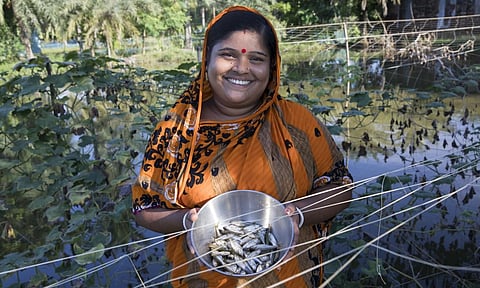
Water shapes every aspect of life in the Sundarbans. Flowing through a maze of tidal creeks, mudflats and mangrove forests, the Hooghly Matlah Estuarine System sustains fisheries, livelihoods, nutrition and local economies across one of the world's largest deltaic landscapes. Every day, thousands of fishers venture into its waters, relying on the estuary's productivity for survival.
Yet the health of this water system is showing signs of strain. A recent scientific assessment suggests that the ecological foundations supporting fisheries and communities are weakening, even as parts of the sector continue to generate strong economic returns. The findings raise important questions about the future of fisheries in the Sundarbans and the long-term sustainability of one of India's most productive estuarine ecosystems.
A 2025 study published in Cleaner Environmental Systems, titled “Multidimensional assessment of fisheries sustainability in India's largest estuarine system", provides a rigorous and deeply concerning diagnosis. Using the RAPFISH framework—a multidisciplinary tool that evaluates fisheries across ecological, economic, social, technological, and governance dimensions—the study concludes that the Hooghly–Matlah Estuarine System, despite its productivity, is overall “less sustainable". This is not a marginal classification. It signals a system under structural stress, where economic viability persists even as ecological and social foundations weaken.
Estuaries are globally recognised as ecological powerhouses. They function as breeding grounds for fish, buffer zones against coastal hazards, and engines of economic activity. The Hooghly–Matlah Estuarine System, stretching across more than 8,000 square kilometres, exemplifies this role. It supports a diverse, multi-species fishery and delivers a wide array of ecosystem services. Yet, like estuaries worldwide, it is increasingly subject to anthropogenic pressure. Overfishing, habitat degradation, pollution, and disrupted hydrological flows are reshaping the system in ways that are not immediately visible but are deeply consequential.
The study’s most striking finding is the imbalance across sustainability dimensions. Economic performance remains relatively strong. Many fisheries generate incomes that exceed regional averages, and species such as hilsa dominate both revenue and cultural significance. However, this economic strength masks a deeper vulnerability. The system is becoming increasingly dependent on a narrow set of high-value species, intensifying fishing pressure precisely where stocks are already declining. As catches diminish, market prices rise, temporarily cushioning incomes but accelerating ecological stress. This is a classic case of a fishery approaching a tipping point, where short-term gains obscure long-term decline.
Ecology in decline: The cost of overexploitation
Ecological indicators present the clearest warning signals. The majority of fisheries fall within the “less sustainable” category, with widespread evidence of overexploitation. A significant proportion of fish are being caught before reaching maturity, undermining the reproductive capacity of stocks. Bycatch remains high, particularly in fisheries using non-selective gear, resulting in both ecological waste and economic inefficiency. The study documents that out of 22 fisheries assessed, 14 are already overexploited, placing them at risk of collapse if current practices continue. The implications extend beyond biodiversity loss; they directly threaten the long-term viability of fishing livelihoods.
The ecological stress is compounded by habitat degradation and broader environmental pressures. Mangrove ecosystems, critical for fish breeding and coastal protection, are being damaged by destructive fishing practices and coastal change. Declining water quality and altered river flows further disrupt ecological balance. While these broader drivers were not the primary focus of the study, their cumulative impact reinforces the urgency of intervention.
Livelihoods at risk: Social and economic contradictions
Despite strong earnings in aggregate, fishers remain socially vulnerable. Fishing communities in the Hooghly–Matlah Estuarine System operate within conditions of limited resilience, characterised by low levels of formal education, limited livelihood diversification, and precarious living conditions. A significant proportion of fishers live in temporary housing, exposed to climate risks such as cyclones and flooding. Participation in decision-making processes is minimal, leaving communities with little influence over policies that shape their futures.
Economic sustainability, meanwhile, presents a paradox. Fisheries generate substantial income, with species like hilsa contributing a dominant share of total revenue. However, this economic strength is unevenly distributed and increasingly fragile. Overdependence on a few high-value species exposes the system to shocks, while declining catches in several fisheries signal emerging stress. Women engaged in activities such as prawn seed collection face particularly acute vulnerabilities, with low incomes and limited alternatives.
The lack of livelihood diversification is a critical concern. With most households dependent on fishing as their primary income source, any ecological decline translates directly into economic hardship. Seasonal migration for labour during fishing bans is already a coping strategy for many, indicating underlying instability in the system.
Technology and governance: Gaps that matter
Technological stagnation is one of the most significant constraints on sustainability. Fishing practices in the Hooghly–Matlah Estuarine System have remained largely unchanged, with widespread use of non-selective gear that captures both juvenile and adult fish. Post-harvest infrastructure is minimal, leading to inefficiencies and lost value. While some offshore fisheries use basic navigation and safety equipment, the broader system lacks innovation in gear, processing, and supply chains.
Governance, in contrast, shows relatively better performance but remains inconsistent in practice. Regulatory frameworks exist, including seasonal bans and vessel registration requirements, but enforcement is uneven. Larger mechanised fisheries tend to comply more consistently, while small-scale operations often function outside effective regulation. This creates a fragmented system where rules are unevenly applied and compliance is influenced by economic necessity.
Spatial disparities further complicate governance. Offshore zones perform relatively better due to stronger enforcement and higher economic returns, while freshwater and estuarine zones lag behind, marked by weak regulation and higher vulnerability. This unevenness highlights the need for localised governance strategies that reflect the diversity of the system.
Rethinking fisheries management: A way forward
The study offers a clear set of directions for reversing current trends, emphasising that incremental change will not be sufficient. One of the most critical shifts required is moving from static to adaptive management. Blanket fishing bans, while useful, do not account for species-specific breeding cycles or ecological variability. Introducing dynamic, species-based restrictions aligned with ecological conditions can significantly improve outcomes.
Reforming fishing practices is equally important. Reducing bycatch and juvenile capture through improved gear design and enforcement of mesh-size regulations can help restore ecological balance. These measures must be supported by institutional mechanisms, including training and financial incentives, to enable fishers to transition without losing livelihoods.
Stock restoration efforts are essential, particularly for overexploited species. Integrated approaches combining habitat restoration, captive breeding, regulatory enforcement, and community participation offer a viable pathway. Lessons from existing programmes in India demonstrate that such approaches can deliver results when implemented effectively.
Strengthening co-management frameworks is another priority. Engaging fishers as active participants in governance can improve compliance, reduce conflicts, and incorporate local knowledge into decision-making. This requires institutional innovation, including the creation of platforms for dialogue between communities, government agencies, and researchers.
At the same time, livelihood diversification must be central to any sustainability strategy. Expanding opportunities in aquaculture, eco-tourism, and non-farm sectors can reduce pressure on capture fisheries while enhancing economic resilience. Improving access to government schemes and financial support is critical in this regard.
Finally, investments in post-harvest systems can enhance value without increasing extraction. Improved storage, processing, and market infrastructure can reduce losses and increase incomes, creating incentives for more sustainable practices.
A narrow window for action
What emerges from this analysis is a system at a crossroads. The Hooghly–Matlah estuary continues to sustain millions, but the foundations of that sustainability are weakening. Economic viability alone cannot compensate for ecological decline and social vulnerability. Without coordinated and sustained intervention, the risk of long-term degradation—and eventual collapse—cannot be ignored.
At the same time, the situation is not irreversible. The absence of “poor” sustainability scores suggests that recovery remains possible. The challenge lies in translating evidence into action, aligning policy with ecological realities, and ensuring that communities are at the centre of the transition.
For the Sundarbans, the stakes extend beyond fisheries. The estuary is part of a larger ecological system that underpins coastal resilience, biodiversity, and climate adaptation. Protecting it is not just about sustaining livelihoods—it is about safeguarding a critical component of India’s natural infrastructure. The question now is whether policy and practice can move quickly enough to secure that future.