
- Topics
- Feature
- Opportunities & Events
- About
- Hindi Portal
- Data
- Topics
- Feature
- Opportunities & Events
- About
- Hindi Portal
- Data
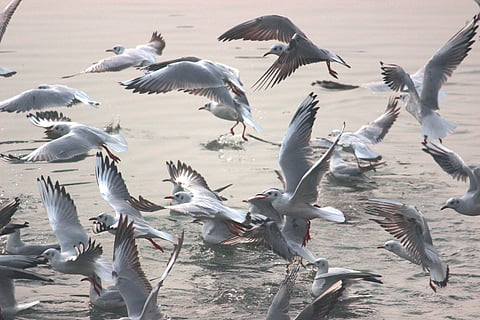
A mixed flock of brown-headed gulls and black-headed gulls on the Ganges River in Varanasi.
Ashutosh Kumar Tripathi, Wikimedia Commons

India’s ecological narrative is inseparable from its rivers, and none more so than the Ganges. Flowing from the Himalayas to the Bay of Bengal, the river is not merely a hydrological system but a dynamic ecological corridor—linking glaciers, forests, agricultural plains, wetlands, deserts, and coastal ecosystems. The BBC Earth documentary The Amazing Wildlife of India: The Ganges & Beyond offers a compelling lens into this continuum, revealing how wildlife and human systems are intricately interwoven, often in fragile equilibrium.
This documentary focuses on key themes: hydrological dependency, human–wildlife interactions, adaptive strategies of species, and the emerging pressures of anthropogenic change. More than a celebration of biodiversity, it is a story about rivers and the relationships they sustain. The film reveals how wildlife and people depend on the same waters, adapt to the same environmental changes, and increasingly face the same risks in a rapidly changing world.
The story begins in the high Himalayas, where spring meltwaters surge downstream, forming the lifeblood of northern India. This seasonal pulse is not merely a physical phenomenon but a powerful ecological driver. Species such as the Himalayan mahseer, among the world's largest freshwater fish, depend on this hydrological rhythm to migrate between spawning and feeding grounds.
However, this migration has become increasingly perilous. Overfishing and poaching have significantly reduced mahseer populations across many river systems. Interestingly, religious and cultural practices have created unintended sanctuaries for these fish. At temple ghats, where feeding fish is a ritual act, mahseer are able to survive and often grow to remarkable sizes. This illustrates a critical lesson from the documentary: cultural ecosystems can function as important conservation buffers in otherwise degraded landscapes.
The same meltwater that sustains aquatic biodiversity also supports intensive terrace agriculture in the Himalayan foothills. Crops such as barley and millet rely on this predictable water supply, underscoring the shared dependence of both biodiversity and human livelihoods on glacial hydrology.
As the river descends through the Shivalik Hills and enters the plains, its character changes dramatically. Fast-flowing mountain streams give way to slower, sediment-rich channels. This transformation has enabled the development of floodplain agriculture, particularly rice cultivation, which has been practised in the region for more than 7,000 years.
The rise of rice as a dominant crop reshaped the ecological landscape in profound ways. Flooded paddy fields created habitats that closely resemble natural wetlands. These environments attracted a wide range of species, including migratory birds, while human-managed agricultural systems began to mirror ecological processes found in nature.
A striking example is the integration of duck herding into rice cultivation. Ducks feed on weeds and pests while fertilising fields through their droppings, creating an early form of ecological intensification. This practice reflects a traditional knowledge system that aligns closely with the principles of circular bioeconomy and sustainable agriculture.
Yet the benefits of agricultural expansion have not been shared equally among species. Birds such as the sarus crane have adapted well to these modified landscapes and continue to thrive, aided by cultural reverence and protection. Other wildlife, however, has faced displacement and increasing conflict. As agriculture expands, habitats become fragmented, bringing wildlife into closer contact with human settlements.
One of the documentary's most compelling themes is the ability of wildlife to adapt to human-dominated environments. In towns such as Rishikesh, rhesus macaques have become urban opportunists, exploiting human behaviour as a reliable source of food.
These interactions reveal several important ecological and social dynamics. Behavioural adaptation enables species such as macaques to survive in human-made environments, while cultural tolerance provides them with a degree of protection through traditions of non-violence. Together, however, these factors can create an emerging and often unsustainable conflict.
As animals become habituated to food provided directly or indirectly by people, their natural foraging instincts are gradually replaced by what is often perceived as nuisance behaviour. This can lead to increased aggression and create health risks for both wildlife and humans.
The documentary highlights this "synanthropic" relationship, in which wildlife benefits from human environments. While such relationships can increase resilience and allow certain species to flourish, they also create new vulnerabilities. Dependence on unstable food sources and exposure to urban hazards can leave wildlife increasingly susceptible to changing human behaviour and environmental conditions.
In contrast to the heavily modified landscapes of the Ganges plains, the Chambal River remains a relatively pristine ecosystem. Flowing through arid regions, it serves as a refuge for species that have disappeared or declined across much of their former range.
Among its notable inhabitants are Indian skimmers, rare birds with highly specialised feeding adaptations; migratory waterfowl such as bar-headed geese; and resident wetland birds, including spoonbills. The Chambal functions as an ecological archive, preserving elements of what the wider Ganges system may once have looked like before extensive human modification.
However, this refuge is far from secure. Increasing pressures from water extraction, pollution, and development threaten to erode the ecological integrity that has allowed these species to persist.
The contrast between the Ganges and the Chambal reflects a broader ecological pattern. As anthropogenic pressures intensify, ecological integrity tends to decline. Yet pockets of resilience can still survive where human pressures remain comparatively low.
Perhaps the most dramatic example of human wildlife interaction in the documentary unfolds in the Sundarbans, the world's largest mangrove forest. This dynamic tidal landscape is defined by salinity gradients, constantly shifting waterways, and dense vegetation.
Here, communities depend on high-risk livelihoods such as honey collection. These practices are guided by generations of ecological knowledge. Honey collectors use smoke to pacify aggressive giant honeybees and harvest only part of the hive, ensuring that colonies can recover and continue producing honey.
Yet the greatest threat in the Sundarbans does not come from bees. It comes from tigers. The region records some of the highest incidences of human fatalities caused by tiger attacks anywhere in the world. This reflects a complex interaction of factors, including habitat overlap between humans and predators, limited alternative livelihood opportunities, and ecological conditions that favour ambush predation.
The Sundarbans therefore represent a form of "extreme coexistence", where both people and wildlife survive by continually negotiating risk. In this landscape, the survival of humans and animals alike depends on their ability to navigate an environment shaped by uncertainty, danger, and constant ecological change.
The Sundarbans also reveal extraordinary evolutionary adaptations. Mudskippers move across mudflats using modified fins and can breathe air through specialised gill chambers. Fiddler crabs use oversized claws for communication and competition.
These species illustrate a broader ecological principle: highly variable environments favour flexibility. Such ecosystems are remarkably productive, but they are also highly vulnerable to environmental change, particularly rising sea levels and shifting salinity patterns associated with climate change.
Migration is another recurring theme. These birds undertake long-distance journeys across the Himalayas, navigating extreme altitudes and predation risks. The documentary highlights the use of thermal currents to gain altitude, vulnerability to predators such as golden eagles and high mortality rates during migration. This underscores the concept of ecological bottlenecks—points in a species’ life cycle where risks are concentrated. Conservation strategies must therefore consider entire migratory pathways, not just isolated habitats.
In several instances, cultural practices play a pivotal role in shaping ecological outcomes. Jain communities in Rajasthan feed migratory cranes, supporting large seasonal populations. Hindu reverence for animals fosters tolerance towards species like monkeys and cranes. Ritual feeding of fish at temples creates localized conservation zones. These examples demonstrate that conservation in India cannot be understood purely through regulatory frameworks. Cultural ecology—belief systems, traditions, and social norms—forms an integral component of biodiversity governance.
In the dense forests of the Himalayas and Northeast India, species like the great hornbill and hoolock gibbon serve as vital biological indicators of environmental integrity. The great hornbill acts as a "forest architect" through seed dispersal, though its highly specialized nesting ritual—where the female is sealed within a tree cavity—renders the species exceptionally vulnerable to habitat loss. Similarly, the hoolock gibbon represents the necessity of structural connectivity, as these apes are strictly canopy-dependent for movement. Their presence confirms a functional, unbroken ecosystem, while their absence is a primary warning sign of forest fragmentation.
The Ganges’ journey concludes at the coast, where its nutrient-rich sediment creates the nesting grounds essential for the olive ridley turtle. These turtles employ a fascinating survival mechanism known as arribada, a mass-nesting event designed to overwhelm predators through sheer numbers. However, with an adulthood survival rate of only 1 in 1,000, this strategy highlights a profound natural vulnerability. This "final link" emphasizes that even the most robust evolutionary tactics can be easily dismantled by human-induced pressures like beach lighting, plastic pollution, and mechanized fishing.
These examples reinforce a key message: biodiversity conservation in India cannot be understood solely through laws and protected areas. Belief systems, traditions, and cultural values remain powerful conservation forces.
From a policy perspective, the "Ganges and Beyond" narrative suggests that conservation must shift from isolated protected areas to a landscape-level approach. Effective planning requires the integration of "cultural buffers"—such as temple sanctuaries—into formal biodiversity frameworks, acknowledging that local traditions often provide more resilient protection than legal mandates alone. Furthermore, policy must prioritize hydrological integrity; protecting the river's seasonal flow is not just an aquatic concern but a necessity for the terrestrial forests, agricultural stability, and coastal nesting grounds that depend on that specific pulse of water. Ultimately, the goal for planners is to transition from managing human-wildlife conflict to fostering systemic resilience, where infrastructure development and agricultural expansion are designed to maintain, rather than split, the ecological corridors used by India's most vulnerable species.
What makes The Amazing Wildlife of India: The Ganges and Beyond particularly compelling is its insistence on seeing connections. Rivers link glaciers to floodplains, forests to farms, and mangroves to coastal ecosystems. Wildlife survival, human livelihoods, and ecological processes emerge not as separate stories but as parts of the same system.
The documentary ultimately argues for a landscape approach to conservation. Protected areas alone cannot safeguard biodiversity if rivers are fragmented, migratory pathways disrupted, or cultural practices ignored. Protecting seasonal flows and ecological corridors is as important as protecting individual species.
More than a wildlife documentary, this is a story about water and the relationships it creates. The Ganges emerges not simply as a river but as a living thread connecting ecosystems, cultures, and livelihoods across the subcontinent. Its enduring lesson is that resilience arises from interdependence and that the future of India's wildlife remains inseparable from the future of its waters.