
- Topics
- Feature
- Opportunities & Events
- About
- Hindi Portal
- Data
- Topics
- Feature
- Opportunities & Events
- About
- Hindi Portal
- Data
The hidden link between industrial farming, global trade, and disappearing rivers.
Yogendra Singh

Water has always been seen as nature’s most generous gift. Rivers built civilisations, sustained agriculture, shaped cultures, and defined the geography of human survival. Yet across the world today, rivers are shrinking, aquifers are collapsing, and communities are being pushed towards a future defined by scarcity. The documentary, Rivers at Risk: Water Crisis on Four Continents, by DW Documentary, is a powerful reminder that this crisis is not unfolding because the planet is running out of water. It is unfolding because humanity has chosen to consume, extract, and trade water in deeply unsustainable ways.
The film moves across India, Egypt, Spain, France, and the United States to expose the hidden relationship between industrial farming, global trade, fast fashion, and disappearing rivers. What emerges is not merely an environmental story but a moral and political reckoning with modern economic systems. As the documentary repeatedly suggests, the world is not facing only a water crisis. It is facing a crisis of management, consumption, and priorities.
The hidden business of virtual water
One of the documentary’s most important contributions is its explanation of “virtual water”, the invisible amount of water embedded in the goods and services people consume every day. Through this lens, the film exposes how water-scarce countries are effectively exporting their lifeblood through crops, animal fodder, meat, dairy products, and industrial goods.
The documentary follows the trail of alfalfa fields in Arizona to dairy farms in Saudi Arabia and shows how the global food system has become a massive “water export” business. Water-rich and water-poor regions alike are draining rivers and ancient aquifers to sustain industrial agriculture and global trade.
The film repeatedly returns to a disturbing reality: nearly 70 percent of the world’s freshwater is consumed by agriculture, much of it linked to export-oriented farming and industrial meat production. Rivers such as the Nile, the Colorado, the Ebro, and the Kaveri are shown not as isolated ecological tragedies but as interconnected symptoms of the same economic model that treats water as an unlimited commodity.
The film introduces the concept of the "water Footprint"—the invisible volume of water used to produce the goods and services we consume. Through a sprawling narrative that connects the alfalfa fields of Arizona to the dairy farms of Saudi Arabia, the film argues that the global food supply chain is essentially a "water export" business, where water-scarce nations bleed their aquifers dry to satisfy the appetites of the wealthy.
India: A microcosm of the global crisis
While the documentary spans four continents, its most powerful and emotionally layered segments are set in India. India is presented as a striking paradox. The country supports nearly 18 percent of the world’s population while possessing only 4 percent of global freshwater resources. The film argues that the Green Revolution and rapid industrialisation have pushed the country towards what can only be described as hydrological bankruptcy.
Rajasthan and the collapse of groundwater
In Rajasthan, the documentary captures the terrifying decline of groundwater levels. A local resident explains that within one lifetime, the water table has fallen from 400 feet to more than 1,200 feet. The film describes this not as a natural fluctuation but as the result of “indiscriminate exploitation”. As shallow water disappears, drilling moves deeper into fossil aquifers that took millions of years to form and cannot be replenished within human timescales.
The consequences are devastating. Traditional livelihoods collapse, groundwater turns saline, and poor households are forced to spend large portions of their income on private water tankers. One haunting line from the documentary captures the despair of the region: “Death is certain” for the traditional way of life.
The toxic cost of fashion
The documentary’s investigation into Surat, India’s synthetic textile hub, reveals the brutal human cost of industrial water pollution. The film notes that the textile industry accounts for nearly 20 percent of global water pollution, much of it outsourced from Europe to countries with weaker environmental regulations.
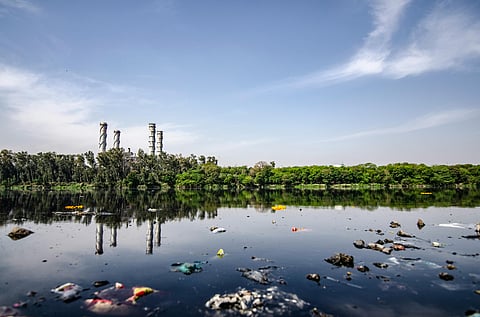
Workers such as Raju Manjhi are shown living amid toxic fumes and black, polluted drains. The documentary exposes a cruel irony: the water treated for factories is often cleaner than the groundwater local residents are forced to drink. Activist Jennifer Stoikovich describes this as a “deliberate disconnect”. The poor labour in industries that poison the very water they need to survive. In cities such as Surat and Chennai, the documentary argues water has ceased to function as a basic right and has become a commodity paid for through deteriorating health.
The politics of the Kaveri
The documentary also explores the century-old Kaveri conflict between Karnataka and Tamil Nadu to show how water scarcity transforms rivers into political weapons. The film argues that the Green Revolution introduced chemical farming systems that consume nearly ten times more water than traditional agriculture. Water-intensive crops such as paddy are cultivated for export despite growing ecological stress. India’s position as the world’s largest rice exporter is presented as deeply contradictory in a water-stressed nation.
“When one kilogram of rice requires 3,000 litres of water, every grain exported is a litre of Indian water leaving the country forever,” the documentary argues. The legal disputes and tensions between states are shown as the inevitable result of policies that prioritise economic trade over long-term hydrological stability.
The illusion of engineering solutions
One of the documentary’s strongest arguments is its critique of modern ideas of water “efficiency”. In Spain and Egypt, governments have invested heavily in concrete lined canals to reduce seepage losses. Yet the documentary reveals what scientists call the “rebound effect”. When irrigation becomes more efficient, farmers often do not save water. Instead, they expand cultivation and consume even more.
The film also points out that canal lining prevents groundwater recharge, accelerating aquifer depletion rather than solving it. This critique extends to large dams and centralised engineering projects. The documentary argues that attempts to dominate rivers through massive infrastructure have often damaged ecosystems instead of protecting water security.
Letting rivers live again
Amid its bleak realities, the documentary offers powerful stories of restoration and hope. In France, the removal of dams on the Sélune River is shown as a remarkable example of ecological recovery. Within months of the dams being dismantled, migratory fish such as salmon began returning. The message is clear: after decades of trying to control rivers, the best solution may be to let rivers function naturally again.
The guardians of water
The documentary finds its strongest hope in the work of environmentalists Vandana Shiva and Rajendra Singh. At Navdanya Farm, Vandana Shiva demonstrates what she calls “water literate” agriculture. Indigenous seeds and organic soils act like sponges, improving water retention and groundwater recharge. Shiva notes that groundwater levels at her farm have risen by 70 feet since 1994, directly challenging the belief that ecological collapse is inevitable.
Rajendra Singh’s revival of traditional Johads, earthen check dams used to capture monsoon rain, is equally inspiring. By slowing rainwater and allowing it to sink into the ground, Singh has helped revive seven dried rivers. The documentary describes this as “sensible, simple science”. Rather than relying on mega-dams and endless extraction, the film argues for decentralised and community-managed water systems rooted in ecological understanding.
Water, consumption, and moral responsibility
What makes Rivers at Risk deeply unsettling is its insistence that the global water crisis is not distant from everyday life. The documentary forces viewers to confront the hidden water footprint behind food, fashion, and consumption habits.
The steak on a dinner plate, the milk in a refrigerator, or a synthetic shirt purchased cheaply in a city store are all linked to shrinking rivers, collapsing aquifers, and polluted landscapes elsewhere in the world. The documentary calls this crisis one of “deliberate ignorance”. Humanity continues to separate consumption from ecological consequence.
Its final message is especially urgent for India. With rapidly expanding cities and growing dependence on groundwater, the country is running on what the film calls “borrowed time and borrowed tankers”. Unless India shifts away from water-intensive agriculture towards regenerative and community-driven systems, the coming decades may be shaped not by economic growth but by “water famines”.
The documentary leaves viewers with one unforgettable image: a child living besides a polluted drain in Surat while the water meant for her survival is used to produce clothing for consumers thousands of kilometres away. It is a painful reminder that the most valuable currency on Earth is not money, but water itself.
Ultimately, Rivers at Risk succeeds because it transforms water from an environmental issue into a question of ethics, survival, and justice. It asks humanity to rethink its relationship with rivers, agriculture, trade, and consumption before the collapse becomes irreversible.