
- Topics
- Feature
- Opportunities & Events
- About
- Hindi Portal
- Data
- Topics
- Feature
- Opportunities & Events
- About
- Hindi Portal
- Data
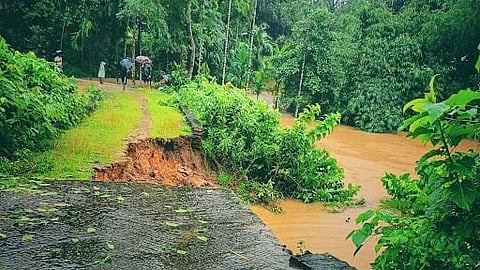
A landslide in a village in south Tripura triggered by heavy rainfall.
Image: Thomas Malsom

Water has always arrived in North-east India on its own terms: generous, relentless, occasionally destructive, but rarely a stranger. What unsettled the residents of South Tripura between 19 and 24 August 2024 was not that water came. It was how it came and from where.
The sound that woke them was not the familiar drum of monsoon rain on tin roofs. It was a roar. Streams that villagers waded across every morning had swollen into torrents overnight. Rivers broke their banks. Roads vanished beneath currents thick with mud. Families carried children and livestock onto rooftops and to higher ground as water rose through their homes. Schools turned into relief camps. Entire villages fell silent, cut off from roads, from each other, from help.
For days, rescue teams could not reach everyone who needed them. Helicopters circled over submerged settlements while boats moved slowly through what had once been streets. By the time the water finally receded, around 30 lives had reportedly been lost. Crops were destroyed, riverbanks eroded, and thousands of families displaced. Many residents said they had not witnessed anything like it in decades.
The intensity of the rainfall and the speed at which river levels rose were severe enough that questions emerged across the border in Bangladesh's eastern districts, where some suspected that water released from a dam in India may have worsened flooding downstream. The Dumbur Dam, located roughly 70 to 90 kilometres from the international border, had reached a reservoir level of 93.85 metres against a danger mark of 94 metres, prompting authorities to make controlled releases.
The Government of India later clarified that the released water had not reached Bangladesh and could not be linked to the flooding there. What happened in Tripura, however, was not an isolated event. It was a glimpse into something larger taking shape across the entire region.
A flood rescue team is searching for stranded residents in flood-affected areas of Tripura.
Source: Facebook, Times of India, 24 August 2024
North-East India has never known life without water close by. Its relationship with rivers, wetlands and monsoon systems runs deep, almost symbiotic. The region is home to two of South Asia's most significant river systems, the Brahmaputra and the Barak, and its hills, valleys and plains receive some of the highest rainfall totals recorded anywhere on Earth. Mawsynram and Cherrapunji, also known as Sohra, in Meghalaya have long stood as global symbols of monsoon abundance.
For generations, flooding was simply part of the region's ecological rhythm. Seasonal floods replenished farmland, deposited nutrient-rich silt and sediment, and sustained the wetlands and fisheries that communities built their lives and livelihoods around.
That rhythm is now changing. Across North-east India, floods, flash floods and landslides are becoming more frequent and more intense. In 2025, extreme rainfall affected nearly every state in the region. Assam experienced widespread flooding across the Brahmaputra basin, while landslides disrupted transport networks in Meghalaya, Mizoram and Arunachal Pradesh.
Paradoxically, several reports suggest that some areas are receiving lower seasonal rainfall even as flood disasters become more common. Climate change, it seems, is altering not only how much rain falls but also when, where and how it falls.
When the rain comes all at once
Researchers and environmental observers across the region point to a fundamental shift in the nature of rainfall itself, not simply its volume. Independent journalist Sanat, based in Shillong, observed that while floods have always existed in the region, "their frequency and destructiveness have sharply increased."
Environmental researcher Donald Takhell, from Manipur, described a similar pattern: "Our rainfall is no longer like before; now it comes less often, but when it does, its rage is faster."
Instead of rainfall spreading gradually across the monsoon season, large volumes of water are increasingly arriving within a few hours. The result is rapid runoff, flash flooding, soil erosion and landslides, conditions that rivers, drainage systems and mountain ecosystems are increasingly unable to absorb. For communities whose lives depend on predictable monsoon cycles, this growing unpredictability is becoming one of the region's defining environmental challenges.
Aerial view of a village engulfed by floodwaters in South Tripura.
Source: Facebook, Times of India, 24 August 2024.
Flood risk in North-east India was once associated mainly with the floodplains of the Brahmaputra and Barak rivers. Today, that geography is expanding. Small mountain catchments are generating flash floods within hours of intense rainfall. Urban centres are experiencing repeated waterlogging. Landslides triggered by cloudbursts are becoming as destructive as river floods.
In Tripura, villages far from major rivers have experienced sudden flooding following extreme rainfall. In Meghalaya and Mizoram, heavy rain has destabilised slopes and triggered landslides. In Arunachal Pradesh, mountain streams are increasingly producing flash floods capable of destroying roads and settlements within hours.
The flood frontier is moving beyond traditional floodplains. Areas once considered relatively safe are becoming vulnerable, while historically flood-prone locations are experiencing more severe and unpredictable impacts.
Climate change is often the first explanation offered after a flood or landslide. While it is undoubtedly intensifying extreme weather, several researchers caution against treating it as the sole cause. Environmental researcher Eklavya Prasad argues that climate change has become an enemy without a face. "Every time floods occur, we blame climate change without addressing local causes like ecological degradation, urban congestion, and poor planning," he says.
His observation points to an important reality. Extreme rainfall becomes a disaster only when it interacts with vulnerable landscapes and inadequate planning. Across North-east India, wetlands are shrinking, forests are being cleared, riverbanks are being encroached upon, and infrastructure is expanding into fragile ecosystems. Highways cut through unstable slopes, while urban growth often replaces the natural drainage systems that once managed excess water.
A couple outside their waterlogged house in Agartala, Tripura.
Image: Amaresh Debbarma.
Landscapes losing their capacity to hold water
Researchers across the region argue that ecological degradation is reducing the landscape's ability to absorb and regulate water. Forests that once slowed runoff are shrinking. Wetlands that once stored excess water are disappearing. Soil structures are weakening under changing land use patterns.
Environmentalist K K Chattadhara, from Assam, explained that weakened soils, declining forest cover and rapid land use change have reduced the region's natural ability to absorb water. According to him, even moderate rainfall can now trigger flooding, because the ecosystems that once slowed the movement of water have been severely disrupted.
A senior forest official from Nagaland added, "With shrinking forest cover, the soil's water retention is reduced, leading to faster runoff, erosion, and flooding even from moderate rains. The most intense rainfall now arrives in shorter, more destructive bursts, overwhelming both natural and built drainage systems."
Who bears the greatest burden
While flood risk is expanding across the region, its impacts are not shared equally. People dependent on farming, fishing, wage labour and other climate-sensitive livelihoods often face the greatest losses. Tribal communities and residents of underserved urban areas are particularly vulnerable.
In Tripura, floodwaters damaged paddy fields and disrupted rural livelihoods. Riverbank erosion continues to consume agricultural land and displace families. In the hills, landslides isolate villages and interrupt access to schools, healthcare facilities and markets.
Recovery is often far slower than the disaster itself. Rehabilitation and recovery efforts in Tripura remain incomplete long after the 2024 floods, a reminder that flood impacts continue long after the water levels fall. Repeated disasters are deepening existing inequalities across the region.
A house submerged under floodwaters in Tripura.
Image: Thomas Malsom
Preparing for a more uncertain water future
Climate projections suggest that extreme rainfall events are likely to increase across South Asia in the coming decades. For North-east India, this means preparing for a future in which floods, flash floods and landslides become more frequent and less predictable. Experts argue that adaptation must extend well beyond emergency response. Protecting wetlands, restoring watersheds, conserving forests, improving urban drainage, strengthening early warning systems and involving communities in environmental governance will all be essential. Infrastructure planning must also account for ecological realities, while climate adaptation needs to become part of everyday land use planning rather than an afterthought reached for only once disaster strikes.
Learning to live with unpredictable water
The emerging geography of floods in North-east India is not simply a story about climate change. It is a story about water behaving differently across landscapes that are themselves undergoing rapid transformation. The floods that swept through Tripura in 2024 revealed how quickly familiar hydrological patterns can change.
Across the region, rivers, hills, wetlands, forests and cities are becoming part of a new map of flood risk. As rainfall grows more erratic and landscapes lose their capacity to absorb water, the challenge facing North-east India is not only how to respond to disasters when they occur.
It is how to rebuild ecological resilience before the next extreme rainfall event arrives. Water has always shaped the region's history. The question now is whether planning, governance and development can adapt quickly enough to a future in which water itself is becoming increasingly unpredictable.