
- Topics
- Feature
- Opportunities & Events
- About
- Hindi Portal
- Data
- Topics
- Feature
- Opportunities & Events
- About
- Hindi Portal
- Data
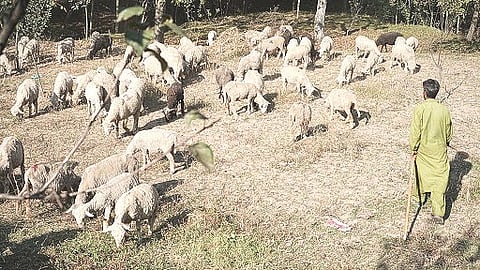
A shepherd is guiding a large herd of sheep through dry pastureland in Kashmir.
Photo credit: Wahid Bhat

By late spring, the roads leading into Kashmir’s Sonamarg begin to fill with tourists drawn by snow-covered peaks and alpine meadows. But long before the first tourists arrive, another journey is already underway.
Every year, thousands of pastoralists, including Gujjar, Bakarwal and Chopan communities, undertake a seasonal migration with their sheep, goats, horses and cattle. Entire families spend weeks travelling from the plains of Jammu across the Pir Panjal range to the high-altitude summer grazing grounds of Kashmir. Along the way, they camp beside glacial streams and set up temporary dhokas (shelters made of wood and mud) in alpine meadows that serve as their homes until autumn.
For centuries, this migration has followed the same rhythm. Snow melts. Springs begin to flow. Grass emerges across the alpine pastures. The herds arrive. Before winter closes the mountains again, the journey reverses.
On an October afternoon last year, the sky turned black without warning. Rahim Poswal, 77, looked up from guiding his flock across an alpine meadow near Sonamarg and saw a wall of clouds rolling over the ridge. Within minutes, hailstones the size of walnuts came crashing down, hammering the mountainside for nearly fifteen minutes. He ran towards a cluster of pine trees, shouting for his 600 sheep and goats to follow. Five were too slow.
When it stopped, the sun returned as if someone had flipped a switch. Two animals lay dead. Three more were bleeding, their legs trembling in spasms. "I have never seen hailstones like this in my life," Rahim said. "This was the first time." Seventy of the animals were his. The remaining 530 belonged to families from the plains who had entrusted their livestock to him for the summer.
For nearly six decades, Rahim had walked these mountains. He knew when the snow would melt, which streams would keep flowing through summer, which passes would open first and which meadows would stay green the longest. It was knowledge inherited from his father and grandfather, shaped by generations of walking the same routes.
Rahim Poswal sits alone and mourns the sheep he lost suddenly.
Photo credit: Wahid Bhat
"I came here first with my father in 1990," he said. "The weather was so good back then. We used to say we could live our whole lives here. Now everything has changed. One moment it's sunny, the next moment heavy rain comes from nowhere." It wasn't just the storm that unsettled him. It was the feeling that the mountains no longer behaved the way they once did.
Following water across the Himalayas
This seasonal migration, known as transhumance, is one of the oldest pastoral systems in the Himalayas. According to official data, more than a million Gujjars and Bakarwals live in Jammu and Kashmir, making them the Union Territory's third-largest ethnic group and accounting for nearly 74 percent of its tribal population.
But transhumance has never simply been about just moving livestock. It is about following water. Snow has to melt at the right time. Glaciers have to release water steadily through the summer. Springs determine where families camp. Moisture decides which pastures will sustain thousands of animals.
For generations, pastoralists learnt to read these rhythms with remarkable precision. Their knowledge was built not from instruments or forecasts, but from years of observing these mountains. Their seasonal journeys also shaped the landscape itself. Moving between summer and winter pastures let both regenerate, while their herds picked up flammable pine needles and brushwood along the way, and their hooves and dung aerated and fertilised the soil. A recent Oxford-based policy report values just these services at roughly Rs 5,880 crore a year in Jammu and Kashmir alone, not counting carbon sequestration or preservation of traditional ecological knowledge even though this contribution remains largely invisible in public policy.
Today, however, the mountains are becoming harder to read. Kashmir recorded its highest temperature in seventy years last season, touching 37.4°C. But heat is only the backdrop. The real threat arrives in sudden, violent bursts: lightning and hailstorms that kill dozens of animals in seconds and floods on mountainsides that haven't flooded in living memory.
“Extreme rainfall events of more than 100 millimetres a day have increased by 50% over the past five decades because of global warming,” said Prof. J. Srinivasan, a climate scientist at the Indian Institute of Science. “As a result, floods, landslides and related damage are occurring more often and on a much larger scale.”
Trapped between extremes
Fourteen kilometres away near Sarbal village, Abdul Rashid Chopan, 49, stood looking towards mountain passes that should have opened weeks earlier.
Heavy snow had delayed migration into the higher meadows. Too many herds remained trapped below, where the grass had already been grazed to its roots.
“What my father taught me about these routes doesn’t work anymore,” he said. “The timing, the weather signs, the places to stop – none of it is reliable now.”
Dr Kieran Hunt of the University of Reading says winter weather systems that once built snowpacks increasingly bring rain instead. Spring storms release intense rainfall that runs rapidly off mountain slopes rather than slowly feeding streams through the summer.
The consequences unfold across the landscape. Blocked passes mean stalled migration. Stalled migration means starvation. Zahid Parwaz Choudhary, president of the Gujjar Bakarwal Youth Welfare Conference, said extreme weather has taken a heavy toll on livestock across the region.
Hungry sheep climb steep slopes to find food after heatwaves destroy the lower pastures.
Photo credit: Wahid Bhat
For families already living close to the edge, a single disaster can undo years of work. Abdul once owned more than 150 sheep. Since a lightning strike killed dozens of them in 2022, his flock has fallen to nearly half its former size.
The government provides compensation of Rs 3,000 for every sheep lost. A healthy animal can be worth at least Rs 15,000. “I don’t expect anything,” Abdul said.
When the glaciers stop feeding the mountains
Near the Thajiwas Glacier trail, Khurshi Begum, 45, crouched beside a tap that once drew water from a nearby glacier. Now there was only cracked earth.
For two decades, she has made the same 257-kilometre journey from Rajouri to the alpine meadows near Sonamarg. But the water source her family relied on has dried up. “This water source gave us water for years,” she said. “Now we walk more than an hour each way to the stream.” According to Dr Irfan Rashid of the University of Kashmir, much of the landscape below 4,300 metres now holds little snow by summer.
Khurshi Begum faces a hard future as climate change dries up glacier water she relies on.
Wahid Bhat
“Earlier melt means less summer water,” he said. “If circulation patterns don’t change, the scarcity will deepen.” For pastoralists, glaciers determine where families camp, where livestock drink and which pastures remain usable through the summer.
The Himalayan Pastoral Trust has partnered with herding families to construct small rainwater harvesting ponds in the high-altitude pastures. Three have already been built, with more planned. “A spring drying up means we have to abandon that place,” said the organisation’s founder, Shahid Sulaiman.
The many pressures on pastoral life
Near Rahim Poswal’s camp, his 12-year-old granddaughter sat outside the dhoka, drawing letters in the dirt with a stick. Her notebook lay beside her. She had not been going to school since March, when the family began preparing for migration.
For nomadic Gujjar-Bakarwal families, movement often means losing several months of the academic year. Mobile schools were meant to bridge this gap, with teachers travelling alongside herder families. But in practice, many remain irregular or poorly equipped. As Rahim said, “They don’t have tents, books, or blackboards. Sometimes a teacher comes. But they don’t stay.”
He watched his granddaughter write a crooked letter in the dirt. “She is smart. But what future does she have out here?” he said quietly.
An artificial pond was dug in the pasture in an attempt to harvest rainwater. With the region witnessing intense heatwaves and disappearing natural springs, NGOs and herding families are now forced to construct these water bodies to sustain their flocks in an ecosystem that is rapidly changing.
Photo credit: Himalayan Pastoral Trust
The question goes beyond schooling. Climate change has made the journey harsher and less predictable, but it is not the only force unsettling pastoral life. Traditional grazing routes are shrinking, access to land is becoming more contested, and families that have moved with their animals for generations now find themselves treated as encroachers.
Since Jammu and Kashmir’s autonomy was revoked in 2019, government records show that a large share of land claims filed by Indigenous tribal communities have been rejected, while eviction drives continue. “We don’t own the land we graze on,” Abdul said. “We never have. But now even the old routes are blocked. If our animals enter the wrong place, they fine us. Sometimes they take the livestock.”
Shahid Sulaiman estimates that six to seven lakh people depend on seasonal migration for their livelihoods. But climate change, insecure access to land, poor public services and shrinking migration routes are making this way of life increasingly difficult. Many pastoral families are being pushed towards wage labour, threatening a tradition that has endured for centuries.
When old knowledge is no longer enough
Scientists believe the changes pastoralists describe are unlikely to reverse. "Temperatures are breaking records," said independent weather forecaster Faizan Arif Keng. "This is not a temporary anomaly. The patterns we're seeing will become more frequent and more intense," he added.
"The government needs to measure the financial impact and initiate robust climate adaptation measures. Otherwise, these communities will be forced to abandon their way of life entirely," Shahid said. The Animal Husbandry Department declined to provide data on livestock mortality linked to extreme weather.
A herder, Abdul Rashid Chopan, sits inside his tent while unpredictable weather disrupts his family's daily life.
Photo credit: Wahid Bhat
As evening settled over the mountains, Khurshi began the climb back from the stream carrying two heavy pots of water. Before setting off, she paused and looked towards the ridge where the glacier once stretched across the mountainside.
"This life is getting harder," she said. "But we keep walking. What else can we do?"
A few kilometres away, Rahim stands outside his camp thinking about something his father used to say: you could leave your cap on a ridge in autumn and find it in spring exactly where you had left it. That's how much they once trusted these mountains.
"We love our animals more than anything else. But loving them isn't enough anymore," he said.