
- Topics
- Feature
- Opportunities & Events
- About
- Hindi Portal
- Data
- Topics
- Feature
- Opportunities & Events
- About
- Hindi Portal
- Data
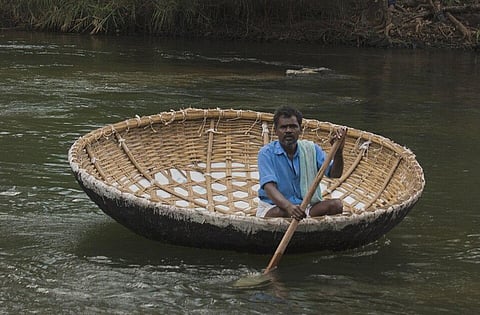
A coracle fisherman venturing out into the estuarine waters. Image Source: ezhuttukari via Wikimedia Commons.

One often comes across a rare sight along the northern estuaries of Kerala. Bowl-shaped boats, woven from bamboo and hide, glide like giant leaves across the water - steered by fisherfolk using single oars. These are coracles—ancient, keelless crafts that have been used by generations of fisherfolk along India’s inland waters. Light but sturdy enough to survive the fast flows of rivers, coracles are perfectly suited for use in Kerala’s estuaries and can often slip effortlessly into narrow shallow streams where larger vessels cannot go.
Locally referred to as Kottavanchi or Vattathonni, they are operated mainly by migratory fishermen from Karnataka in estuaries such as Vembanad, Nethravathi and Guripur that are well studied. However, the smaller tropical estuaries of Valapattanam and Dharmadam, where this ancient craft still survives, remain overlooked.
A recent open access study titled 'Coracle: the living heritage of migratory fishermen of Kerala’ by Swetha K C, Jayalakshmi K J and Sreekanth G B, published in the Indian Journal of Traditional Knowledge shines a light on these hidden waters.
In Valapattanam, coracles cover nearly 6.27 km² through fishing grounds at Kalloori Kadavu, Mangadavu, Paarakkal, Pamburuthi, and Narathu. In Dharmadam, they navigate around an area of 1 km² near Melur and Parapram Bridge. In these overlooked estuaries, the coracle is more than a relic of the past—it is a symbol of adaptation, of livelihoods shaped by water’s moods on which the lives of fisherfolk in the region hang precariously in balance.
The migratory fisherfolk who use the coracles are mainly from Hosur, Karnataka, speak Tamil, Malayalam, and Kannada, and have been residing along the banks for over three decades. They live in makeshift tarpaulin tents or modest rental homes and venture out at dawn between 4:00 and 8:00 a.m., returning with their catch before breakfast, and sometimes heading out again in the evening if the tides are kind.
The coracle itself is a marvel of improvisation, with bamboo strips forming its circular frame, two to two-and-a-half metres wide, lined with woven plastic bags sealed with coal tar to keep it watertight. Some boats are now made of FRP (fibre-reinforced plastic), but the traditional bamboo versions are still procured from Bhadravathi in Shimoga district at around Rs 2,500 – a relatively affordable price, transported by bus or lorry, and finished with tar and wood like mango or sal. Tar, cashew nutshell oil, and fish oil are used to keep the boats sturdy. Each coracle carries 3–5 sets of monofilament gillnets, panels stitched together to stretch up to 8 km in Dharmadam and nearly 20 km in Valapattanam. A stick marks the net’s end, and the boat zigzags across the water as the net is hauled back within an hour. Two men usually operate the craft — one to control the net, the other to haul..
The rhythm of the fishing activity is tied to the tides with spring and neap tides giving the best catch and July to November is the busiest season. In Valapattanam, 20 coracles operate year-round, landing nearly 9.94 tonnes of fish annually. In Dharmadam, just five coracles ply the waters, landing about 1.21 tonnes — though local fishermen often drive the migrants out after a week each month.
In Dharmadam, the catch is dominated by a fish called pearlspot, which makes up nearly 37% of landings. In Valapattanam, the whiskered catfish takes the lead, contributing about 33%. The mud crab accounts for 32.7% of the Dharmadam estuary’s shellfish landings and 12.5% in Valapattanam. Together, the pearlspot, catfish, and mud crab form the backbone of the coracle fishers’ economy.
While Valapattanam (VAL) has higher annual production than Dharmadam (DHA), Dharmadam’s shorter fishing intervals give its waters time to breathe. With fishermen allowed only a week each month, stocks replenish more quickly, leading to richer species landings despite lower overall volume. Seasonality shapes the catch. The post-monsoon months are peak season, with average landings of 2.1 tonnes in Valapattanam and 0.4 tonnes in Dharmadam. Pre-monsoon yields 1.5 tonnes in Valapattanam and 0.25 tonnes in Dharmadam, while the monsoon itself yields smaller catches at 1.2 tonnes in Valapattanam and 0.19 tonnes in Dharmadam.
During peak months, a coracle crew can earn around ₹1,000 a day, hauling 60–100 kg of fish in Valapattanam and 30–40 kg in Dharmadam. In leaner months, the catch drops to just 5–10 kg, and daily earnings shrink to ₹200–500. The lives of the fisherfolk thus swing between abundance and scarcity, between tradition and survival. The coracle fishermen paddle not just against currents but against the uncertainty of tides, seasons, and markets — their income rising and falling with the estuary’s pulse.
Fisher families live together in clusters beneath makeshift tarpaulin tents, with children as young as four months old growing up along the riverbanks. During the monsoon, they shift into modest rental homes built of asbestos sheets — fragile shelters against the rains. Half of the fishermen are between 20 and 40 years old, with a significant share under 20. Family sizes vary with some households having fewer than three members, while others stretch to seven. Education is scarce — over half are illiterate, and 30% have only completed elementary school. Migration is not just a livelihood choice but a survival strategy, leaving little room for children’s schooling.
Why do the coracle fishers migrate? Image Source: Swetha K C, Jayalakshmi K J and Sreekanth G B (2026) Coracle: the living heritage of migratory fishermen of Kerala. Indian Journal of Traditional Knowledge, 25 (8), p 832.
Debt and financial constraints top the list of reasons for migration, with unemployment and low income close behind. Drought, small landholdings, and lack of alternative jobs push them further, while the coracle’s low cost and mobility pull them into new estuaries. Migration, for them, is both necessity and tradition.
Why do coracle fishers migrate? Image Source: Swetha K C, Jayalakshmi K J and Sreekanth G B (2026) Coracle: the living heritage of migratory fishermen of Kerala. Indian Journal of Traditional Knowledge, 25 (8), p 833.
Operating a coracle is risky — the lightweight craft moves with the wind, and only skilled paddlers can manage it in rough weather. This risk ranks highest among workplace constraints, especially in Dharmadam (54.6) compared to Valapattanam (27.3). Competition with native fisherfolk is another barrier, often forcing migrants out of Dharmadan. Language differences add to the struggle, while in Valapattanam, declining fish species pose the bigger challenge. Marketing and seasonality compound the uncertainty, though cultural lag barely registers as a concern.
Despite hardships, migration has, however, improved livelihoods. Nearly 50% of respondents report better income, while many used earnings to repay debts (around 30 to 34%). Around 16–17% have invested in children’s education, and a smaller share have managed to save (8–9%).
Although coracle fishing is relatively low cost and rooted in tradition, the practice faces regulatory and environmental concerns. The Kerala Inland Fisheries Act, 2010, prohibits the use of nets longer than 500 metres. However, the study reports that some migrant fishers extend their nets to 1,000 metres. Longer nets increase fishing effort and can intensify competition with local communities that depend on the same waters.
Plastic waste adds to the pressure on estuarine ecosystems. Discarded nets and tar-coated bags contribute to pollution in habitats that support the fishery. Safety is another concern, particularly when family members, including young children, accompany fishers on trips in open water. The Kerala Inland Vessels Act, 2010, requires life jackets and flotation devices, highlighting the need to follow safety provisions.
The study points to cooperative-based management as a way to address these challenges. Regular dialogue between migrant fishers and local governing bodies could help reduce conflicts and support the shared use of fishing grounds. Awareness programmes at the panchayat and district levels could also improve understanding of regulations, encourage compliance and strengthen cooperation in conserving resources and improving safety.
Coracle fishing continues to connect traditional knowledge with the everyday livelihood needs of migrant fishing families. Its future, however, depends on how fishers, local communities and governing institutions address the pressures on the practice.
Balancing fishing effort with the condition of estuarine resources, improving safety and reducing conflict over access to fishing grounds are important parts of this effort. Cooperative management and greater awareness of regulations can help support both conservation and livelihoods.
For the fishers who depend on these small estuaries, sustaining coracle fishing means protecting not only an old craft but also the work and income built around it. Its continuation will depend on maintaining a balance between traditional practices, the needs of fishing communities and the long-term health of the waters they share.
This is an open access journal, and all articles are under the Creative Commons Attribution-BY-NC-ND 4.0 International License.