
- Topics
- Feature
- Opportunities & Events
- About
- Hindi Portal
- Data
- Topics
- Feature
- Opportunities & Events
- About
- Hindi Portal
- Data
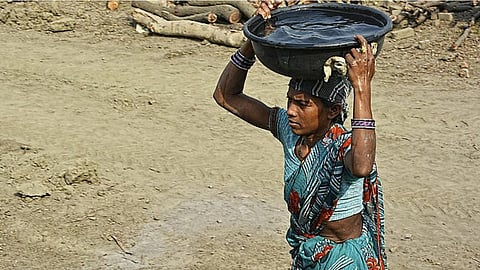
Local level water poverty assessment important for better water resource management. Source: IWP Flicker photos.

Water security and food security are often discussed separately. Yet for millions of rural households, the two are inseparable. Access to water influences what farmers grow, how much they harvest, and ultimately whether families have enough nutritious food to eat.
In Maharashtra, where rainfall varies dramatically across regions and drought is a recurring reality, understanding this relationship is critical. A new study by Megha D Mhaskar and Parmeshwar D Udmale published in Environmental Research Communications offers the first integrated assessment of water and food security at both district and sub-district levels across the state. The findings reveal striking regional inequalities. While parts of Konkan, Pune and Nashik perform relatively well, large areas of Marathwada and Vidarbha continue to face overlapping challenges linked to water scarcity, groundwater stress, agricultural vulnerability, and poor nutritional outcomes.
The study also highlights an important insight: regions with relatively lower groundwater exploitation are not necessarily food secure. Several tribal-dominated subdistricts continue to experience malnutrition, poor food access, and inadequate water services despite having comparatively lower pressure on groundwater resources.
Water security Index Maharashtra
Source: Mhaskar and Udmale (2026) Integrated assessment of water and food security at the sub-district level in Maharashtra State, India. Environ. Res. Commun. 8 (2026) 065019, p 4
Maharashtra's diverse agroclimatic conditions make water and food security highly uneven across the state. The state receives an average annual rainfall of 1,181 mm. However, nearly one-third of its geographical area lies within the rain shadow region, characterised by low and erratic rainfall. Around 42.5 percent of Maharashtra is drought-prone.
Agriculture remains a key economic activity and source of livelihood for the state's predominantly rural population. As climate variability increases, the agricultural sector faces growing risks that directly affect both water availability and food production.
Recognising these interconnections, researchers undertook a comprehensive assessment using a range of indicators covering water availability, access, utilisation, and stability, alongside indicators measuring food availability, access, utilisation, and stability at the district and subdistrict level in the state. The results provide one of the most detailed pictures yet of how water and food security vary across Maharashtra.
The study finds substantial differences in water availability across regions. Konkan emerges as the most water-abundant division, followed by Pune. In contrast, Chhatrapati Sambhajinagar division in Marathwada and Nagpur division in Vidarbha show the lowest levels of water availability.
At the sub-district level, Mahabaleshwar in the Satara district records the highest water availability. Dharmabad in Nanded district records the lowest, followed by Lakhandur and Zari Jamani in Vidarbha.
Interestingly, Mahabaleshwar, despite abundant rainfall, shows a high groundwater extraction rate of 61.09 percent, indicating significant dependence on groundwater resources. Dharmabad, by contrast, records a lower groundwater extraction rate of 15.31 percent despite limited rainfall, possibly reflecting restricted access to groundwater resources.
Water security, spatial variations at the subdistrict level in Maharashtra.
Source: Mhaskar and Udmale (2026) Integrated assessment of water and food security at the sub-district level in Maharashtra State, India. Environ. Res. Commun. 8 (2026) 065019, p 12.
The study identifies significant disparities in access to drinking water infrastructure. Parts of the Nagpur and Amaravati divisions face challenges linked to forest land diversion, while topographical constraints affect water access in Konkan.
Mokhada, a tribal-dominated sub-district in Palghar district, records the lowest water accessibility due to inadequate infrastructure. Several sub-districts in the Nashik and Dharashiv districts report a complete absence of villages with drinking water supply facilities despite having full electricity coverage. The findings suggest that water availability alone does not guarantee access to safe water services.
Water security Index, Maharashtra.
Source: Mhaskar and Udmale (2026) Integrated assessment of water and food security at the sub-district level in Maharashtra State, India. Environ. Res. Commun. 8 (2026) 065019, p 14.
Differences become even more pronounced when examining how water is used. Kalyan in water abundant Konkan region records the highest water utilisation, followed by Daryapur and Thane. These areas benefit from stronger infrastructure, better healthcare access, and improved water services. In Kalyan, 93.2 percent of households have access to treated tap water, while diarrhoeal disease incidence remains relatively low.
At the other end of the spectrum, Jawhar in Konkan records the lowest water utilisation, followed by Washi and Mokhada. Tribal dominated regions of Jawhar and Mokhada have very limited access to treated tap water, with only 21.6 percent of households in Jawhar receiving treated drinking water. These areas also report high rates of diarrhoeal diseases. The findings underline the close relationship between water quality, public health, human wellbeing and inequities in access and utilisation of water.
Spatial variations in food security across subdistricts in Maharashtra.
Source: Mhaskar and Udmale (2026) Integrated assessment of water and food security at the sub-district level in Maharashtra State, India. Environ. Res. Commun. 8 (2026) 065019, p 16.
The stability dimension captures the ability of regions to withstand recurring climate shocks. Marathwada emerges as particularly vulnerable due to frequent droughts and limited groundwater reserves.
Within the region, Lakhandur performs relatively well because of lower numbers of water-scarce villages and higher groundwater availability. In contrast, Fulambri, Sillod, and Khuldabad face severe challenges due to large numbers of water-scarce villages and limited groundwater resources. The study finds that drought frequency affects all regions, but has a greater impact on areas that already face water scarcity.
Food security Index in Maharashtra subdistricts.
Source: Mhaskar and Udmale (2026) Integrated assessment of water and food security at the sub-district level in Maharashtra State, India. Environ. Res. Commun. 8 (2026) 065019, p 18.
The overall Water Security Index reveals clear regional contrasts. Konkan performs best, with 59 percent of its sub-districts falling into the high category and 24 percent into the very high category. Pune also performs strongly, with 41 percent of sub-districts classified as highly water secure and 54 percent as very highly water secure.
By contrast, the Chhatrapati Sambhajinagar division in Marathwada records the highest proportion of sub-districts in the low category, highlighting severe water security challenges. The Nagpur division is dominated by medium-category subdistricts, reflecting moderate levels of water security.
At the sub-district level, Mahabaleshwar records the highest Water Security Index, followed by Radhanagari in Kolhapur and Raver in Jalgaon. Mokhada, Washi, and Kalamb rank among the least water-secure due to poor infrastructure and inadequate utilisation of available water resources.
Water and Food Security Index combined at the subdistrict level in Maharashtra.
Source: Mhaskar and Udmale (2026) Integrated assessment of water and food security at the sub-district level in Maharashtra State, India. Environ. Res. Commun. 8 (2026) 065019, p 19.
Food availability varies significantly across the state. Kopargaon records the highest food availability due to extensive cultivation of fruits and vegetables, crop diversification, and high livestock numbers. Chandwad and Parner also perform well. Thane, a tribal dominated district, records the lowest food availability. The study notes that tribal-dominated areas often experience lower food security and frequently overlap with regions facing water insecurity.
The study finds large disparities in food access across Vidarbha. Kamptee, Shrivardhan, and Murud perform well because of stronger transport networks, better infrastructure, and higher literacy rates.
By contrast, Bhamragad and Etapalli in Gadchiroli district record some of the lowest food accessibility scores. Jawhar also performs poorly, reflecting the challenges faced by tribal communities in accessing markets, services, and government support systems.
Kamptee reports 100 percent ration card coverage compared with only 20.81 percent in Bhamragad. Literacy rates also differ sharply, reaching 87.57 percent in Kamptee compared with 54.71 percent in Bhamragad. These findings highlight the importance of social infrastructure in improving food access.
Food security is not only about availability and access. It is also about nutritional outcomes. The study finds better food utilisation in Mangaon, Roha, and Alibag in Raigad district, where food intake and nutrition indicators are relatively strong.
In contrast, tribal-dominated sub-districts such as Jawhar, Akrani, and Chikhaldara continue to experience poor nutritional outcomes, reflected in higher infant mortality rates and child malnutrition levels. The results indicate that nutrition challenges persist even in areas where food may be physically available.
Food stability measures the ability of agricultural systems to maintain production over time. Amaravati and Chhatrapati Sambhajinagar divisions record particularly low food stability due to limited storage infrastructure, low irrigation coverage, and lower cropping intensity. Nagpur also performs poorly.
The study identifies rainfall variability as a major factor influencing agricultural productivity. Water-scarce regions often lack the capacity to cultivate water-intensive cash crops, while irrigated regions are generally less vulnerable to climatic shocks.
The Food Security Index reveals significant regional differences. Amaravati division records the lowest food security levels, indicating serious concerns. Pune and Nashik perform best, with 61 percent and 43 percent of sub-districts, respectively, falling into the 'very high' category.
Konkan also performs relatively well, with a high proportion of sub-districts classified as very highly food secure. Chhatrapati Sambhajinagar records a large share of sub-districts in the medium category, indicating moderate food security conditions.
When water and food indicators are analysed together, regional disparities become even more apparent. Pune records the highest combined water and food security index, with 64 percent of its sub-districts falling into the 'very high' category. Nashik and Konkan also perform strongly.
The Chhatrapati Sambhajinagar division records the highest proportion of sub-districts in the low category, indicating severe water and food security challenges. Nagpur and Amaravati divisions largely fall within the moderate category. Several districts identified under India's Aspirational Districts Programme continue to show persistent vulnerabilities. Dharashiv, Gadchiroli, Nandurbar, and Washim perform poorly across both water and food security indicators.
All sub-districts in Dharashiv and Washim fall into the low category, while half of the sub-districts in Gadchiroli and Nandurbar also do so. The study notes that tribal-dominated and forested districts such as Gadchiroli and Nandurbar face additional constraints, including geographical isolation, fragmented landholdings, and limited institutional capacity for water management.
The study highlights how deeply interconnected water security, agricultural production, and nutrition are across Maharashtra. The findings point to an urgent need for targeted interventions in Marathwada and Vidarbha, where vulnerability remains high. Measures such as groundwater recharge, water conservation, expansion of micro-irrigation, and adoption of less water-intensive crops could strengthen drought resilience and improve food security outcomes.
At the same time, relatively secure regions such as Konkan, Nashik, and Pune need to focus on improving water use efficiency while sustaining agricultural productivity. Perhaps the study's most important contribution is its ability to identify vulnerabilities at the sub-district level that show that even within relatively better off regions such as Konkan, tribal areas continue to lag behind showing inequities in access to food and water resources. Such granular analysis can help policymakers prioritise investments, design region-specific programmes, and track progress more effectively.