
- Topics
- Feature
- Opportunities & Events
- About
- Hindi Portal
- Data
- Topics
- Feature
- Opportunities & Events
- About
- Hindi Portal
- Data
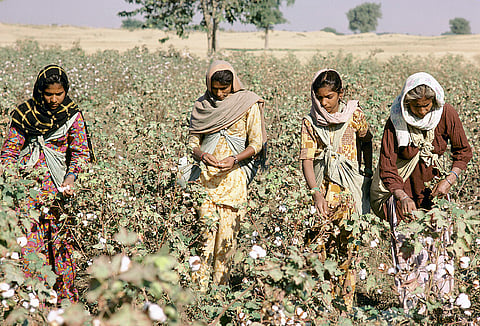
Only a minor portion of rainfall actually infiltrates the soil to become available to the cotton plants
Ray Witlin / World Bank

When discussions about water and agriculture turn to cotton, the crop is often portrayed as a major contributor to water scarcity. Yet a closer look at cotton cultivation in central India tells a more complex story. The challenge may not be that cotton consumes too much water, but that much of the rain falling on cotton fields is never captured or used by the crop.
A recent study from Nagpur reveals that more than half of the rainfall received by cotton farms is lost as runoff, carrying away valuable soil in the process. At a time when climate change is bringing more intense and erratic rainfall, the findings offer important lessons for water management, soil conservation, and the future of rainfed farming in India.
For years, cotton has occupied an uncomfortable place in global debates on water sustainability. Environmental campaigners have frequently highlighted its role in water depletion in regions ranging from Central Asia to parts of Australia. In India, where cotton covers nearly 13 million hectares and supports millions of farmers, the crop is often criticised for its large water footprint. However, much of this criticism has relied on broad estimates rather than field-based measurements.
A study published in Cleaner Water, “Water footprint, runoff and soil loss assessment of cotton production in central India", offers one of the most detailed assessments of what actually happens to water in cotton fields in central India. Conducted over four consecutive cropping seasons at the Indian Council of Agricultural Research’s Central Institute for Cotton Research (ICAR-CICR) in Nagpur, the research reveals a striking paradox. Cotton itself may not be the biggest problem. Instead, the larger challenge is the enormous quantity of rainfall that never reaches the crop.
The study found that only about 47 percent of annual rainfall becomes effective rainfall available to cotton plants, while approximately 51 percent is lost as runoff. At the same time, farmers lose an average of 8.81 tonnes of soil per hectare every year. These findings raise important questions about how India manages rainfed agriculture in an era of climate uncertainty.
The research also suggests that relatively modest interventions such as supplemental drip irrigation, rainwater harvesting and soil conservation could substantially improve productivity while reducing the crop’s water footprint.
Central India produces nearly two thirds of the country’s cotton. Unlike irrigated cotton systems in northern India, most cotton farms in Maharashtra, Madhya Pradesh, and neighbouring regions depend almost entirely on monsoon rainfall. Rainfed agriculture is often assumed to have a lower environmental impact because it relies less on groundwater and canal irrigation. However, the Nagpur study reveals a more complicated reality.
Between 2019 and 2022, researchers closely monitored cotton fields, measuring rainfall, runoff, soil erosion, evapotranspiration, and water use. Using eddy covariance systems, soil moisture measurements, and runoff collection structures, they tracked how water moved through the farming landscape.
The study found that the region received an average annual rainfall of around 1,140 mm. Yet cotton plants effectively used only about 541 mm of this water. Most of the remaining rainfall was lost through runoff and other pathways.
The concentration of rainfall within short periods appears to be the key reason. More than 90 percent of annual rainfall arrives during the monsoon. Increasingly, this rainfall occurs as intense downpours rather than evenly distributed showers. When rainfall intensity exceeds the soil’s capacity to absorb water, large volumes flow away before they can be stored in the soil.
Researchers identified 65 erosive rainfall events over three years. Just 11 highly intense storms caused the greatest runoff and soil losses. During these events, average rainfall reached 83.5 mm per storm, generating runoff of 54.6 mm and soil losses approaching one tonne per hectare from a single event.
The findings align with broader climate projections indicating that central India is likely to experience fewer rainy days but more extreme rainfall events in the future. This means that even if annual rainfall remains unchanged, the amount of water available to crops may continue to decline. The challenge, therefore, is becoming less about how much rain falls and more about how effectively landscapes can capture and retain it.
While the water findings are significant, the study’s results on soil erosion may be even more alarming. Researchers recorded average annual soil losses of 8.81 tonnes per hectare, with losses rising to 11.5 tonnes per hectare in particularly wet years. These figures represent the steady removal of fertile topsoil that can take decades or even centuries to form.
The impacts extend far beyond agriculture. Soil erosion reduces water infiltration, lowers nutrient availability, weakens soil structure, and ultimately affects crop productivity. Sediments washed away from fields also carry fertilisers and agrochemicals into streams, reservoirs, and groundwater systems.
The study found that runoff and soil loss were strongly linked to rainfall intensity, especially rainfall concentrated within short periods. High-intensity storms generated disproportionately greater damage than moderate rainfall events.
These findings have important implications for water management policy. Much of India’s response to water scarcity continues to focus on irrigation infrastructure and water supply augmentation. Soil conservation often receives less attention despite its critical role in determining how much rainfall remains available within agricultural landscapes.
Healthy soils act like natural reservoirs. They absorb rainfall, store moisture, and release water gradually to crops. Degraded soils do the opposite, shedding water rapidly and increasing vulnerability to both floods and droughts.
Measures such as mulching, conservation tillage, cover crops, contour cultivation, farm bunding, and vegetative barriers can significantly reduce runoff while improving infiltration. These interventions conserve both soil and water, increasing the proportion of rainfall that becomes productive green water. Given the growing frequency of extreme rainfall events across India, soil conservation should be viewed not only as an agricultural practice but also as a climate adaptation strategy.
The concept of water footprint has become an influential tool in assessing agricultural sustainability. It measures the total volume of water required to produce a unit of output and distinguishes between green water (rainwater), blue water (surface and groundwater used for irrigation) and grey water (water needed to dilute pollutants).
The Nagpur study estimated that producing one tonne of cotton lint under rainfed conditions required 11,339 cubic metres of water. Under drip irrigation, the water footprint declined to 9,959 cubic metres per tonne.
At first glance, these numbers appear high. However, context is important. In rainfed systems, 83 percent of the water footprint consisted of green water derived from rainfall. Only a relatively small share was associated with pollution-related grey water. Under drip irrigation, green water still accounted for 73 percent of the total footprint, while blue water contributed just 8 percent.
This distinction matters because rainwater use generally imposes less pressure on rivers and aquifers than irrigation withdrawals. The researchers argue that Indian cotton is often unfairly compared with highly irrigated cotton systems elsewhere in the world. Although the water footprint values are substantial, most of the water originates from rainfall rather than groundwater extraction.
Nevertheless, the study highlights significant opportunities for improvement. Rainfed cotton yielded an average lint production of 0.65 tonnes per hectare, while drip-irrigated cotton achieved 0.83 tonnes per hectare. This represents a yield advantage of approximately 28 percent.
Importantly, the yield gain was achieved through relatively modest irrigation inputs of just 50–120 mm during the post-monsoon months of October and November. These supplemental irrigations coincided with critical crop growth stages when rainfall becomes scarce. Because yield increased more rapidly than water use, the overall water footprint declined.
This finding challenges a common misconception that reducing agricultural water footprints necessarily requires using less water. In many situations, improving productivity can be equally important because higher yields spread water consumption across larger outputs.
The most important message emerging from the study is that central India’s cotton systems possess substantial untapped potential.
The researchers conclude that relatively small quantities of supplemental irrigation can dramatically improve productivity. Yet irrigation alone is not the answer.
The first priority should be capturing the enormous volume of rainfall currently being lost. If half of annual rainfall is escaping through runoff, investments in rainwater harvesting could generate major returns. Farm ponds, check dams, recharge structures and community water storage systems can intercept runoff and make it available during dry spells.
The second priority is strengthening soil and water conservation measures. Watershed development programmes have already demonstrated success across parts of semi-arid India. Expanding such efforts in cotton-growing regions could simultaneously reduce erosion, increase infiltration and improve groundwater recharge.
Third, policymakers should accelerate the adoption of micro-irrigation. The study demonstrates that limited drip irrigation applied strategically during boll formation and development stages delivers substantial benefits. Public subsidies should increasingly focus on precision irrigation systems rather than conventional flood irrigation methods.
Fourth, research institutions need to shift attention toward climate-resilient rainfed agriculture. Historically, agricultural innovation has often prioritised irrigated systems. Yet rainfed regions continue to support millions of smallholder farmers and contribute significantly to national production.
Finally, water footprint assessments should become more nuanced. Instead of treating all water use as environmentally equivalent, evaluations must distinguish between productive rainwater use and unsustainable groundwater extraction. Such differentiation is essential for informed policy decisions.
As climate change intensifies rainfall variability across India, the lessons from Nagpur extend far beyond cotton. The future of agricultural water security may depend less on finding new water sources and more on managing the rainfall already available.
The study reveals a powerful insight: central India’s cotton fields are not necessarily suffering from a shortage of water. They are suffering from a failure to retain it.
If policymakers, researchers and farmers can work together to capture runoff, conserve soil and deploy limited supplemental irrigation strategically, cotton production could become both more profitable and more sustainable. In a country where water scarcity is increasingly viewed as an existential challenge, that may be one of the most important agricultural lessons of all.