
- Topics
- Feature
- Opportunities & Events
- About
- Hindi Portal
- Data
- Topics
- Feature
- Opportunities & Events
- About
- Hindi Portal
- Data
Low-tech irrigation scheduling can prevent India’s groundwater crisis
World Bank

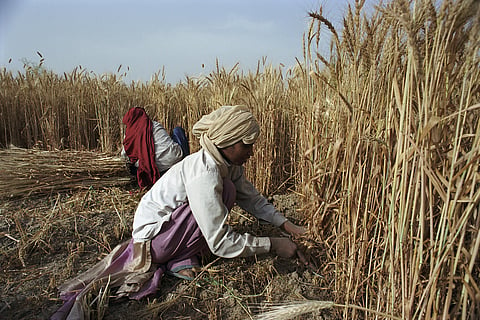
Across the wheat-growing plains of north-west India, groundwater has become the invisible foundation of food production. Farmers in Haryana, Punjab, and western Uttar Pradesh depend heavily on tube wells to irrigate wheat during the dry winter months, but decades of over-extraction have pushed aquifers into alarming decline. In many districts, groundwater tables are falling so rapidly that the region is now recognised as one of the world’s major groundwater depletion hotspots.
For decades, debates around India's groundwater crisis have focused on shifting away from water-intensive crops or investing in expensive irrigation technologies. But what if a significant share of the solution lies elsewhere? What if farmers could continue growing wheat while using substantially less water?
A new study, “Estimation of wheat yields and water savings with deficit irrigation in water-stressed NW India” by Divyam Garg and Hemant Kumar, published in Agricultural Water Management in 2025, argues that a large share of this crisis stems not from wheat cultivation alone but from how irrigation is managed. The research shows that wheat farmers could save between 18 and 38 percent of irrigation water with little or no meaningful decline in yields if irrigation is scheduled more intelligently.
The findings are significant because they challenge a deeply entrenched assumption in Indian agriculture that more irrigation automatically translates into higher production. Instead, the paper demonstrates that beyond a certain threshold, additional water offers negligible yield benefits while sharply increasing groundwater extraction and electricity consumption.
India’s groundwater paradox
India is the world’s largest user of groundwater, and agriculture accounts for more than 80 percent of freshwater withdrawals in the country. In north-west India, this dependence has intensified because of the Green Revolution model that encouraged water-intensive rice-wheat systems supported by subsidised electricity and assured procurement.
The study focuses on Mahendragarh district in Haryana, where groundwater extraction has crossed sustainable limits. Nearly 91 percent of irrigation water in the district comes from bore wells, while groundwater development has exceeded 127 percent, meaning extraction is far greater than natural recharge. Despite low winter rainfall and semi-arid conditions, farmers continue cultivating irrigated wheat because it remains economically secure under current procurement systems.
This creates a paradox. Wheat production is economically rational for farmers but hydrologically unsustainable for the region. Governments have tried to promote micro-irrigation and crop diversification, yet adoption has remained slow because farmers are reluctant to shift away from remunerative crops. The study therefore takes a more pragmatic approach: if wheat cultivation is likely to continue, can irrigation itself become substantially more efficient?
Understanding deficit irrigation
The study explores a water management technique known as deficit irrigation. Rather than supplying crops with their full theoretical water requirement, deficit irrigation provides slightly less water during selected growth stages. The objective is not to stress crops severely but to avoid excessive irrigation that contributes little to yield improvement.
To evaluate its potential, the researchers used AquaCrop OSPy, a Python-based version of the Food and Agriculture Organisation's AquaCrop model. The model simulates crop growth under varying water conditions and was calibrated using 26 years of weather and wheat yield data collected between 1997 and 2023.
A notable aspect of the research is the use of Particle Swarm Optimisation, a machine learning-inspired calibration method that efficiently identifies optimal crop growth parameters. This approach allowed the researchers to test 47 different irrigation strategies under a range of climatic conditions and irrigation schedules. In effect, the study recreated decades of wheat growing seasons to examine how irrigation demand, crop yield and water productivity changed under different management scenarios.
The key finding: wheat does not need as much water as farmers apply
One of the study's most important findings is that wheat yields stabilise before irrigation reaches full irrigation levels. Under full irrigation conditions, seasonal irrigation demand reached 648 millimetres. However, reducing irrigation substantially resulted in only small declines in yield.
For example, the irrigation strategy known as SMT 30 reduced irrigation water use by 35 percent while causing only a 2.1 percent decline in yield. Another strategy, SMT 40, achieved water savings of 32 percent while keeping yield losses below one percent. The relationship can be represented as a plateauing yield response curve:
y = f(x), where wheat yield y rises rapidly with irrigation x initially, then approaches a plateau beyond moderate irrigation levels.
This suggests that farmers often apply water beyond the point where it significantly contributes to crop production. According to the study, maximum wheat yields can be achieved with substantially lower irrigation quantities than those commonly applied under conventional flood irrigation practices. The implications are considerable. Even modest reductions in irrigation across large wheat-growing areas could generate substantial groundwater savings.
Why the low-tech solutions matter most
The paper’s most important contribution may not be the sensor-based irrigation strategies but the simpler alternatives designed for resource-poor farmers. Most precision irrigation systems require soil moisture sensors and digital infrastructure, which remain inaccessible for many smallholders.
To address this, the researchers developed two low-tech approaches. The first, called Historical Rainfall-Based Fixed Interval irrigation (HRFI), uses historical rainfall patterns to determine irrigation frequency. The second, Modified Predefined Calendar irrigation (MPC), follows fixed irrigation schedules adjusted slightly when rainfall occurs.
Surprisingly, the HRFI approach performed nearly as well as sensor-based systems. One HRFI strategy achieved 38 percent water savings with only 4.4 percent yield loss. This finding is critical because it suggests that meaningful irrigation efficiency gains do not necessarily require expensive technological systems. Relatively simple irrigation scheduling methods based on rainfall history and basic soil-water calculations can deliver substantial benefits. For India, where small and marginal farmers dominate agriculture, this could make large-scale adoption far more realistic than relying solely on high-end precision farming technologies.
Climate variability changes the equation
The study also highlights the growing challenge posed by climate variability. Rainfall during the wheat-growing season in Mahendragarh was found to be highly erratic, with a coefficient of variation exceeding 87 percent. As a result, irrigation requirements fluctuate significantly from one year to another.
In drier years, rainfall-based irrigation strategies performed better. In wetter years, soil moisture threshold systems achieved greater water savings and irrigation productivity. These findings have important implications in the context of climate change. Rising temperatures are increasing evapotranspiration rates, while rainfall patterns are becoming more unpredictable. Irrigation practices based on fixed assumptions are therefore becoming less reliable. The researchers argue that future irrigation systems must become more adaptive and responsive to changing climatic conditions rather than relying on rigid schedules or precautionary over-irrigation.
Why current policies are insufficient
India’s irrigation policy still remains heavily infrastructure-centric. Governments continue focusing on canal expansion, subsidised electricity, and hardware subsidies for drip and sprinkler systems. While these interventions matter, they often overlook irrigation decision-making itself. The research suggests that poor scheduling is one of the biggest hidden drivers of water waste. Farmers frequently irrigate pre-emptively because they lack reliable advisories on soil moisture, rainfall variability, and crop water demand.
Moreover, policy incentives often encourage over-irrigation. Free or heavily subsidised electricity reduces the cost of pumping groundwater, while procurement systems reward maximum output rather than water productivity. Under such conditions, farmers have little incentive to optimise irrigation. The paper also warns about the “irrigation efficiency paradox,” where water-saving technologies can unintentionally increase total water consumption if farmers expand irrigated area or intensify cultivation after saving water. Without groundwater governance and extraction controls, efficiency gains alone may not stabilise aquifers.
What governments should do next
The findings point toward several immediate policy priorities. First, state governments should invest in district-level irrigation advisory systems using crop simulation models such as AquaCrop. These advisories could provide farmers with locally tailored irrigation recommendations based on rainfall forecasts, soil conditions, and crop stages.
Second, agricultural extension systems need to shift from generic recommendations toward dynamic irrigation management. SMS alerts, mobile applications, and village-level advisory services could help farmers decide when irrigation is actually necessary instead of relying on routine flooding practices.
Third, irrigation efficiency programmes should focus not only on hardware subsidies but also on operational guidance. Even without advanced sensors, farmers could achieve substantial water savings through improved scheduling practices such as the HRFI approach demonstrated in the study.
Fourth, groundwater governance must accompany irrigation reforms. Without limits on extraction, water savings may simply encourage greater agricultural intensification rather than long-term aquifer recovery.
Finally, procurement and support policies should begin recognising water productivity as an agricultural objective. Incentivising farmers to produce “more crop per drop” could gradually shift irrigation behaviour without threatening livelihood security.
A realistic pathway for water-stressed agriculture
For years, India’s groundwater debate has been dominated by two extremes — either calls for drastic crop shifts or faith in expensive technological solutions. This study offers a more practical middle path grounded in irrigation efficiency. Its core message is both simple and powerful: farmers do not necessarily need to abandon wheat to save water. Much of the crisis stems from over-irrigation rather than crop cultivation alone.
By demonstrating that irrigation can be reduced significantly without major yield penalties, the research provides evidence that smarter scheduling may achieve faster and more scalable groundwater savings than many existing interventions. In a country where agricultural transitions are politically sensitive and economically complex, that realism matters. The future of India’s water security may depend not only on what farmers grow, but on how intelligently they irrigate it.