
- Topics
- Feature
- Opportunities & Events
- About
- Hindi Portal
- Data
- Topics
- Feature
- Opportunities & Events
- About
- Hindi Portal
- Data
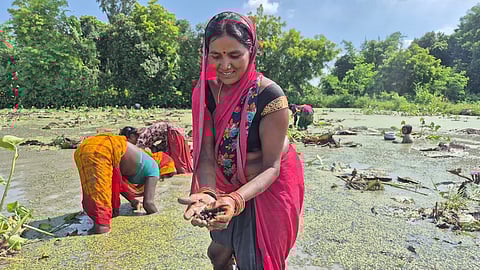
Anita Devi lifts her hand and smiles softly. With the foxnuts she collected during harvest in her hands that are rough and wounded.
Credit: Sharat Chandra Prasad

By eight in the morning, Anita wraps a leftover chapati and a small portion of roasted potato in cloth and tucks it under her arm. Then she walks towards the pond. There is no rush in her steps. She has been doing this for years and knows exactly how the day will unfold. The water. The weight. The bent knees. The long hours.
Inside India’s Makhana Heartland
Puthlaha village lies about 180 kilometres from Patna in Darbhanga district. Along with Katihar, Purnia and Madhubani, this region forms the heart of India’s makhana belt. Nearly ninety percent of the country’s makhana, the lotus seed now sold in supermarkets and marketed globally as a health food, comes from the ponds of Mithila. Most of the people who pull it from the water are women like Anita.
A makhana pond in Puthlaha village, Mithila, Bihar. These ponds are the main source of income for many families here.
Credit: Sharat Chandra Prasad
Makhana cultivation follows a long seasonal cycle. The seeds are sown in April, while harvesting begins months later and continues through winter. In between lies a long period of waiting and maintenance—ponds must be cleared of weeds, water levels monitored, and the seeds watched as they mature unseen beneath the surface.
The ponds being prepared for harvest in Mithila
Credit: Sharat Chandra Prasad
This season, Anita has chosen to work in her own village instead of migrating because her daughter’s exams are approaching. As in many farming households, work adjusts around family needs. Payment depends on output. Workers earn between ₹100 and ₹150 per kilogram of seeds collected. In a good month, Anita can earn ₹10,000 to ₹15,000, though much of it goes towards repaying old loans.
Before makhana cultivation starts, fisherfolk enter the muddy water to remove thick weeds. They clear the pond with bare hands, preparing it for the next crop. The work is slow and exhausting.
Credit: Sharat Chandra Prasad
The Long Seasonal Cycle of Makhana
Harvesting takes place in two stages. Fisherfolk first dive into the ponds to collect most of the seeds from beneath the water. About a week later, women enter the ponds for a second round, gathering what remains floating or buried in the mud. This second harvest can account for nearly half of the total production.
Rita Devi is forty-two years old. She speaks about her work plainly. Her husband works as a daily-wage labourer, and they have two children. During the season, her daughter joins her in the pond. Rita owns no land, which means makhana cultivation is not something she controls. It is work she performs on someone else’s field.
“In the season I earn around 150 to 200 a day,” she says, continuing to search through the water as she speaks. “It helps the house run. I do not have my own field, so I cannot really do anything else.”
Her workday runs in two shifts, from morning until noon and again from two in the afternoon until evening. On some days the work stretches to ten hours. Much of that time is spent bent forward in the water, pulling and sorting seeds by hand. Her knees hurt. She mentions it quietly, as a fact rather than a complaint.
Bending for hours, Rita Devi searches underwater for seeds. The work demands patience and endurance.
Credit: Sharat Chandra Prasad
Entering the water for the Harvest
Most pond owners belong to upper caste communities and supervise the work from the edges. The physical labour is largely carried out by women and fisherfolk from Scheduled Caste and Other Backward Class communities. The work is repetitive and demanding. For hours women move through the ponds, feeling through mud with their hands. Their skin remains wet for long periods, and rashes and fungal infections are common.
When asked about gloves or protective equipment, Rita laughs. “I have never seen such things here.” Despite the rising demand for makhana in national and international markets, wages have changed little. During peak season Rita works both shifts every day. “There is no policy that helps us,” she says. “If we get hurt, we apply something at home and come back.”
After hours in the water, the women gather at the pond’s edge. The seeds are collected in one place, and the wages are divided equally later.
There is a deep cut on Anita Devi’s palm. When asked about using gloves or protective gear, she laughs, saying, “We are hearing about this for the first time.
Credit: Sharat Chandra Prasad
Women in the Second Harvest
Women play a crucial role in sustaining the makhana production system, particularly in processing and household-level operations. Studies show that more than 66 percent of women participate in post-harvest activities, and processing alone accounts for nearly 60 percent of the total labour time in the makhana value chain. Overall labour contributions are estimated at about 50 percent by men, 40 percent by women, and 10 percent by children, highlighting the scale of women’s involvement.
Across generations, women in fishing communities have developed specialised skills in roasting, popping, grading, and processing. These tasks determine the final quality and market value of makhana. While men largely dominate pond-based cultivation and seed collection, women increasingly assist in field operations such as weeding, sowing, thinning, and pest management.
Yet despite their central role in production and processing, much of women’s labour remains informal, undervalued, and largely unrecognised within the makhana economy.
Anita Devi showing the injury caused by extracting makhana
Credit: Sharat Chandra Prasad
The Hidden Cost on Workers’ Health
At a private hospital in Darbhanga, physician Abhishek Kumar says skin infections among makhana workers are frequent. Prolonged bending often leads to knee and back pain. The later stage of makhana processing also carries risks. Seeds are roasted over wood fires, and constant smoke can affect breathing. “These are not always fatal conditions,” he explains. “But over years the damage accumulates.”
Most workers rely on home remedies. Mustard oil is common. Over-the-counter medicines are used when necessary. Nutritious food is not always affordable. Injuries are treated and work resumes. Anita once again lifts her palm to show the cut. “We are hearing about protective gear for the first time,” she repeats with a smile.
Anita Devi lives with her family in a small house. Income from makhana supports food, school fees and daily expenses.
Credit: Sharat Chandra Prasad
Seasonal Work and Uncertain Incomes
Bihar’s economy remains largely dependent on agriculture. Industrial growth has been slow. For many rural households, makhana provides seasonal income but rarely long-term stability.
Many of the men from this village are not present. They work in Delhi, Punjab or Haryana and return once a year during Chhath Puja. In their absence, women manage households, raise children, tend livestock and work in the ponds.
This is the other side of migration. Bihar has long sent its labour to wealthier states because work at home is scarce. Makhana cultivation creates local employment, but the industry remains limited. Most of the raw seeds leave Bihar for processing. Packaging, branding and value addition happen elsewhere. The profits travel with them.
Rita puts it plainly. “If I got even a ten thousand rupees a month job, I would never do makhana cultivation. I just do not have that option.”
Even when the sun stands high and the heat becomes unbearable, the women remain inside the water.
Credit: Sharat Chandra Prasad
Small farmers face their own challenges. Ramsundar Rai, a small farmer, says labour costs for soaking and extraction can go up to Rs. 500 or 600 per unit of work. After frying and sorting, buyers often reject part of the produce, citing quality.
“We also earn less,” he says. “If the government sets equal wages, we will follow. We are also surviving.” His sister and daughter help with drying and frying the seeds. Like many households here, makhana cultivation is a family effort. But margins remain thin.
In some ponds, husbands and wives work side by side. Makhana cultivation is family labour; survival depends on both.
Credit: Sharat Chandra Prasad
Women Sustain the Makhana Economy
During the second harvest the ponds belong almost entirely to women. They sing while working. They exchange stories. Lunch is simple. Rotis, a little sabzi and sometimes pickle.
Ten hours together creates a quiet rhythm of companionship. There is laughter and sometimes even dancing between tasks. It is not romance. It is simply a way to make the day lighter.
After drying, the seeds are roasted over fire. The shells are cracked open carefully to reveal the white puff inside.
Credit: Sharat Chandra Prasad
Anita shows another small wound on her hand. “With this salary, this is what we get,” she says. Then she adds, “Ham sarkari babu nahi hai, na hi ham tankhwa par hai. Bahut samasya hai, haan ke ki bataaun.” “I am not a government officer, nor am I a salaried person. There are many problems. Where do I even begin?”
Anita also knows Mithila painting and works with sikki grass. These crafts are closely tied to the region’s identity. Yet access to credit, markets and investment remains limited. “We do not have land. How will we take a loan?” she says. Early marriage and school dropout among girls continue to worry many families. For Anita, education offers the only imagined path out. “If they study well,” she says about her children, “that is our hope.”
In the local market, a shopkeeper sells polished white makhana. Customers see a healthy snack.
Credit: Sharat Chandra Prasad
From Pond to Market Shelves
The final product is sorted by size. Larger pieces fetch higher prices. After drying, the seeds are roasted over fire and cracked open. Later they are sorted by size. In local markets, shopkeepers display polished white makhana as a healthy snack. Customers see a light, nutritious food. They do not see the ponds.
Sorting of makhana is a time-consumingly long process that decides the price and payment of the produce every season.
Sharat Chandra Prasad
Evening Falls Over Mithila’s Ponds
As evening settles over the fields, the women step out of the ponds one by one. Some return home to cook. Some help children with homework. Others check on goats or cows before nightfall.
By the end of the season, a few may have earned enough to repay part of a loan or cover school fees. Some may decide not to return the following year. Pain in the knees, recurring infections and exhaustion can eventually become too much.
Makhana brings income in a state where opportunities are limited. But it rarely brings financial security. By the time packets of makhana reach city shelves, they carry none of the mud, the bent backs or the hours spent waist deep in water. In Mithila, however, the ponds remember. And tomorrow morning, before the sun rises fully, the women will step into the water again.