
- Topics
- Feature
- Opportunities & Events
- About
- Hindi Portal
- Data
- Topics
- Feature
- Opportunities & Events
- About
- Hindi Portal
- Data
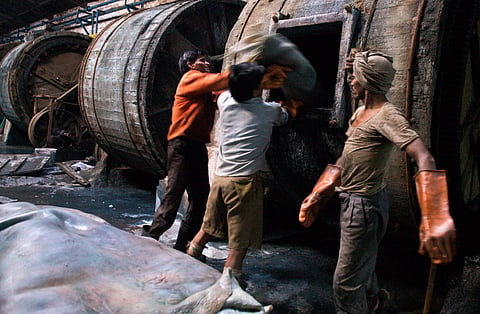
Kanpur's primary industry consists of 400 tanneries that treat hides using water and heavy chemicals like chromium. This multi-step process generates highly polluted water, which is typically discharged back into the Ganges River without being treated. Image: Daniel Bachhuber; CC BY-NC-ND 2.0; Flickr Commons

Across India, wastewater is often viewed as a costly urban burden that must be treated and disposed of before it pollutes rivers and threatens public health. Yet every day, millions of litres of sewage carry not only contaminants but also valuable organic matter and energy. As cities expand and water pollution intensifies, a growing body of research suggests that wastewater could become an important resource rather than a liability.
A new study from Kanpur, one of India's largest industrial cities, explores how sewage treatment systems could simultaneously improve water quality, recover resources and generate renewable energy. The new paper published in the journal Cleaner Waste Systems argues that wastewater may instead be one of India’s most underutilised energy resources. The study, titled “Energy-positive wastewater management in urbanizing tropical cities: Integrating membrane filtration and anaerobic digestion in Kanpur, India” by Ruben Vingerhoets, presents a technically ambitious but potentially transformative approach to wastewater treatment in one of the country’s most polluted industrial cities.
The research focuses on Kanpur, particularly the Jajmau sewage treatment system that receives a toxic mix of domestic sewage and tannery waste before discharging into the Ganges River. The study proposes integrating direct membrane filtration (DMF) with anaerobic digestion (AD), creating a system capable not only of treating wastewater more effectively than conventional activated sludge plants but also of generating enough biogas to offset operational energy costs and even produce a net profit.
The paper arrives at a critical moment. Indian cities are expanding faster than sewerage infrastructure, while rivers continue to absorb untreated or partially treated waste. According to the study, only a fraction of wastewater in low- and middle-income countries is adequately treated, leading to persistent organic pollution, oxygen depletion, and public health risks. Kanpur exemplifies this crisis: a city of more than five million people generating between 376 and 550 million litres of wastewater per day, much of which eventually enters the river system.
Why conventional treatment systems face limitations
Most urban sewage treatment in India relies on the activated sludge process (ASP), a technology widely used around the world. While effective under many conditions, ASP systems consume considerable amounts of electricity, require substantial land area and are not designed to optimise energy recovery.
The study notes that nearly half of the organic carbon entering conventional treatment plants is converted into sludge rather than being recovered as energy. Aeration, a key component of the process, also adds significantly to operating costs.
These limitations become more pronounced in cities such as Kanpur, where wastewater contains not only domestic sewage but also industrial contaminants including chromium from tannery effluents.
The researchers suggest that wastewater in such settings should be viewed as a complex resource stream containing organic matter, nutrients, suspended solids and contaminants that require integrated management.
Turning sewage into a source of energy
The study proposes combining direct membrane filtration (DMF) with anaerobic digestion (AD). In the first stage, ultrafiltration membranes separate suspended solids and organic matter from wastewater. Rather than allowing organic carbon to be lost through conventional treatment processes, the membranes concentrate it into a retentate stream.
This concentrated organic material is then transferred to anaerobic digesters, where it is processed alongside food waste and other biodegradable materials. During digestion, microorganisms break down organic matter and produce methane-rich biogas that can be used to generate electricity.
In essence, the system treats sewage as a feedstock for renewable energy production while simultaneously improving water quality.
Cleaning the water while recovering energy
The technical results reported in the paper are striking. The integrated system achieved a 58 percent chemical oxygen demand (COD) recovery rate and reduced pollutant discharge into the river by 83 percent compared with untreated wastewater. COD is a key indicator of organic pollution, and its reduction directly translates into improved river health and lower oxygen depletion.
The membranes also demonstrated exceptionally high pollutant removal efficiencies. COD removal reached nearly 91 percent, while total suspended solids removal was approximately 99 percent. Chromium — a major concern in Kanpur because of tannery waste — was effectively eliminated from permeate samples, with concentrations falling below detectable levels.
The chromium findings may prove especially important for environmental regulators. Much of Kanpur’s tannery wastewater contains chromium in its trivalent form, Cr(III), which tends to bind to suspended solids. Because the membrane system removes suspended matter so effectively, chromium contamination can also be sharply reduced before discharge into the river.
The implications extend beyond compliance standards. Chromium accumulation in sediments and aquatic ecosystems has long posed risks to both human health and river ecology. Reducing chromium loads at source could significantly improve downstream water quality and lower long-term ecological damage.
Equally important is the system’s energy balance. Anaerobic digestion of concentrated sewage retentate combined with food waste generated substantial biogas yields. The study estimates that a full-scale 130 million litre per day facility could produce roughly 1.136 gigawatt-hours of electricity daily after accounting for ultrafiltration energy use.
That changes the economics of sewage treatment entirely. Instead of wastewater plants being perpetual consumers of electricity, the study suggests they could become decentralised renewable energy producers. According to the economic assessment, the DMF+AD model could generate annual profits of nearly 8 million dollars through energy recovery, offsetting the otherwise high capital cost of membrane systems.
The importance of co-digestion
One of the paper’s most innovative contributions lies in its emphasis on co-digestion. Municipal wastewater alone typically lacks sufficient organic concentration for efficient anaerobic digestion. The researchers therefore combined sewage retentate with food waste and municipal organic waste to enhance methane production.
The results were clear. Digesters using combined kitchen waste and sewage retentate significantly outperformed digesters operating on sewage retentate alone. Stable biogas production was achieved after 30 days, with organic removal efficiencies reaching 71 percent. This integrated approach effectively links two urban crises: sewage management and solid waste disposal.
Indian cities currently struggle with both. Large quantities of biodegradable municipal waste still end up in landfills, generating uncontrolled methane emissions. By diverting organic waste into anaerobic digesters linked witsewage systems, cities could simultaneously reduce landfill pressure, lower greenhouse gas emissions, and improve urban sanitation.
The concept also aligns strongly with circular economy principles. Wastewater treatment plants could evolve into resource recovery hubs producing energy, treated water, compostable digestate, and potentially recoverable nutrients.
For Indian policymakers, this may be one of the most compelling aspects of the study. Urban infrastructure investments are increasingly expected to deliver multiple co-benefits: climate resilience, energy security, pollution reduction, and economic viability. DMF+AD systems potentially offer all four.
What this means for the Ganga
The study devotes considerable attention to impacts on the Ganges River, particularly during low-flow summer periods when pollutant concentrations become most severe. During monsoon conditions, river discharge volumes dilute wastewater impacts substantially. But in summer, untreated sewage dramatically increases COD, suspended solids, and nutrient concentrations.
According to the paper, a 130 MLD DMF+AD facility could significantly improve summer water quality by sharply reducing COD and suspended solids entering the river. The researchers argue that lower organic pollution would increase dissolved oxygen availability, supporting aquatic ecosystems and potentially reversing local oxygen depletion trends.
This is not a minor issue. Sections of the river near Kanpur have frequently fallen into highly degraded water quality categories, with low dissolved oxygen and elevated biochemical oxygen demand levels. Under such conditions, fish populations decline, microbial imbalances intensify, and ecosystem recovery becomes difficult.
The study also raises an intriguing possibility: that advanced wastewater treatment combined with nutrient recovery could eventually help convert parts of the river system from a net carbon source into a net carbon sink.
That remains speculative and would require broader interventions across the basin. Nevertheless, it reflects a larger conceptual shift underway globally — from viewing wastewater treatment as pollution control towards seeing it as climate infrastructure.
The real barriers are institutional, not technical
Despite the promise of the technology, scaling such systems across Indian cities will not be straightforward.
The most immediate challenge is capital cost. Membrane filtration systems remain significantly more expensive than conventional ASP or UASB systems. The study acknowledges that standalone membrane treatment without anaerobic digestion would be economically difficult to justify.
The profitability emerges only when wastewater treatment is integrated with energy generation and organic waste management.
This creates institutional complications. In most Indian cities, sewage management, solid waste management, electricity distribution, and river conservation fall under different departments with fragmented financing structures. An integrated resource recovery model would require unprecedented coordination between urban local bodies, pollution control boards, energy regulators, and municipal waste agencies.
There are also operational challenges. Membrane fouling, variations in wastewater composition, interruptions in organic waste supply, and maintenance requirements could all affect performance. Skilled operators and reliable monitoring systems would be essential.
Land availability may present another obstacle. The proposed full-scale facility described in the study would require large membrane and digester infrastructure. Urban land scarcity in rapidly growing cities could complicate deployment unless retrofitting opportunities are identified within existing sewage treatment sites.
Still, none of these barriers appear insurmountable.
A blueprint for India’s next generation of sewage plants
What makes this study particularly important is that it does not merely propose another incremental upgrade to wastewater treatment. It suggests a fundamentally different philosophy.
India’s sewage infrastructure has traditionally been designed around disposal. The goal was to move waste away from cities as cheaply as possible. But climate pressures, energy costs, and ecological degradation are making that model obsolete.
Future wastewater systems will likely need to recover energy, recycle nutrients, minimise emissions, and integrate with broader urban metabolism systems. The Kanpur study offers one of the clearest Indian examples yet of how such a transition might work in practice.
The policy implications are substantial.
First, wastewater treatment should be integrated into India’s renewable energy planning framework. Biogas from sewage and organic waste deserves far greater policy attention than it currently receives.
Second, urban sewage missions such as the National Mission for Clean Ganga should prioritise resource recovery metrics alongside conventional treatment targets. Measuring only litres treated is no longer sufficient.
Third, industrial wastewater regulation must become stricter, especially in mixed sewer systems such as Kanpur’s tannery zones. Technologies like membrane filtration become far more valuable when industrial contaminants are systematically managed.
Fourth, municipal solid waste and sewage infrastructure planning should be merged wherever feasible. Co-digestion models depend on coordinated waste streams.
Finally, India needs pilot-scale demonstration projects beyond laboratory studies. The Kanpur research provides strong technical evidence, but operational validation at city scale will determine whether the model can truly transform urban wastewater management.
The central insight of the study is difficult to ignore: cities are currently paying to destroy energy-rich organic matter through inefficient sewage systems while simultaneously struggling with energy shortages, landfill overflows, and river pollution.
If sewage can become fuel rather than waste, urban infrastructure economics could change dramatically. Kanpur — long associated with some of the worst industrial pollution in India — may unexpectedly offer a glimpse of what the next generation of sustainable Indian cities could look like.