
- Topics
- Feature
- Opportunities & Events
- About
- Hindi Portal
- Data
- Topics
- Feature
- Opportunities & Events
- About
- Hindi Portal
- Data
The Turtle Sanctuary, located on the banks of the Ganges River in Mirzapur, Uttar Pradesh, is a biodiversity hotspot. It is the country's only freshwater turtle sanctuary, relocated from Varanasi, and serves as a breeding ground for rare turtles.

The Turtle Sanctuary along the Ganga in Mirzapur, Uttar Pradesh, is India’s only freshwater turtle sanctuary. Spread across a 30-kilometre stretch covering parts of Prayagraj, Mirzapur and Bhadohi, it serves as a critical breeding ground for several rare turtle species. Despite restrictions and eco-sensitive zone protections, illegal sand mining continues to threaten this fragile riverine ecosystem.
A study was done by biologists Arunima Singh and Dr. Shailendra Singh of TSA Foundation India on the turtles found in India. Out of 28 turtle species found in India, 15 are recorded in Uttar Pradesh, according to the National Institute of Conservation of Nature (NICN). Many of these species inhabit rivers such as the Ganga, Yamuna, Chambal, Gomti, Ghaghra and Gandak. Of the 15 species found in the state, 10 are listed in the ‘Threatened’ category of the International Union for Conservation of Nature (IUCN). Thus, this area is very important from the point of view of biodiversity, but due to illegal mining, the special species of turtles here are now in danger.
The Mirzapur Turtle Sanctuary is estimated to support between 5,000 and 10,000 turtles, although the Forest Department has not released official population data. In addition to turtles, the sanctuary also supports crocodiles and dolphins, making it a biodiversity-rich stretch of the river.
The Forest Department has not yet released any data on the turtle population. Smuggling is also a reason for the decline in turtle numbers. According to a report, by 2023, approximately 6,000 turtles were recovered from smugglers every year. The Forest Department releases them back into the sanctuary. However, the process of releasing turtles into the river continues from time to time.
The Turtle Sanctuary, located on the banks of the Ganges River in Mirzapur, Uttar Pradesh, is a biodiversity hotspot. It is the country's only freshwater turtle sanctuary, relocated from Varanasi, and serves as a breeding ground for rare turtles. Despite strict restrictions, illegal mining poses a serious threat to the ecosystem and the turtles' survival. Here's a ground report from the Turtle Sanctuary.
The Mirzapur Turtle Sanctuary begins at Kothari village in Sirsa, Prayagraj, and ends at Baripur Uparhar village in Bhadohi. This entire area falls within the scope of the Turtle Sanctuary. Previously, the Turtle Sanctuary was located in Varanasi, but was denotified three years ago.
To ensure the establishment of this sanctuary in Mirzapur was conducted in a planned manner and within the framework of all regulations, the government appointed the District Magistrate of Prayagraj as the nodal officer. The District Magistrates of Bhadohi and Mirzapur were appointed as Member Secretaries, and the District Forest Officer (DFO) as Secretary.This sanctuary is spread over an area of about 18 km in Prayagraj and six km each in Mirzapur and Bhadohi.
Indian Black Turtle
Photo Credit – Gopal V.R. Namboodiri (Wikicommons)
According to a report (published in 2016) by the Wildlife Institute of India, between 1987 and 1992, 28,920 turtles were released into the river at the Turtle Sanctuary on the banks of the Ganga in Varanasi. Subsequently, 1,549 turtles were released into the river between 2005 and 2006, and 1,000 to 2,000 turtles were released into the Ganga every year after that. But then, a sudden decision was made to relocate the sanctuary to Mirzapur. This decision was made because of the rapid development of Varanasi and the increased cargo movement on the National Waterway that originates there. Furthermore, the construction of the Kashi Vishwanath Corridor led to increased human activities, which began to impact the Ganga River ecosystem, which was once conducive to turtle survival.
When large cargo ships passed through this area, waves exceeding 150 decibels were generated, which were unbearable for the turtles. Gradually, the turtles began to leave this area. The government took action and reduced the maximum speed of the cargo to 5 km per hour to reduce the frequency of the waves, but the environment still remained unfriendly for the turtles. This is why the government decided to relocate the turtle sanctuary. Kaura Chandra Das, a researcher at the Wildlife Institute of India, explained this in conversation with Mongabay. He said that when cargo passes through the water, the speed of waves in the water is 10 times more than that of wind, which is unbearable for turtles.
There are 29 species of turtles found in India. The following species are found only in the Ganga River.
Ganga Softshell Turtle
Indian Flapshell Turtle
North Indian Softshell Turtle
Indian Roofed Turtle
Red-crowned Roofed Turtle
Three-striped Roofed Turtle
Brown Roofed Turtle
Indian Tent Turtle
Black Softshell Turtle
Assam Roofed Turtle
Six species of turtles are found in this turtle sanctuary. The Forest Department is conducting a survey to document the turtle population. Once completed, the survey will reveal not only the turtles but also the dolphin population. The first round of the survey has been completed, and the second round will begin in February 2026.
Arvind Yadav, Divisional Forest Officer, Prayagraj
Turtles play a vital role in cleaning the Ganga river. Therefore, programs like Namami Gange have linked turtle conservation to the health of the river. Turtle sanctuaries will enhance biodiversity and purify the Ganga River. To this end, a 30-kilometer stretch of the Ganga River's banks, and an area within a 10-kilometer radius of the river's boundaries, has been declared an eco-sensitive zone for the purpose of creating a turtle wildlife sanctuary.
This is why mining was banned in this area. However, the high-handedness of the locals is posing a threat to the turtles here. According to Ashok Panda, a researcher at the Wildlife Institute of India, as mentioned in conversation with a publication, turtles come to the sand to lay eggs and remain lying in the open sky for hours. During this time, female turtles lay eggs. But due to sand mining, their ecosystem gets disturbed and they are unable to lay eggs. He said that in the last 30 years, more than 40 thousand turtles have been released into the river, yet their population is declining. This indicates that turtles are not able to find suitable places for breeding.
Tarun Nair, program lead and biologist at the Wildlife Conservation Trust, said, "While specific information about the impacts of mining in the Mirzapur area is lacking, sand mining generally damages turtle nesting sites, and the loss and degradation of breeding sites impacts nesting. Many freshwater turtles rely on open sand dunes and riverbanks for nesting. These sand dunes provide the right substrate, thermal profile (warmth favourable for eggs), moisture, porosity, and elevation above normal water level, where female turtles can dig nests and lay eggs. Excessive sand mining destroys or erodes these sand dunes, reducing suitable nesting sites. This forces turtles to nest in areas more vulnerable to flooding or predation.
There was no ecological basis for shifting the turtle sanctuary from Varanasi to Mirzapur—it was merely a bureaucratic compensation exercise to expand the inland waterways project and other major infrastructure around the original site of the turtle sanctuary. Releasing over 40,000 turtles, mostly from the Chambal River, here as part of the Ganga Action Plan was a complete waste of turtle life, time, and resources.
- Tarun Nair, conservationist
Sand mining is strictly prohibited in areas bordering 14 villages in the Sadar tehsil of Mirzapur district. Illegal sand mining poses a significant challenge to the sanctuary, and the Forest Department is taking action against it, but the mafia remains active. According to locals, the area within the Turtle Sanctuary is prohibited and under police surveillance, yet illegal mining continues.
After mining, people leave such heaps, and vehicles supply them whenever they get a chance.
Barati Lal (55), a farmer from Gogaon village in the Jigna police station area of Sadar tehsil, said that some people come here early in the morning by boat to extract sand from the middle of the Ganga River. When forest and mining officials crack down, these people disappear for a few days, but once they get a little leeway, sand mining resumes.
Barati Lal further explained that these people enter the boundaries of the turtle sanctuary, load sand onto boats, collect it at a distance, and then transport it to the market via tractor for sale. Despite the area being prohibited, excavation continues daily. Therefore, it is unclear where the turtles might be living. He explained that the Ganga River on the banks of Gogaon village is home to turtles and fish, although crocodiles are sometimes seen.
Map and photos of the Turtle Sanctuary.
Source: India Sand Watch
Speaking about the turtle sanctuary, businessman Pritesh Singh, 40, from Gaura village said, "People living along the Ganga river have been mining sand to earn their livelihood. This area is now declared a turtle sanctuary, but for generations, people here have been extracting sand from the river using boats. Honestly, after the area was banned, the people here haven't found any new work, so they continue to secretly extract sand to support themselves."
From the Jigna police station area, Rupesh Kumar, explained that the sand here is a source of livelihood for the people. Most of the people living along the Ganges River earn their living by mining and driving vehicles. When the department conducts raids, work stops for a few days. Sand mining will not stop completely until they find another source of livelihood.
Local people steal sand and carry it away on bikes.
On June 19, 2025, based on a complaint from Anil Kumar Yadav, Regional Forest Officer, Meja Range, Prayagraj, an FIR was registered at Jigna police station in Mirzapur against 15 people for illegal sand mining under the Wildlife Protection and Prevention of Damage to Public Property Act. Illegal sand mining in the area was alleged to have damaged the turtle habitat and attempted to destroy endangered turtles, their young and eggs."
In addition, two separate cases were registered in March and April, 2025. The first case was registered against 45 people based on a complaint by Deepak Kumar Rajbhar, Mineral Clerk, while in the second, an FIR was registered against 10 named and a dozen unidentified sailors under the Prevention of Damage to Public Property Act.
Continuous vehicle movement endangers turtle habitat
In order to prevent geographical, geological, and forest damage to the Ganga River and to preserve its biodiversity, the National Green Tribunal (NGT) declared it a restricted area and prohibited any type of sand mining there. Despite the ban, large boats loaded with sand are found in Gogaon. On March 9, 2025, during a raid led by Deputy District Magistrate Gulab Chand and Mining Officer Jitendra Singh, trucks, JCBs, and hives loaded with sand were seized from fields adjacent to the Ganga River.
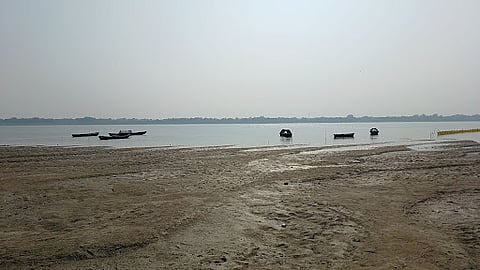
Tractor and truck tyre marks along the riverbank are evidence of the mining that takes place here.
Arvind Yadav, Divisional Forest Officer, Prayagraj, said, "We monitor illegal mining not to increase or decrease the number of turtles, but to protect them. Since sand is their breeding ground, the area is monitored to ensure there is no illegal poaching. Turtles lay their eggs in sand, so we strive to provide them with favourable ecological conditions."
When asked about mining on the banks of the Ganga river, the forest officer stated that he was absolutely confident that mining does not occur on the Prayagraj side of the Ganges. He added that complaints about mining on the Mirzapur side occasionally arise. In those cases, he takes appropriate action in collaboration with the DFO Mirzapur and DFO Bhadohi.
He stated that mining in the breeding area will inevitably impact the turtle population. To protect the turtles, arrangements are being made to protect their breeding grounds (natural habitat). He added that the river's sandy banks are regularly patrolled by officials from the police, district administration, mining department, and forest department. Immediate action is taken upon receiving complaints.
Overall, if the sand mining taking place in the Turtle Sanctuary located in the Mirzapur area is not stopped in time, the turtles living here will never find a suitable sandy place to lay their eggs, and even if 40,000 more turtles are released into the water, this sanctuary will never survive.
Special Note: This report was written under the Regional Journalism Fellowship 2025. For security reasons, the identities of the local people included in the report have been kept secret and their pseudo names have been used.