
- Topics
- Feature
- Opportunities & Events
- About
- Hindi Portal
- Data
- Topics
- Feature
- Opportunities & Events
- About
- Hindi Portal
- Data
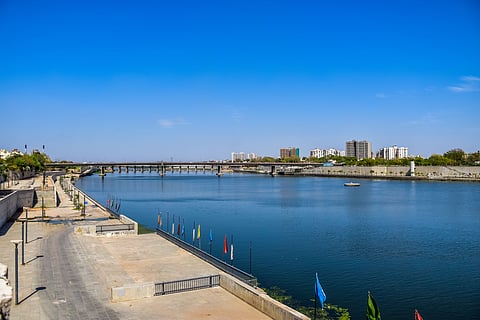
Hidden mercury hotspots and toxic risks beneath Sabarmati Riverfront's concrete banks. (Image: Tarun, Wikimedia Commons)

A river can look completely transformed and still be quietly struggling underneath. That is the uncomfortable truth at the heart of the Sabarmati, the river whose Ahmedabad stretch has become India's most photographed example of urban water redevelopment.
For over a decade, the Sabarmati Riverfront has stood as the poster child of modern Indian city planning. Where seasonal trickles and dusty riverbeds once stood, gleaming promenades, landscaped parks and a stabilised, year-round water level now draw millions of visitors, and the project has earned international praise as an engineering and planning achievement. Yet a fundamental question sits beneath all that polished concrete: has the Sabarmati actually recovered as a living river, or has its aesthetic transformation simply outpaced its chemical and ecological recovery?
A 2026 study published in Environmental Science and Pollution Research, led by Mukesh P. Chaudhari and colleagues, offers one of the most detailed scientific answers yet. Titled Integrated Hydrochemical Assessment and Water Quality Evaluation of the Sabarmati River in a Metropolitan Region of Western India, the research looks past surface impressions and single-number summaries. By combining hydrochemical testing, heavy metal risk metrics, geochemical diagrams and multivariate statistical modelling, the authors reveal a far more layered reality. The Sabarmati is neither a fully revived ecosystem nor the uniformly dead drain it is sometimes described as. Instead, it is a highly dynamic urban river caught between natural geochemical processes, altered hydrology and localised toxic stress.
In public policy and environmental reporting, river health is often compressed into one figure, the Water Quality Index or WQI. While a single score is convenient for public communication, it inevitably oversimplifies a complex living system. Rivers are not static pipes. They interact continuously with underlying geology, seasonal rainfall, agricultural runoff, industrial discharge and urban groundwater.
Recognising these limitations, Chaudhari and his team sampled ten key locations along the urban stretch of the Sabarmati in Ahmedabad across both the pre-monsoon and post-monsoon periods. Rather than testing only basic physicochemical indicators such as pH, total dissolved solids and hardness, the study combined four distinct layers of analysis: major ion chemistry and nutrients, mapping the balance of calcium, magnesium, sodium, potassium, chlorides, sulphates and nitrates; irrigation suitability metrics, evaluating parameters such as the Sodium Adsorption Ratio, Permeability Index and Magnesium Hazard; heavy metal risk assessment, measuring trace metals and calculating the Heavy Metal Pollution Index or HPI; and multivariate hydrogeochemical modelling, applying Piper, Gibbs and Durov plotting alongside principal component analysis to separate natural geochemical signatures from human pollution.
This integrated approach marks a meaningful shift in how river science is done. Rather than simply asking whether the water is good or bad, it asks why the water chemistry changes at specific points along the river's course, a distinction that matters enormously when designing targeted engineering and policy solutions.
The initial findings offer a genuine surprise, set against the widespread public perception of severe, citywide degradation. When measured against standard physicochemical parameters for drinking water, the Sabarmati performed remarkably well.
Using standard WQI calculations, 40 percent of the sampling sites were classified as excellent, while the remaining 60 percent fell into the good category. Not a single sampled site fell into the poor or unsuitable categories during the study period. Basic parameters, including alkalinity, general hardness and primary dissolved ions, stayed consistently within safe, acceptable thresholds across the monitored urban stretch.
A similarly encouraging picture emerged from the Irrigation Water Quality Index assessment. For farming communities downstream, excess sodium or salinity can damage soil structure over time, impairing permeability and crop yield. By calculating specialised agricultural metrics such as the Sodium Adsorption Ratio and Residual Sodium Carbonate, the researchers found that nearly 70 percent of sampled locations were suitable for unrestricted agricultural irrigation, with the remaining 30 percent requiring only moderate caution depending on crop type and soil drainage. None were found completely unfit for farming.
These baseline numbers matter for municipal water managers. They show that broad claims declaring the Sabarmati completely dead miss the mark. Large stretches of the river retain reasonably sound basic chemistry, shaped partly by dilution and regulated water inputs. However, as the authors are quick to point out, conventional indices only tell part of the story. A river can comfortably pass basic drinking and irrigation metrics while still harbouring toxic trace contaminants that threaten long-term ecological and human health.
The most urgent finding in the study comes from its heavy metal evaluation. Unlike organic pollutants, which break down over time through biological degradation, heavy metals persist indefinitely in aquatic environments. They settle into riverbed sediments, enter the food chain and undergo biomagnification, building up in progressively higher concentrations within aquatic organisms and the animals that feed on them.
To quantify this risk, the researchers calculated the Heavy Metal Pollution Index. On paper, the river's overall average HPI stayed below the critical alarm threshold of 100. Yet this river-wide average concealed severe, localised contamination spikes.
At specific sampling locations, mercury concentrations exceeded safe ecological and drinking limits by significant margins. Mercury is among the most potent aquatic toxins known to science. Microorganisms living in riverbed sediments can convert inorganic mercury into methylmercury, a bioavailable compound that moves readily up the food web, posing serious long-term neurological and systemic health risks to humans and wildlife that consume fish or interact with the water.
The study traces these mercury hotspots back to specific, unintercepted industrial outfalls and partially treated urban wastewater streams entering the Sabarmati. The lesson for river management in India is an important one: a favourable overall average score means little if lethal toxic hotspots remain unchecked. Generic, citywide cleanup drives cannot resolve localised industrial contamination. Only source-specific enforcement can.
Beyond identifying specific contaminants, the study reconstructed the underlying processes shaping the Sabarmati's chemical profile using hydrogeochemical tools.
The researchers observed a distinct spatial shift in hydrochemical facies, the unique chemical fingerprint of the water, moving from sodium chloride-dominant profiles to calcium chloride-dominant profiles along different stretches of the river.
By analysing these shifts using Gibbs and Durov diagrams, the team identified three mechanisms at play. Rock water interactions and weathering provide a baseline concentration of calcium and bicarbonates through the natural leaching of minerals from regional geological formations. Evaporative concentration, driven by the high ambient temperatures of Gujarat's semi-arid climate, naturally concentrates dissolved salts, particularly during the low-flow pre-monsoon months. Anthropogenic overload, from municipal sewage, industrial effluents and urban runoff, then superimposes high loads of sodium, chloride, sulphate and heavy metals onto this natural baseline.
To separate these factors further, the researchers applied principal component analysis, a statistical technique that groups variables that move together. This revealed three primary components driving water quality variation across the Sabarmati: salinity and weathering, driven by natural rock dissolution and evaporative salt concentration; nutrient enrichment, driven by municipal wastewater and domestic sewage outfalls introducing nitrates and organic matter; and industrial contamination, driven by heavy metals, including mercury, and chloride-rich industrial discharges.
This statistical breakdown makes clear that the Sabarmati's water quality challenges cannot be solved by a single blanket intervention. The river is responding to a combination of regional geology, semi-arid climate, gaps in domestic infrastructure and point-source industrial pollution, all at once.
The study's findings feed directly into a growing debate in urban planning: the fundamental distinction between riverfront development and river restoration. As the researchers put it, "A healthy river is defined not by stabilised water levels or attractive concrete embankments, but by dynamic ecological processes—including continuous environmental flows, sediment transport, floodplain connectivity, and biological self-purification."
The Sabarmati Riverfront is an undeniable engineering success in flood management, land reclamation and public infrastructure. But the water holding the riverfront's aesthetic shape is largely artificially maintained. A significant portion of the perennial flow running through Ahmedabad today comes from regulated upstream reservoir releases and interbasin water transfers via the Narmada Canal system, rather than from the river's own natural hydrological cycle.
These engineered inputs guarantee year-round water for urban views, but they also alter natural flushing mechanisms. During low flow periods, reduced flushing velocity can increase the residence time of persistent pollutants in localised pockets, worsening heavy metal accumulation in sediments. Engineering a static, beautiful water body is not the same undertaking as restoring a resilient, self-cleansing aquatic ecosystem.
To close the gap between visual urban renewal and genuine environmental health, the authors set out a clear policy framework for the next generation of river management in India.
The first priority is to shift from generic cleanups to targeted hotspot enforcement. Because severe toxic risks such as mercury are localised rather than spread evenly across the river, broad riverbank cleanup campaigns achieve limited results. Environmental regulators need to focus resources on identifying the specific industrial clusters, illegal sewer outfalls and faulty effluent treatment plants responsible for toxic inputs, with real-time monitoring at industrial discharge points and strict zero liquid discharge enforcement as a top priority.
The second is to modernise water quality monitoring protocols. Relying solely on basic WQI parameters such as pH, total dissolved solids and biochemical oxygen demand creates a false sense of security. Regulatory bodies need to update routine monitoring frameworks to include heavy metals, emerging chemical contaminants, microplastics and persistent organic pollutants, assessed regularly and across multiple locations.
The third is to institutionalise science-based environmental flows. Sufficient water discharge is not simply a hydrological requirement; it is a critical chemical intervention. Adequate environmental flows maintain dilution capacity, prevent pollutants from stagnating, support aquatic biology and enable the river's natural self-purification processes. Determining and maintaining scientifically calculated environmental flows must become a non-negotiable part of river regulation.
The fourth is to prioritise treatment performance over infrastructure creation alone. Building sewage treatment plants is only the first step. Municipalities need to shift focus towards daily operational audits, network connectivity, nutrient removal capability and energy reliability at existing plants, since unconnected sewers and bypassed treatment facilities continue to release raw waste into urban stretches regardless of total installed treatment capacity.
The fifth is to adopt basin-scale environmental governance. Rivers do not stop at municipal boundaries. Upstream agricultural runoff, tributary health, industrial zoning and regional groundwater extraction all shape the quality of water entering a city. Urban water management needs to be integrated into broader river basin governance frameworks that coordinate action across municipal, district and state jurisdictions.
The Sabarmati is not an isolated case. From the Mula Mutha in Pune and the Musi in Hyderabad to the Gomti in Lucknow and the Yamuna in Delhi, cities across India are investing heavily in urban waterfront projects that follow a similar model.
The study by Chaudhari and colleagues offers a valuable, replicable template for these transforming urban centres. It shows how hydrochemistry and statistical modelling can look past visual appearances, diagnose hidden ecological threats and provide decision-makers with evidence they can act on.
The Sabarmati today stands at a crossroad. It is neither the dead, open sewer of its past nor a fully restored ecological haven. It is a system in transition, one where impressive urban engineering coexists with persistent toxic challenges that remain largely invisible from the promenade.
The lesson for policymakers, and for the millions of people who walk along its banks each year, is a clear one. Visual renewal is a welcome first step, but it is not the same as recovery. True restoration will need rigorous science, targeted pollution control and a genuine commitment to treating the river not as a backdrop but as a living ecosystem in its own right.