
- Topics
- Feature
- Opportunities & Events
- About
- Hindi Portal
- Data
- Topics
- Feature
- Opportunities & Events
- About
- Hindi Portal
- Data
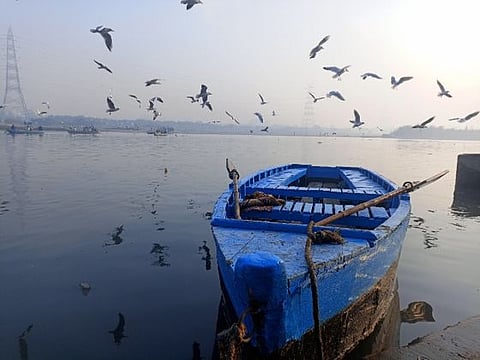
The Yamuna River no longer reliably delivers essential ecosystem services
Saurabh; Wikimedia Commons

For centuries, the Yamuna has been far more than a river. Flowing from the Himalayas through some of north India's most densely populated landscapes, it has supported agriculture, ecosystems, livelihoods, cities and cultural traditions. Its waters have sustained communities for generations and shaped the growth of settlements along its banks.
Today, however, the river tells a different story. Toxic foam drifts across its surface, wetlands are disappearing, floodplains are shrinking, and concrete continues to spread across landscapes that once absorbed, stored and filtered water. While pollution has long dominated discussions around the Yamuna's decline, new research suggests that a deeper transformation is underway. The river's crisis is increasingly being driven by changes in the landscape itself.
A recent study published in Environmental and Sustainability Indicators offers one of the most detailed assessments to date of how land use and land cover changes are reshaping the Upper Yamuna Basin and undermining river health in Delhi. The study by Neenu and Mitthan Lal Kansal, titled, ‘Multi-level intensity analysis of LULC change in the Upper Yamuna Basin and its impact on river health in the Delhi region’, examines two decades of landscape change between 2004 and 2024 and reveals how urban growth is steadily eroding the ecological foundations that sustain the river.
Its findings are stark. Built-up areas are rapidly replacing water bodies, vegetation, cropland and barren land. Water bodies continue to shrink. Vegetation loss remains substantial despite limited gains through afforestation. Pollution loads are increasing as urban expansion intensifies. Most significantly, the study concludes that the Yamuna in the Delhi region "no longer reliably delivers essential ecosystem services".
As Delhi and its surrounding districts continue to expand, while climate variability, groundwater depletion and pollution intensify, the study serves as both a diagnosis and a warning. Current models of urban growth in the Yamuna basin, it argues, are fundamentally incompatible with long-term river sustainability.
The scale of change documented by the study is striking. Across the Upper Yamuna Basin, built-up areas increased by 130 percent between 2004 and 2014 and by a further 28 percent between 2014 and 2024. In the Delhi region, urban land became the dominant land use category after 2014, overtaking cropland.
By 2024, built-up land occupied nearly 48.5 percent of the Delhi region analysed in the study, compared with 42.7 percent under cropland. Across the wider basin, cropland still covers more than half the area, but the long-term trend points towards continued conversion of agricultural and ecological landscapes into settlements and infrastructure.
Unlike conventional mapping exercises that simply show how much land has changed, the study uses an "intensity analysis" approach to identify which land categories are changing most rapidly and which ecosystems are being targeted by urban expansion.
The results show that between 2004 and 2014, Delhi's expanding built up areas primarily replaced vegetation and water bodies. During the following decade, urban growth increasingly spread into barren land and rangelands, indicating that expansion now extends into virtually every available land category.
Across the broader Upper Yamuna Basin, built-up areas consistently expanded into cropland and water bodies. This trend is particularly worrying because it indicates that hydrologically sensitive landscapes are being systematically absorbed into urban systems.
These changes have consequences that extend far beyond land statistics. River basins function as interconnected ecological systems. When wetlands, floodplains, vegetation buffers and groundwater recharge zones are replaced by impermeable surfaces, the hydrology of the basin changes fundamentally. Surface runoff increases, groundwater recharge declines, pollution moves more rapidly through the landscape and river flows become increasingly unstable.
Although the pace of change slowed slightly after 2014, likely because less land remains available for conversion, the study projects continued expansion of built-up areas until at least 2054.
Among the study’s most troubling findings is the sustained decline of water bodies throughout the Upper Yamuna Basin and Delhi region. Water bodies in the basin shrank from 1.36 percent of the total area in 2004 to just 0.62 percent by 2024. In Delhi, they declined from 1.88 percent to 1.60 percent over the same period.
The future projections are even more severe. Using Cellular Automata-Artificial Neural Network (CA-ANN) modelling, the researchers forecast that water bodies in the basin could decline by more than 40 percent between 2024 and 2034 alone. By 2054, only a fraction of current aquatic systems may remain.
This loss of water bodies is not simply an ecological concern. It directly affects flood moderation, groundwater recharge, biodiversity, urban cooling, pollution dilution, and environmental flow maintenance.
The Yamuna’s hydrology is already under acute stress. The study documents how increasing water abstraction, expanding sewage discharge, and declining environmental flows have pushed the river towards ecological dysfunction. Delhi now withdraws enormous quantities of water through barrages such as Wazirabad and Okhla, while simultaneously discharging massive volumes of untreated or partially treated wastewater back into the river.
The numbers are stark. According to the study, untreated effluent volumes in Delhi increased from 70 million gallons per day (MGD) in 2004 to 242 MGD in 2024. The Yamuna receives approximately 688 MGD of effluent through 22 drains, with the Najafgarh drain alone contributing 453 MGD.
Reduced freshwater flows mean the river increasingly lacks the capacity to dilute these pollutants. This has resulted in recurrent toxic foam episodes near the Okhla barrage and worsening water quality downstream.
The paper also highlights the transformation of natural river systems into drainage infrastructure. The Sahibi River, for example, has effectively become the Najafgarh drain — a symbol of how urbanisation has converted ecological assets into polluted wastewater channels.
Agricultural activity within the floodplain further compounds the problem. Around 2500 small farms continue operating along the Yamuna floodplain in Delhi, contributing fertilisers, pesticides, and nutrient runoff into the river system. As conventional sewage treatment systems are often unable to remove emerging contaminants effectively, these combined pollution sources create severe cumulative ecological stress.
The study’s broader message is that river degradation in Delhi cannot be understood solely as a wastewater management problem. It is fundamentally a land-use governance crisis.
The study strongly links land use change with growing climate vulnerability in Delhi and the wider Upper Yamuna Basin. Rapid urbanisation, loss of vegetation, and the expansion of impervious surfaces are increasing urban heat, altering natural water flows, and raising flood risks.
Land surface temperatures in Delhi rose sharply between 2001 and 2021, increasing from 36.58°C to 41.81°C in urban areas. The study associates this rise with declining green cover and the rapid spread of built-up areas. At the same time, concretisation has reduced the land's ability to absorb water and increased surface runoff, making urban flooding more frequent and severe. The record-breaking Yamuna flood of 2023 highlighted how fragile the city's hydrological balance has become.
The research argues that climate resilience cannot be separated from land use planning. Current patterns of urban growth are becoming major drivers of both climatic and hydrological instability across the basin.
The loss of wetlands and floodplains is at the heart of Delhi's growing vulnerability. Natural floodplains act as sponges that slow floodwaters, support groundwater recharge, and sustain biodiversity. When these areas are replaced by roads, buildings, embankments, and riverfront infrastructure, their ecological buffering capacity is lost.
Najafgarh Lake offers one of the clearest examples of this transformation. Once spread across 226 square kilometres, the lake has shrunk to around 7 square kilometres because of fragmentation, encroachment, and land conversion.
Groundwater depletion is another serious consequence. As the gap between Delhi's water demand and supply continues to grow, dependence on groundwater extraction has increased. The study notes that groundwater levels have fallen by 20 to 30 metres across large parts of the city.
These changes are creating a dangerous cycle. Declining groundwater reserves and worsening surface water quality increase reliance on water transfers from distant sources, while rising temperatures and climate variability continue to drive up water demand. Together, these pressures are weakening the ecological foundations that sustain both the Yamuna and the city that depends on it.
One of the study’s most important findings is that the Yamuna cannot be restored by focusing only on Delhi’s stretch of the river. Changes in land use across the wider Upper Yamuna Basin directly affect river health downstream, making basin-scale planning essential.
The authors argue that river restoration efforts must move beyond a narrow focus on wastewater treatment and adopt an integrated approach that combines hydrology, ecology, urban planning, and land use regulation. Sewage treatment plants alone cannot revive the river if wetlands, floodplains, recharge zones, and riverside vegetation continue to disappear.
The study calls for greater investment in nature-based solutions such as wetlands, bioswales, urban forests, permeable landscapes, and ecological buffers. It also highlights the need to improve water quality in major drains entering the Yamuna, including the Najafgarh, Shahdara, Barapulla, Main Drain No. 2, and Drain No. 6. Integrated treatment systems and decentralised wetlands can help reduce pollution while enabling the reuse of treated wastewater for non-potable purposes.
The study stresses that stronger land use governance is critical for the Yamuna’s future. Despite repeated regulations and court interventions, encroachment on floodplains continues. Enforceable zoning laws are needed to prevent permanent construction in ecologically sensitive areas and safeguard the river’s natural buffers.
Urban planning in Delhi and the NCR must also account for ecological carrying capacity rather than prioritising land monetisation and infrastructure expansion. Future projections indicate that built-up areas will continue to replace cropland and natural ecosystems unless clear safeguards are established for vegetation, water bodies, and agricultural land.
Urban greening should become a central climate adaptation strategy through native tree plantations, rooftop gardens, biodiversity corridors, and the restoration of degraded commons. At the same time, India needs a stronger national framework for wastewater reuse, supported by clear standards, incentives, and monitoring systems to reduce pressure on freshwater resources.
The study ultimately argues that the Yamuna’s decline is not only a pollution crisis but also a consequence of large-scale landscape transformation. Rivers deteriorate when the ecosystems that sustain them are steadily removed. The Upper Yamuna Basin is approaching a point where urban growth, hydrological stress, ecological degradation, and climate vulnerability reinforce one another. Without stronger ecological regulation of land use, restoration efforts may continue to address symptoms while the underlying causes of river decline remain unresolved.
The Upper Yamuna Basin is now approaching a tipping point where urban growth, hydrological stress, ecological decline, and climatic vulnerability are reinforcing one another. Unless land-use transitions are brought under ecological regulation, future river restoration investments may continue treating symptoms while the underlying drivers worsen unchecked.
The Yamuna’s future will ultimately depend not only on cleaning drains or building treatment plants but also on whether India is willing to redesign urban growth around ecological limits rather than against them.