
- Topics
- Feature
- Opportunities & Events
- About
- Hindi Portal
- Data
- Topics
- Feature
- Opportunities & Events
- About
- Hindi Portal
- Data
A Gangetic river dolphin (Platanista gangetica) surfaces as a fisherman holds his net at the water’s edge.
Roujat Ul Hussain Mondal

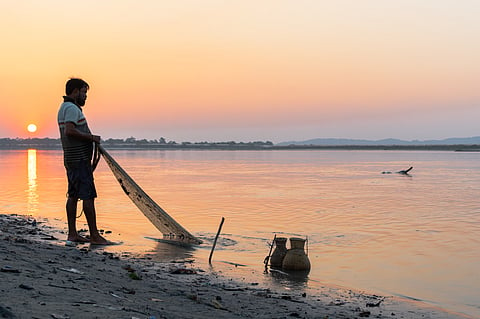
At Khanamukh, on the outskirts of Guwahati in Assam, fishing begins as the floodwaters fall. Fish leave Deepor Beel, a Ramsar-listed wetland, and move down the Khanajan, the channel that drains it into the Brahmaputra. Where the channel meets the river, fish gather in the shallows. For about two months after the monsoon, fishermen from Dharapur and Garigaon cast their nets along the banks. They have been coming here for generations, many to catch fish for the kitchen rather than the market.
The Gangetic river dolphins follow the fish too. Sometimes a dolphin drives fish towards a cast net. Sometimes fish slip past the net and into the path of a dolphin. It's an unusual encounter between people and wildlife, brought about by the seasonal movement of fish.
The fishermen say there is less to bring home now. Some remember days when they could catch two or three kilos. These days, even 250 grams can feel like a good catch. There are concerns about growing pollution in the river, and a sluice gate now stands across the Khanajan. Has the gate changed how freely fish can move between Deepor Beel and the Brahmaputra?
If fewer fish pass through these shallows, what will become of the tradition that brings people back each year? And what might that mean for the dolphins that feed here? For now, the nets still arc over the water. Not far from them, a dolphin surfaces.
An aerial view of the Khanajan tributary meeting the Brahmaputra at Khanamukh.
Roujat Ul Hussain Mondal
Deepor Beel, a Ramsar-listed wetland, provides habitat where fish can breed and grow. The Khanajan connects those habitats to the Brahmaputra and to the shallows where fishermen and dolphins gather after the monsoon.
Roujat Ul Hussain Mondal
Fishermen from the nearby villages of Dharapur and Garigaon gather at Khanamukh for around two months after the monsoon.
Roujat Ul Hussain Mondal
Fishermen spread out along the banks of the Khanajan, casting their nets into the shallows.
Roujat Ul Hussain Mondal
The fishermen cast from the bank while the dolphins chase fish through the same stretch of water
Roujat Ul Hussain Mondal
They use a circular cast net called a khewali jal, also known as an asora jal.
Roujat Ul Hussain Mondal
They keep their catch in a bamboo basket called a khaloi.
Roujat Ul Hussain Mondal
A fisherman displays a bhagon fish (Labeo bata) caught at Khanamukh.
Roujat Ul Hussain Mondal
People from nearby areas also come to the riverbank to watch the dolphins surface.
Roujat Ul Hussain Mondal
A Gangetic river dolphin breaks the surface near Khanamukh.
Roujat Ul Hussain Mondal
Local residents say dolphins sometimes enter the Khanajan from the Brahmaputra early in the morning and swim upstream towards the sluice gate, nearly a kilometre away.
Roujat Ul Hussain Mondal
Ramesh Chandra Das has fished at Khanamukh for more than eight decades. His account reflects the changing fishing conditions, declining catches and growing pressures on the Khanajan tributary.
Roujat Ul Hussain Mondal
Untreated wastewater enters the Khanajan, the tributary that connects Deepor Beel to the Brahmaputra.
Roujat Ul Hussain Mondal
Wetland health is vital for both fishermen and the dolphins along the Khanajan.
Roujat Ul Hussain Mondal
This photo essay was produced as part of the India Water Portal Regional Storytelling Fellowship 2026.