
- Topics
- Feature
- Opportunities & Events
- About
- Hindi Portal
- Data
- Topics
- Feature
- Opportunities & Events
- About
- Hindi Portal
- Data
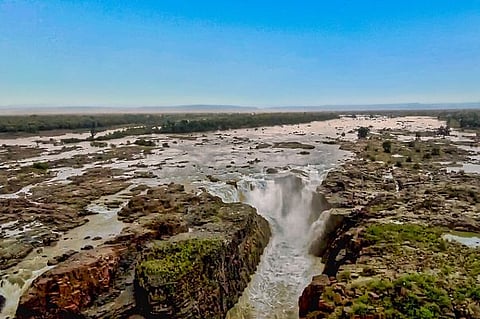
Ken river (Image: Sarah Welch)

There is a river in central India that was, until recently, spoken of mostly in terms of what it could give away. The Ken flows through Bundelkhand, a region long defined by drought, migration and the quiet arithmetic of survival. For decades, planners have looked at its waters and seen not a river to be protected, but a surplus to be moved to to the water-deficit Betwa River. That single word, surplus, now sits at the centre of one of India's most consequential and contested infrastructure decisions: the Ken Betwa Link Project, the first of thirty river interlinking schemes envisaged for the country.
As construction rises at the Daudhan dam site inside the Panna Tiger Reserve, so too do the questions it was meant to have already answered. Is there truly water to spare? What happens to a rebuilt tiger reserve, and to the people who call its edges home? And can a project this large keep moving forward while the legal ground beneath it remains unsettled?
More than a year after Prime Minister Narendra Modi laid the foundation stone at Khajuraho on 25 December 2024, the answers remain genuinely open. What follows is the story of a river, a reserve and a region caught between the promise of water security and the price that promise may demand.
From approval to foundation stone: a compressed timeline (prepared using Gemini AI)
The Ken Betwa Link Project is the first of thirty inter-basin water transfer links envisaged under India's decades-old National Perspective Plan, administered by the National Water Development Agency (NWDA). Its engineering core is the Daudhan Dam, a structure 77 metres high and 2.13 kilometres long, built on the Ken River inside the Panna Tiger Reserve in Madhya Pradesh and designed to hold 2,853 million cubic metres of water.
From there, a 221-kilometre link canal, together with two tunnels measuring 1.9 kilometres and 1.1 kilometres, would carry the river's so-called surplus water westward into the Betwa in Uttar Pradesh. Both rivers are tributaries of the Yamuna and, further downstream, part of the Ganga system.
The stated purpose is to solve the chronic drought cycles of the Bundelkhand region, which straddles the Madhya Pradesh–Uttar Pradesh border and has long been synonymous with agrarian distress, farmer suicides, and seasonal migration. Government figures put the promised benefits at drinking water for roughly 44 lakh people in Madhya Pradesh and 21 lakh in Uttar Pradesh, irrigation for 9.08 lakh hectares of farmland benefiting more than 7 lakh farming families across roughly 2,000 villages, plus 103 MW of hydropower and 27 MW of solar generation. The project was formalised through a March 2021 tripartite agreement between the Centre, Madhya Pradesh, and Uttar Pradesh, and it is scheduled for completion by March 2030.
As of July 2026, the Union Cabinet has approved full funding and implementation at a cost of ₹44,605 crore, and construction is advancing at the Daudhan dam site. The government continues to describe the project as one of national importance, with officials stressing job creation, hydropower and an end to Bundelkhand's water scarcity. The Ken Betwa Link Project Authority's Steering Committee has continued to meet through 2026, with officials publicly emphasising efforts to protect biodiversity even as construction clearances have already been exercised.
That framing of national importance and farmer welfare is the lens through which the government wants the project understood. It is also, almost point for point, the lens contested by critics on hydrological, ecological, legal and human rights grounds.
Yet the renewed momentum has unfolded alongside persistent controversy. In recent weeks, tribal communities have resumed protests, including a fortnight-long hunger strike that was broken up by police. Legal challenges remain pending before the National Green Tribunal (NGT) and the Supreme Court. Adding to the debate is the finding of a Supreme Court-appointed expert panel, which concluded several years ago that the project may be economically unviable and that its central assumption of surplus water remains unproven.
Map of Ken-Betwa link (Image created using Gemini AI)
The single most consequential challenge to the Ken Betwa Link Project is one that predates 2026 but has hardened rather than faded with time. The entire project rests on the premise that the Ken basin generates water surplus to its own needs, safely transferrable to the water-short Betwa basin.
The Supreme Court's Central Empowered Committee challenged this directly in its 2019 report, finding that projecting a transferrable surplus without first exhausting irrigation possibilities within the upper Ken basin itself was "premature", particularly given the scale of public investment involved. The committee suggested that Bundelkhand's stated goals of irrigation and poverty alleviation could instead be achieved through cheaper, local water conservation and harvesting measures, and that once the costs of tiger conservation and species recovery programmes for vultures and gharials were properly accounted for, the project's economics could look very different.
River researchers have pressed the point further. Himanshu Thakkar of the South Asia Network on Dams, Rivers and People has stated plainly that "there is no surplus water in the Ken Basin." He has also pointed to a claim with real bearing on how the project should be understood: that the project's own Detailed Project Report reportedly admits its primary objective is not to serve drought-hit Bundelkhand villages but to transfer water to the upper Betwa basin districts of Raisen and Vidisha, which lie outside the Bundelkhand region entirely. If accurate, this represents a significant gap between the project's public justification and its documented purpose.
Independent hydrologists have also been unable to fully verify basin flow data, which, because the Ken and Betwa eventually feed the Ganga system flowing into Bangladesh, has reportedly been treated as sensitive on national security grounds, limiting outside scrutiny of the core assumption on which the entire project rests.
A separate and more recent critique has come from atmospheric scientists rather than river engineers. Climate researchers at IIT Bombay have flagged the risk of land-atmosphere feedback disruptions, the concern that large-scale submergence and land-use change in the Ken basin could itself alter regional rainfall patterns, potentially undermining the very water availability assumptions the project depends on. Critics also note that climate change is producing more erratic, short-duration flow spikes in Indian rivers, which can create a statistical illusion of surplus that does not reflect reliable, sustainable, year-on-year water availability.
The project's geography compounds the hydrological doubts. The Daudhan dam and much of its submergence zone sit inside the Panna Tiger Reserve, a park that lost its entire tiger population by 2009 and was rebuilt through one of India's most celebrated tiger reintroduction programmes. It is now home to roughly 60 to 70 tigers.
Estimates of the ecological toll vary but are consistently severe. Official assessments put submergence at around 90 square kilometres of the reserve and 7.2 lakh trees. A more recent compilation puts the figure at 98 square kilometres of forest, along with impacts on gharials and vultures. A Forest Advisory Committee sub panel has cited figures of up to 23 lakh trees requiring felling, and some accounts put the number as high as 2 to 4 million trees across the wider Panna landscape.
The state government's own estimate suggests that 40 percent of the reserve's area could be irretrievably damaged, with around 18 lakh trees, a significant carbon sink, removed from the submergence area. The Central Empowered Committee's language on the reserve's ecological significance was unusually stark for an official report, warning that implementing the project would cause "the complete breakdown of the evolutionary processes of millions of years."
To compensate for this habitat loss, planners proposed folding three additional wildlife sanctuaries into an expanded conservation landscape, formalised as an integrated landscape management plan for the greater Panna landscape. One of these three, the Veerangana Durgavati Wildlife Sanctuary, was itself notified as a tiger reserve in 2023. Yet in January 2026, the Standing Committee of the National Board for Wildlife approved diverting roughly 272 hectares of forest land inside that very reserve for an irrigation dam tied to the broader river-linking programme.
Critics see this as illustrative of a deeper pattern, in which land earmarked to compensate for habitat loss is consumed by the same infrastructure logic it was meant to offset. Biodiversity loss beyond tigers, including sloth bear, leopard, rusty spotted cat, hyena, sambhar, chital, four-horned antelope and chinkara, along with the caves, gorges and rock crevices of the Ken basin that serve as irreplaceable breeding and shelter sites, has received comparatively little institutional attention since valuation frameworks remain built almost entirely around the tiger as a flagship species. The project's submergence zone also overlaps with the Ken Gharial Sanctuary, adding the critically endangered gharial to the list of species whose recovery costs the Central Empowered Committee flagged as unaccounted for.
Running beneath the entire project is a legal contest that has arguably never closed, even as construction has proceeded. Public interest litigation challenging the project's environmental clearance remains pending before the National Green Tribunal, and questions about the validity of its wildlife clearance, first flagged by the Supreme Court's own Central Empowered Committee in 2019, are still before the apex court.
The South Asia Network on Dams, Rivers and People has pointed out that the project's Stage II Forest Clearance was granted subject to conditions that would materially alter the project's basic parameters, conditions that critics argue should trigger a fresh Environmental Impact Assessment and fresh clearances altogether, rather than being treated as a formality.
Even at the point of Cabinet funding approval in 2022, Thakkar told NewsClick the move was "illegal as the Supreme Court is yet to give its order" based on the Central Empowered Committee's report, since final forest, environmental and wildlife clearances had not been secured. A Tribune editorial made the same procedural argument more directly, concluding that "the Cabinet should not have cleared the project." In effect, physical construction has advanced at pace even as the legal foundation beneath several of its core approvals remains contested, a sequencing critics describe as a fait accompli strategy, in which facts on the ground pre empt judicial or regulatory reconsideration.
India's first river-interlinking project faces fierce legal, environmental, and human rights battles (Image: Khabar Lahariya, X Handle)
If the ecological and legal debates are years old, the human displacement crisis has become acute and immediate through 2026. Construction activity near Dhondhan village, where the dam is rising, has intensified efforts to move tribal communities out of the submergence zone, and local resistance has escalated in step.
On 8 April 2026, tribal women in Dhondhan staged a symbolic pyre protest, known as 'chita satyagraha', warning that the conditions of displacement were worse than death itself and alleging that the resettlement process violated both the Forest Rights Act and the transparency requirements of the 2013 land acquisition law. That protest cooled temporarily after state assurances but reignited on 3 July 2026, when villagers again staged chita andolan alongside other forms of resistance, including jal satyagraha, a water-based protest; mitti satyagraha; and a symbolic faansi satyagraha in which women wore nooses around their necks, warning they would rather die than accept the terms on offer.
The state government's response has combined incremental concessions with eventual force. In Chhatarpur district, an official review ordered on 15 April 2026 led to village-wise resurveys, with 3,080 families initially sanctioned benefits and 638 more approved after fresh surveys. The rehabilitation package was later raised to ₹12.5 lakh per family. Protesters rejected this as inadequate, insisting their objection was fundamentally about the loss of ancestral land, not merely its price.
The dispute escalated into a fifteen-day hunger strike and sit-in on the banks of the Barana River near Kupi village, which ended abruptly on 19 and 20 July 2026, when police cleared the protest site. Protest leaders alleged that organiser Amit Bhatnagar, who had been on hunger strike for fourteen days, along with other demonstrators, was detained by police. Additional Superintendent of Police Aditya Patle rejected this account, stating: "We have neither arrested nor detained any protester." He said Bhatnagar was taken to hospital for a medical check given his deteriorating health, with the rest of the participants sent back to their villages.
Rights groups, including the National Alliance for Climate and Environmental Justice, have since condemned what they describe as the suppression of a democratic movement and violations of constitutional rights, explicitly linking the Ken Betwa displacement to grievances at two other regional irrigation schemes, Majhgaon and Runjh, where similar allegations of inadequate rehabilitation have surfaced.
Bundelkhand's water distress is real, longstanding, and has driven genuine human suffering. The project's supporters are not inventing a problem. But the specific solution chosen carries costs that are significant and, in key respects, irreversible: the deliberate flooding of a rebuilt tiger reserve; the displacement of tribal communities whose legal protections under forest and land acquisition law are contested as inadequately honoured; and a hydrological premise, that of basin surplus, which the Supreme Court's own expert committee found insufficient. established as far back as 2019, and which some analysts now argue may primarily serve districts outside the very region the project claims to rescue.
The government's position rests on an essentially utilitarian argument: that aggregate welfare gains for millions of drought-affected people justify concentrated, severe costs borne by a comparatively small number of forest-dependent and tribal households and by a fixed quantity of irreducible wildlife habitat. Opponents contest both halves of that calculation, disputing the reliability of the benefit estimates while arguing that the costs, once incurred, cannot be undone in the way the benefits are not guaranteed to materialise at the scale projected.
Layered on top of this substantive dispute is a procedural one: whether a project can legitimately advance to full construction while its foundational wildlife and forest clearances remain under active judicial challenge, a question the National Green Tribunal and Supreme Court have yet to resolve conclusively, even as the Daudhan dam continues to rise.
Because the Ken Betwa Link Project is explicitly designed as the pilot for twenty-nine further planned river links across India, its outcome carries weight well beyond Bundelkhand. How the rehabilitation disputes are ultimately resolved, what the National Green Tribunal and Supreme Court decide on the outstanding clearance challenges, and whether the promised irrigation and drinking water benefits materialise at anything like the scale projected will together determine whether river interlinking becomes a template the country repeats or a cautionary tale it revisits.
As of July 2026, with construction advancing and protest cycles recurring roughly every few months, that verdict remains open. What is certain is that the river at the centre of it, and the people and wildlife who depend on it, are still waiting for an answer.
