
- Topics
- Feature
- Opportunities & Events
- About
- Hindi Portal
- Data
- Topics
- Feature
- Opportunities & Events
- About
- Hindi Portal
- Data
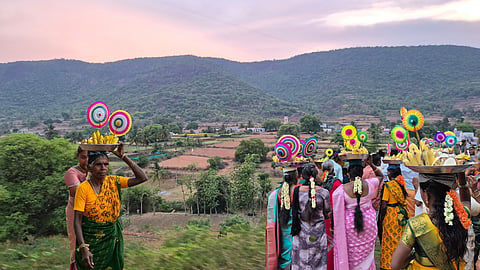
Kempakarai rests in a forested valley, where farms, homes, and water sources shape life at the edge of the wilderness.
Photo Collage: Sharat Chandra Prasad

By late April, when streams shrink to isolated pools and wells begin to recede under the summer heat, residents of Kempakarai gather around the village stepwell. They come carrying harvest produce, coconuts, prayers, and memories. For three days, this forest-fringed settlement in Krishnagiri district celebrates not only a harvest but also the water sources that make life possible.
Nestled between the Manchi and Kodekare hills in Tamil Nadu’s Krishnagiri district, Kempakarai sits at the edge of the Cauvery South Wildlife Sanctuary. A single road connects the village to the outside world before disappearing into forests frequented by wildlife.
The village is inhabited by Vanniyar, Kurumba, and Irula communities. The Kurumba and Irula are among Tamil Nadu's recognised Scheduled Tribes, while the Vanniyar community belongs to the state's Most Backward Class category. Agriculture remains the foundation of local livelihoods, with farmers cultivating ragi, sugarcane, banana, maize, and vegetables. Yet every crop depends on one uncertain factor – water.
Only small pools of water remain in a village stream as summer peaks, underscoring the community’s dependence on the monsoon for water and farming
Picture credit: Sharat Chandra Prasad
By late April, wells begin to shrink under the summer heat. Streams slow to a trickle. The arrival of the monsoon becomes a matter of hope as much as expectation. It is during this period that Kempakarai gathers for its annual three-day festival dedicated to water.
More than a harvest celebration, it is a community prayer for rainfall and a collective expression of gratitude to the water sources that sustain village life. Farmer, village head, and priest, Senthil Manickam, explains its significance simply by saying, “We do this every year for rain, for water, for land. Without that, we would have nothing.”
A ritual sprinkling of water marks the beginning of the celebrations, symbolising purification, gratitude, and prayers for timely rainfall.
Picture credit: Sharat Chandra Prasad
Days before the festival begins, Kempakarai turns its attention to its most important task: caring for its water sources. Villagers come together to clear roads, repair pathways, repaint the temple, and clean the village well and nearby water bodies. The preparations are shared across households, reflecting a belief that water must be cared for collectively long before it is celebrated ritually.
For over six decades, Amma has watched generations gather for the festival, helping ensure that its customs and rituals are carried forward
Picture credit: Sharat Chandra Prasad
Among those overseeing the work is Unamalai, affectionately known as Amma. For more than six decades, she has witnessed the festival and helped guide its customs.
Though age now keeps her from participating in every activity, she remains a watchful presence, observing the preparations from outside her home as people move through the village. “Earlier we were all active during this festival. Now I can only sit and see. But everything must happen properly. This festival is for all of us,” she says.
Women sort grains and vegetables for rituals honouring water, rain, and harvests.
Picture credit: Sharat Chandra Prasad
Inside their homes, families prepare offerings from the harvests that have sustained them through the year. Akhila, Senthil’s wife, joins other women in sorting grains, cutting vegetables, and setting aside produce for the rituals. “Whatever harvest we earn in a year, we give a small part back. It is not much, but it is our way of thanking,” she says.
A torchlit procession with Drums and prayers accompanies villagers on their journey to the Maha Kali temple at night.
Picture credit: Sharat Chandra Prasad
As the festival draws closer, relatives and friends begin arriving from Bengaluru, Mysuru, Chennai, and nearby towns. Homes fill with guests, courtyards echo with conversation, and children reunite with cousins they may not have seen for months. With each passing day, the village grows more vibrant, transforming the annual water festival into a gathering that reconnects families, friendships, and generations.
Seasonal produce is prepared for offerings that celebrate abundance and seek rainfall
Picture credit: Sharat Chandra Prasad
The offerings, which include bananas, maize, coconuts, grains, and other seasonal crops, reflect the agricultural landscape surrounding Kempakarai. More than symbols of abundance, they are acknowledgements of the water and rainfall that make every harvest possible.
The first day’s rituals begin late at night. Around 10 pm, villagers gather with baskets of harvested produce before setting out towards the Maha Kali temple. Women carrying flaming torches lead the procession through narrow pathways as the steady beat of the parai drum reverberates across the valley. Children walk beside elders, while others dance or move quietly through the darkness.
Villagers carrying torches move through the streets as festivities begin.
Picture credit: Sharat Chandra Prasad
After offering prayers at the temple, the procession makes its way to the village stepwell, the focal point of the festival and the water source around which the celebrations revolve. Here, coconuts, bananas, and a portion of the season’s harvest are offered in gratitude and in prayer for timely rains, sufficient water, and a successful farming season.
The Maha Kali temple of Kempakarai is cleaned with water and decorated with fairy lights for the festival celebrations.
Picture credit: Sharat Chandra Prasad
The ceremony is modest but deeply symbolic. Villagers draw water from the stepwell and share it among themselves, recognising its importance in sustaining crops, livestock, and everyday life throughout the year. Standing besides the well, Senthil reflects on its significance, saying, “Water is everything here. Even if it is less, we still come and give thanks.”
Villagers gather around the stepwell, sharing water and prayers for the season ahead.
Picture credit: Sharat Chandra Prasad
The timing of the festival is significant. Held at the peak of summer, when wells and streams are often at their lowest levels, the ritual expresses both gratitude for the water that remains and hope for the monsoon that is yet to arrive.
In a village where agriculture depends largely on rainfall, sharing water from the stepwell becomes a reminder of both abundance and uncertainty and of the community’s enduring connection to the source that sustains it.
The village stepwell becomes the centre of prayers for the coming monsoon.
Picture credit: Sharat Chandra Prasad
The second day begins before sunrise. Across Kempakarai, elderly women collect water from wells and nearby sources while households prepare offerings using seasonal harvests and forest produce. As the village awakens to birdsong, footsteps, and morning conversations, cooking begins in homes across the settlement.
Unamalai carries water from the stepwell, preparing for the rituals of the harvest festival.
Picture credit: Sharat Chandra Prasad
By mid-morning, groups of women set out along narrow forest paths carrying baskets filled with food, harvested crops, and water. The walk itself forms an important part of the ritual, connecting the village’s wells, fields, forests, and farms in a shared expression of gratitude and prayer.
At first light, villagers gather water and prepare offerings from fields and forests
Picture credit: Sharat Chandra Prasad
At a clearing in the forest, each woman places her offering quietly, seeking good rainfall, healthy harvests, and the wellbeing of her family before the onset of the monsoon. After completing the ritual, Akhila says, “We ask for good rain, crops, and health. That is all.”
Morning preparations begin across Kempakarai with water collection, cooking, and harvest offerings.
Picture credit: Sharat Chandra Prasad
Over a hundred women take part, moving through the forest in silence, conversation, and song. Their offerings reflect a shared recognition that farming, livelihoods, and daily life depend on the arrival of timely rains and the availability of water.
Women carry offerings through the forests and fields, praying for rain, water, and wellbeing.
Picture credit: Sharat Chandra Prasad
Watching from nearby, Senthil reflects on how the seasons have changed over the years. “This is how it has been. Now rain is not certain like before, but we continue.” His words capture both concern and resilience. As rainfall patterns become increasingly unpredictable, the ritual remains a way for the community to reaffirm its connection to the water, land, and forests that sustain life in Kempakarai.
Through forest paths, villagers carry hopes for water, crops, and wellbeing.
Picture credit: Sharat Chandra Prasad
The rituals in Kempakarai are rooted in everyday realities rather than symbolism alone. They reflect an understanding that water, forests, soil, and agriculture are deeply interconnected and that the wellbeing of one depends on the health of the others.
Despite uncertain rains, the community returns each year to honour water.
Picture credit: Sharat Chandra Prasad
Filmmaker Sam Venkat, who has documented the village and its annual celebrations, says, “The festival mirrors the relationship people maintain with the natural systems around them. Rainfall determines whether crops thrive or fail. Wells sustain households through the dry months. Forests influence livelihoods, shape local ecosystems, and often define the risks that communities must navigate.”
Unamalai cuts and gathers fodder in the fields, part of the daily work that continues alongside the festival.
Picture credit: Sharat Chandra Prasad
For Venkat, the festival is an acknowledgement of these interdependencies. The prayers for rain and water emerge from lived experience, where farming, food security, and daily life remain closely tied to the rhythms of nature.
By the third day, the focus shifts from ritual to reunion. Families visit one another’s homes, share festive meals, and exchange stories about farming, weather, work, and life beyond the village. Relatives, friends, and former residents who have travelled from Bengaluru, Mysuru, Chennai, and neighbouring towns spend time reconnecting with one another and with the landscape they return to each year.
Families and visitors reunite, sharing meals, memories, and stories across generations.
Picture credit: Sharat Chandra Prasad
As evening falls, the village gathers in an open space. There is no stage, programme, or formal performance. Music begins, children join the dancing, and soon the entire gathering becomes part of the celebration. Watching from a distance, Amma smiles as generations mingle across the open ground. She says, “This is our time. After one year of work, we sit together.”
Relatives and friends gather annually, reaffirming connections to water, heritage, and home.
Picture credit: Sharat Chandra Prasad
The festival reinforces bonds that extend far beyond Kempakarai itself. It brings together people connected by family, memory, and shared dependence on the village’s water sources. In returning each year, they renew not only social ties but also a collective relationship with the land, the forests, and the water that continue to sustain life in the valley.
Music, dance, and shared memories bring generations together on the festival’s final evening.
Picture credit: Sharat Chandra Prasad
The festival unfolds against a landscape where water can never be taken for granted. Agriculture in Kempakarai depends largely on rainfall, wells, and seasonal streams. Yet villagers say the seasons have become less predictable. Summers are longer, water levels fall before the monsoon arrives, and farming decisions increasingly depend on uncertain weather.
Harvested fields stretch across the valley below as Kempakarai prepares for its annual festival dedicated to water, rain, and renewal.
Picture credit: Sharat Chandra Prasad
Life is shaped not only by water availability but also by the realities of living within a wildlife landscape. Elephants frequently move through fields and along the narrow road connecting the village to nearby towns, affecting both cultivation and access to markets.
Elephants crossing fields and roads shape farming decisions and daily village life.
Picture credit: Sharat Chandra Prasad
For farmers, harvest time often means sleepless nights spent guarding crops. “When the crop is ready, we have to watch more. Sometimes we stay awake at night. If animals come, we cannot do much,” says Senthil.
These experiences give deeper meaning to the prayers offered during the festival. They are rooted in everyday concerns about rainfall, water availability, crops, and livelihoods. In Kempakarai, asking for rain is not simply a ritual tradition. It is an expression of hope shaped by lived realities.
As the three-day festival draws to a close, visitors begin their journeys home, decorations are taken down, and the village returns to its daily rhythm. The fields, wells, forests, and pathways that formed the backdrop to the celebrations once again become part of everyday life.
Yet the festival leaves behind a powerful message. In Kempakarai, water is not viewed merely as a resource. It is woven into community life, agriculture, memory, and cultural identity. From cleaning the village well before the festivities begin to sharing water from the stepwell and offering prayers for rain, every ritual reflects a collective commitment to caring for the sources that sustain life.
The festival ends and visitors depart carrying memories of a celebration rooted in water stewardship throughout the year and a sense of belonging.
Picture credit: Sharat Chandra Prasad
At a time when conversations about water often focus on infrastructure, technology, and scarcity, Kempakarai offers a different perspective. It reminds us that water stewardship also begins with relationships between people and place, between communities and the ecosystems on which they depend.
The annual gathering is therefore more than a harvest festival. It is a collective act of gratitude towards water and a reaffirmation that safeguarding rivers, wells, springs, and rainfall starts with recognising their value before they are under threat. In celebrating water together, the people of Kempakarai keep alive a tradition of care that remains as relevant today as ever.