
- Topics
- Feature
- Opportunities & Events
- About
- Hindi Portal
- Data
- Topics
- Feature
- Opportunities & Events
- About
- Hindi Portal
- Data
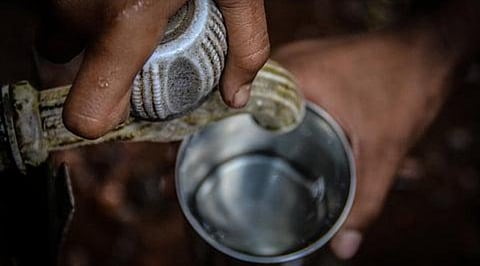
Access to safe drinking water in the North East (Image Source: IWP Flickr photos).

Access to safe drinking water, sanitation and hygiene (WASH) is essential for good health and quality of life. Reliable water and sanitation facilities can reduce infectious diseases, improve nutrition and support maternal and child health. Inadequate access, on the other hand, is associated with diarrhoeal diseases, acute respiratory infections, undernutrition, anaemia and other preventable health conditions, particularly among vulnerable populations.
In India, government programmes such as the Swachh Bharat Mission (SBM), Jal Jeevan Mission (JJM) and Pradhan Mantri Ujjwala Yojana (PMUY) have improved sanitation coverage, household water supply and access to clean cooking fuel. However, significant differences in access remain between and within states.
Northeast India presents particular challenges. Its eight states have varied geographical and social conditions, including mountainous terrain, scattered settlements, ethnic diversity and ecologically sensitive landscapes. While some districts have made considerable progress, remote and rural areas continue to face difficulties because of geographic isolation, poor transport links, recurrent flooding and inadequate infrastructure.
A study authored by Khamnam Michael Meitei & Biswajit Das titled 'Spatial analysis of water sanitation and hygiene services and health outcomes in Northeast India using NFHS-5' published in Discover Public Health uses district-level data from the National Family Health Survey 5 (NFHS 5), conducted between 2019 and 2021, and examines the distribution of WASH facilities across the region, the factors associated with unequal access and the links between WASH conditions and health. It highlights why broad state-level assessments may not reveal the differences experienced by individual districts. This examines the spatial distribution, determinants, and health impacts of WASH across the districts of North-East India using data from the National Family Health Survey-5 (NFHS-5), 2019–21.
Spatial distribution of improved drinking water sources in North East. Image Source: Meitei and Das (2026) Spatial analysis of water sanitation and hygiene services and health outcomes in Northeast India using NFHS-5, Discover Public Health, 23:1474, p 5.
The study finds considerable differences in access to improved drinking water sources. While several districts have achieved high coverage, access remains moderate or low in many others. Forty-eight districts fall in the moderate to moderately low categories, while 12 have low to very low access.
Dibang Valley in Arunachal Pradesh reports 100 per cent access. Hojai, Darrang and Nalbari in Assam have coverage of 99.9, 99.7 and 99.5 percent respectively. Several districts in Sikkim and Mizoram also report near-universal coverage.
At the other end of the scale, Hailakandi in Assam has the lowest reported access at 41.2 per cent, followed by Cachar at 43.8 per cent and West Karbi Anglong at 44.7 per cent. Dima Hasao reports 50.2 percent and Karimganj 62.3 per cent.
In Manipur, access is low in Ukhrul (50.9 per cent), Tamenglong (51.6 per cent) and Churachandpur (62.5 per cent). North Garo Hills (51.5 per cent), South West Garo Hills (58.6 per cent) and South Garo Hills (60.4 per cent) in Meghalaya also report gaps. Longding in Arunachal Pradesh has 62.5 per cent access.
The study associates these differences with rugged terrain, scattered settlements, weak piped water infrastructure and difficulties in maintaining supply systems in remote areas. It suggests terrain-sensitive approaches, including gravity-fed systems, decentralised treatment and community-led maintenance, to improve access in districts with lower coverage.
Spatil distribution of sanitation facilities across the NorthEast. Image Source: Meitei and Das (2026) Spatial analysis of water sanitation and hygiene services and health outcomes in Northeast India using NFHS-5, Discover Public Health, 23:1474, p 17.
Sanitation coverage also differs widely across the region. Thirty-seven districts fall in the moderate category and 30 in the moderately high category. Nineteen districts have moderately low coverage, while 11 fall in the low category. Only seven districts report high coverage.
The lowest levels are concentrated in parts of Assam and Manipur. In Manipur, coverage ranges from 52.6 per cent in Bishnupur to 61.3 per cent in Thoubal. Imphal West reports 58.7 per cent and Imphal East 59.5 per cent.
In Assam, Cachar reports 57.6 per cent, South Salmara 59 per cent, Hailakandi 60 per cent, Karimganj 61.5 per cent, Dhubri 61.8 per cent and Morigaon 62.3 per cent. Unakoti in Tripura has 61.8 per cent coverage.
The study identifies rapid population growth, inadequate waste management, socioeconomic constraints and uneven programme implementation as factors associated with these gaps.
In contrast, several districts report high coverage. Champhai in Mizoram has 98.3 per cent, Serchhip 98.2 per cent, Kolasib 96.8 per cent, Aizawl 96.1 per cent and Lunglei 95.6 per cent. Mokokchung in Nagaland reports 96.7 per cent, while Dibang Valley in Arunachal Pradesh has 95 per cent. These differences point to the need for sanitation programmes that respond to local population pressures, infrastructure gaps and waste management requirements.
Spatial distribution of clean cooking fuel usage. Image Source: Meitei and Das (2026) Spatial analysis of water sanitation and hygiene services and health outcomes in Northeast India using NFHS-5, Discover Public Health, 23:1474, p 18.
Access to clean cooking fuel remains limited in many parts of the region, with ‘Moderate Low’ in 35 districts and ‘Moderate’ in 36 districts, showing restricted adoption. Twenty-nine districts fall in the moderate-high and high categories, while four districts show extremely poor adoption of clean cooking fuel.
The weakest adoption is concentrated in the districts of Meghalaya and Nagaland, such as:
Meghalaya: West Khasi Hills (8.6%), Southwest Khasi Hills (11.6%)
Nagaland: Longleng (11.8%), Mon (13.0%)
Here, households continue to rely on firewood, charcoal, and crop residues. Difficult terrain, low urbanisation, weak energy infrastructure, and socio-economic barriers limit access to LPG and electricity.
High adoption is seen mainly in the districts of Mizoram and Arunachal Pradesh, with strong urban influence and better infrastructure such as:
Mizoram: Aizawl (95.4%), Lunglei (79.9%), Kolasib (87.5%), Serchhip (81.8%), Champhai (79.4%)
Arunachal Pradesh: West Kameng (88.9%), Tawang (88.1%), Papum Pare (81.3%), Kra Daadi (78.3%)
Sikkim: East Sikkim (87.6%)
Assam: Dimapur (84.2%), Kamrup Metro (85.1%)
Manipur: Imphal East (79.0%)
The region thus shows a dual reality with persistent reliance on traditional fuels in hilly, rural districts of Meghalaya and Nagaland and near-universal adoption of clean fuels in urbanised, better-connected districts of Mizoram, Arunachal Pradesh, and parts of Assam and Sikkim. This highlights the need for targeted energy access programmes—expanding LPG distribution, improving electricity infrastructure, and addressing socio-economic barriers in low-adoption districts.
Spatial distribution of hygienic menstrual ptrotection usage. Image Source: Meitei and Das (2026) Spatial analysis of water sanitation and hygiene services and health outcomes in Northeast India using NFHS-5, Discover Public Health, 23:1474, p 19.
The study finds satisfactory menstrual hygiene practices in 69 districts, supported by better infrastructure, access and awareness. However, six districts fall in the low and very low categories.
The lowest levels are reported in West Jaintia Hills (32.6), East Jaintia Hills (47.9 per cent) and West Khasi Hills (48.9 per cent) in Meghalaya. Dhubri (48.8 per cent) and Hailakandi (56.1 per cent) in Assam and South Tripura (49.6 per cent) also face gaps.
Limited awareness, poor access to sanitary products, socio-cultural taboos and inadequate health and sanitation infrastructure contribute to these challenges.
Higher levels are reported in Arunachal Pradesh, where Siang has 98.1 per cent, Kurung Kumey 96.1 per cent, Lower Dibang Valley 96 per cent and Papum Pare 95.4 per cent. Champhai in Mizoram reports 95 per cent.
The findings point to the importance of making menstrual hygiene products more accessible and affordable, improving awareness through schools and communities, and strengthening local health infrastructure.
Composite WASH index across districts in the North East. Image Source: Meitei and Das (2026) Spatial analysis of water sanitation and hygiene services and health outcomes in Northeast India using NFHS-5, Discover Public Health, 23:1474, p 25.
To understand how these different indicators come together, the study uses a combined WASH score covering drinking water, sanitation, clean cooking fuel and menstrual hygiene.
The highest scores are concentrated in Mizoram and Arunachal Pradesh. Aizawl in Mizoram records 4.257, followed by Kolasib (4.011), Champhai (3.996), Serchhip (3.915), West Kameng in Arunachal Pradesh (3.526), Lunglei (3.516), Kra Daadi in Arunachal Pradesh (3.139) and Mamit in Mizoram (3.016).
The lowest scores are found in Assam, Meghalaya and Tripura. Hailakandi in Assam records −4.554, West Jaintia Hills in Meghalaya −4.550, Cachar in Assam −4.200, Karimganj in Assam −3.237 and Unakoti in Tripura −3.129.
These districts face multiple disadvantages, including weaker drinking water systems, inadequate sanitation, continued dependence on traditional cooking fuels and lower menstrual hygiene awareness. Geographic isolation, socio-economic constraints and limited infrastructure add to the challenges.
The combined score shows that districts with stronger WASH outcomes tend to perform better across several indicators, while those with lower scores face gaps in more than one area. This makes it important to address WASH deprivation as a connected set of challenges rather than treating each service separately.
The study also examines the relationship between WASH conditions and health outcomes. Its analysis finds that districts with better access to safe water, sanitation, clean cooking fuel and menstrual hygiene tend to report better child health outcomes.
Diarrhoea rates are lower in districts with stronger WASH conditions, while acute respiratory infections are lower where cleaner cooking practices are more common. Better WASH conditions are also associated with lower levels of underweight, stunting and wasting among children, as well as improvements in anaemia outcomes.
Maternal health indicators show similar associations. Districts with better WASH access report higher levels of postnatal care within two days of delivery, institutional births and skilled birth attendance.
Women's nutritional outcomes also improve, with fewer women reporting low body mass index and anaemia in districts with stronger WASH conditions.
The analysis further identifies women's education and electrification as important factors associated with better WASH access. These findings underline how household infrastructure and wider socioeconomic development are connected to health.
The findings show that improving WASH access across Northeast India requires more than expanding infrastructure uniformly. Districts face different combinations of geographical, social and institutional barriers, and interventions need to reflect these differences.
Areas with limited access to improved drinking water require reliable supply systems and regular water quality monitoring. Districts with poor sanitation coverage need household toilets, safe faecal sludge management and sustained behaviour change programmes.
Where menstrual hygiene practices remain limited, programmes should improve the availability and affordability of products and strengthen awareness through schools and communities. Districts with low access to clean cooking fuel need affordable energy options, wider LPG distribution and improved electricity infrastructure to support a shift away from traditional biomass fuels.
The study also highlights the importance of female education and electrification in improving household conditions. Addressing these wider factors alongside WASH infrastructure can help reduce inequalities and improve health.
The district-level findings make clear that progress in one part of the region does not necessarily reflect conditions elsewhere. Place-based planning, informed by local needs and the specific dimensions of deprivation, is essential to ensuring that improvements in water, sanitation, hygiene and household environmental health reach communities across Northeast India.
This is an open access paper under the creative commons 4 licence