
- Topics
- Feature
- Opportunities & Events
- About
- Hindi Portal
- Data
- Topics
- Feature
- Opportunities & Events
- About
- Hindi Portal
- Data
Dr Rajesh Thadani is addressing the Regional workshop on Himalayan water partnership: strengthening knowledge, practice and partnerships for springshed management
Photo credit: Ajay Mohan

The Himalayan region is heading towards a serious water crisis, and the warning signs extend far beyond the rapid melting of glaciers. Scientists and water experts now say that the mountains' hidden groundwater reserves, known as mountain aquifers, are also being depleted, putting the future of springs, streams, and drinking water supplies at high risk across the Himalayan states. According to NITI Aayog (2018), nearly half of the 3 million springs in the Indian Himalayan Region have dried up or turned seasonal, threatening water security for 50 million people in 12 states.
The issue came under the spotlight during the Regional Workshop on Himalayan Water Partnership: Strengthening Knowledge, Practice and Partnerships for Springshed Management, organised by the Centre for Microfinance and Livelihood (CML) in Guwahati on June 17. The workshop brought together hydrologists, ecologists, policymakers, government officials, and practitioners working on water security across the Himalayan region. India Water Portal participated as the outreach partner for the event.
Divyang Waghela, Head of Water, Sanitation and Hygiene at Tata Trusts, said that this was the first regional consultation and workshop on springs, bringing together representatives from eight northeastern states. He noted that the Himalayan Water Partnership aims to bridge existing gaps by creating a common platform that integrates the science, policy and practice of springshed management.
Attendees at the first regional consultation and workshop on springs
Photo credit: Ajay Mohan
Building on the success of spring rejuvenation and springshed management programmes in the Western Himalayas, efforts are now being expanded to the Eastern Himalayas. To facilitate this, experts, civil society organisations, and government representatives from the northeastern states, often referred to as the Seven Sisters, came together at a workshop in Guwahati recently to discuss the way forward.
The discussions focused on several key issues, including how to enhance spring discharge in the northeastern states, revive dried-up springs, and adapt successful springshed management models to the region. Participants shared experiences and lessons from initiatives implemented in states such as Uttarakhand, Himachal Pradesh, and Jammu & Kashmir, while emphasising the need to tailor and scale these approaches to the unique ecological and socio-economic conditions of the Eastern Himalayas.
Speaking at the workshop, forest ecologist Dr Rajesh Thadani said the world has reached a stage where reversing many of the impacts of climate change is becoming increasingly difficult. However, he emphasised that effective water management can still help protect critical water sources.
According to Dr Thadani, understanding mountain aquifers remains a major scientific challenge. Their recharge capacity, storage potential, and behaviour vary significantly from one location to another. Since these underground water systems are largely invisible, they cannot be repaired directly. What can be controlled, he said, are the activities taking place on the surface that influence the health of these aquifers.
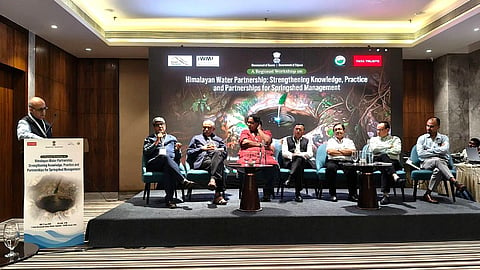
From left to right: Shilp Verma, Ranjit Barthakur, Rajesh Thadani, Rabind Kumar Samal; Divyang Vaghela on screen
Photo credit: Ajay Mohan
CML Chairman Ranjit Barthakur highlighted the urgency of restoring not only existing springs but also those that have already dried up. He pointed out that nearly 50 percent of Himalayan springs are in a critical state, while around 40 percent of the region's groundwater reserves have already been depleted.
"The stakes are enormous," Barthakur noted, adding that nearly three billion people depend directly or indirectly on water originating from the Himalayan region. He called for a strong policy framework that can address emerging water challenges before they become irreversible.
Dr Himanshu Kulkarni is virtually addressing the workshop.
Photo credit: Ajay Mohan
Rabindra Kumar Samal, IFS and Principal Secretary (Forests) in the Government of Tripura, explained how changes in land use are affecting the mountains' natural ability to store water.
“In the past, rainfall on mountain slopes would seep into the soil, gradually replenishing underground aquifers. Today, widespread deforestation and increasing concretisation are causing rainwater to run off rapidly instead of infiltrating the ground. As a result, springs receive less recharge, and many are drying up,” he said.
Adding to this perspective, Jagdish Krishnaswamy of the Indian Institute for Human Settlements (IIHS) stressed the close relationship between forests and springs. Forests absorb water during the monsoon and slowly release it during the dry season, sustaining spring flows throughout the year.
"The spring system is not merely a geological system; it is a geo-biological system," he said, emphasising that the health of surrounding forests directly influences how much water emerges from a spring.
Participating online, Dr Himanshu Kulkarni, founder of ACWADAM, argued that springshed management should not be viewed solely as a strategy to revive springs. Instead, it should be understood as an approach to restore the larger groundwater systems that feed them.
He emphasised the need to recognise springs as visible expressions of extensive groundwater recharge landscapes. Protecting these landscapes, he said, is essential for ensuring long-term water security in the Himalayas.
Dr Vinod Kothari of the Himmotthan Society shared experiences from the Spring Atlas initiative in the Central and Western Himalayas. He highlighted how scientific mapping, systematic documentation, and data-driven assessments can significantly improve efforts to conserve and revive springs at scale.
According to Kothari, reliable data is critical for identifying vulnerable water sources, prioritising interventions, and designing effective restoration programmes across mountain regions.
The workshop also featured insights from Divyang Waghela, Head of Tata Water Mission under Tata Trusts' WASH initiative; Dr Pradeep Kumar Bora of the North Eastern Regional Institute of Water and Land Management (NERIWALM); Dr Aiban Swer of MBDA; Shilp Verma of IWMI; senior geologist Dr Bijoy Krishna Setia of Jal Jeevan Mission Assam; representatives from NABARD; North Tripura District Magistrate Chandni Chandran; Sanjay Singh of CML Assam; and Dr Badrish Mehra of CHIRAG.
Speakers collectively emphasised that safeguarding Himalayan water resources will require a combination of science, community participation, ecosystem restoration, and policy support. As climate change accelerates and pressures on mountain ecosystems grow, experts warn that protecting underground aquifers may be just as important as saving the glaciers that feed Asia's great rivers.