
- Topics
- Feature
- Opportunities & Events
- About
- Hindi Portal
- Data
- Topics
- Feature
- Opportunities & Events
- About
- Hindi Portal
- Data
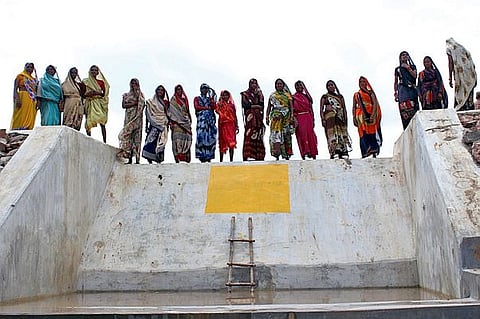
The women stand on the check dam they built while restoring the Baba Talaab. (Image: Parmarth Samaj Sevi Sansthan)

In 2019, recurring droughts in the semi-arid region of Bundelkhand threatened to drain the last remaining water sources from Agrotha village in Chhatarpur district. The community reached a critical tipping point. Taps ran bone dry, queue lines at handpumps stretched for hours triggering daily conflict, and livestock faced acute water stress. Where official mechanisms and administrative responses proved inadequate, over 200 women from Agrotha and neighbouring villages took action into their own hands.
This account is drawn directly from a grassroots documentary tracking community-led water resilience in Central India. The video captures raw interviews with the women of Agrotha, field observations of the carved mountain channel, and reflections from water governance experts on the frontlines of India’s water crisis.
Armed only with pickaxes, spades, and iron head baskets, these women spent 18 months working through intense summer heat, winter cold, and monsoon rains to carve a canal through a mountain measuring 110 metres in length and 11 metres in depth. Their goal was clear: divert a natural stream flowing through the upper forest catchment of the Maccheri river straight into their dried-up village pond.
"The women of Agrotha village worked on a tributary of the Bachheri River and redirected its waters to the village pond, which had gone empty by cutting through the hills. Their triumph stands as a testament to the adage ‘Neer, Nari, Nadi (Water, Woman, River)’, a belief that when water resources and women's agency are respected and unified, community resilience follows and life flourishes," stated Sanjay Singh, Secretary of Parmarth Samaj Sevi Sansthan.
Captured from above, this shot shows the early restoration of the Agrotha pond as newly built channels begin directing rainwater into the reservoir (Image: Parmarth Samaj Sevi Sansthan).
For the women of Agrotha, manual excavation was born out of direct necessity. As ground-level infrastructure failed, domestic and agricultural survival hung in the balance. “The taps were completely dry. There was no water in the utensils, no water in the pond. When there's no water, fights break out. We were in immense distress. So, we decided to unite, cut through the mountain, and bring water to our pond so our cattle could drink and people could survive," recalled one of the village women who led the labour.
The physical labour was arduous, conducted entirely without institutional financial support, machinery, or wages. "As you climb down the slope, you reach the pond. We would take our pickaxes and spades and bring our own iron pans from home. Yes, we would carry them on our heads and work in the scorching sun. We worked hungry and thirsty," said another woman from the village.
To balance heavy physical construction work with domestic responsibilities, the women established an informal rotation system within and across households. "In houses where there are four women, two would go to the mountain and two would manage the house. We would tell each other, 'You handle the home, we are going to the mountain,' and everyone cooperated."
Today, their voluntary labour (shramdaan) has shifted the local microhydrology. Village handpumps and open wells have experienced significant groundwater recharge, allowing even moderate rainfall events to replenish the village storage pond.
The local crisis in Agrotha mirrors broader systemic challenges across the subcontinent. India supports roughly 18% of the global population with approximately 4% of the world's renewable freshwater resources. Assessments by NITI Aayog have repeatedly highlighted the national scale of water stress, placing India among the lower tiers globally on water quality and access metrics, with major urban centres and rural belts alike facing severe supply deficits.
Groundwater dynamics represent the most vulnerable link in the nation's water security. Both rural life and agricultural stability rely overwhelmingly on subterranean reserves, with approximately 85% of rural water supply and 85% of agricultural irrigation dependent directly on groundwater. Urban centres are similarly exposed, relying on groundwater for roughly 50% of their total water supply.
This extreme dependency has made India the world's largest extractor of groundwater, pulling more from its aquifers annually than the United States and China combined. The environmental cost of this extraction is severe: the stage of groundwater extraction stands at 62%, with roughly a quarter of India's assessment blocks falling in the over-exploited, critical or semi-critical category, concentrated heavily in Western India, highlighting a rapid shift towards systemic depletion.
As climate variability increases, localised precipitation patterns are changing—resulting in shorter, higher-intensity monsoon spells interspersed with prolonged dry periods. In semi-arid regions like Bundelkhand, where average annual rainfall frequently remains under 1,000 mm, surface storage and natural recharge infrastructure become critical buffers against complete resource exhaustion.
Beyond its immediate outcome, the Agrotha intervention offers critical empirical insights for regional planners, natural resource managers, and climate adaptation specialists.
Supply-side borewells vs. catchment hydraulics: Standard administrative responses to village-level water stress historically lean towards supply-side fixes, primarily deep borewell drilling. However, in hard-rock or over-extracted aquifers, additional borewells without artificial recharge structures frequently fail within a few seasons. The Agrotha project demonstrates the priority of catchment-based hydrology: restoring natural surface inflows to open surface bodies recharges the local water table holistically, maintaining shallow wells rather than relying on deep, capital-intensive extraction.
Gendered division of labour and resource custodianship: In distress-prone agricultural belts, male seasonal migration to urban centres for wage labour often leaves women as the primary managers of the rural domestic and agricultural landscape. Because women carry the immediate daily responsibility of domestic water collection, they possess precise, place-based knowledge of water source behaviour and localised scarcity. Centring women in community mobilisation transforms passive vulnerability into active ecological governance.
Urban-rural asymmetries in consumption: The narrative contrasts rural water scarcity with urban water footprints. Major metropolitan areas display high per-capita daily consumption rates—often amplified by distribution losses and industrial usage—while rural agricultural catchments face severe supply instability. Because agricultural productivity and regional food security depend entirely on hinterland water stability, urban economic resilience cannot be decoupled from rural watershed management.
Circular Resource Integration (Poshan Vatika): Following the canal construction, community organisations like Parmarth Samaj Seva Sansthan supported the implementation of decentralised household greywater management:
Waste diversion: Runoff water from cooking and utensil cleaning is redirected away from open lanes.
Nutritional security: Diverted greywater feeds backyard kitchen gardens (Poshan Vatika), yielding fresh produce locally and reducing transport trips to market centres.
Soil moisture retention: Continuous household reuse maintains localised soil moisture and minimises stagnant surface pooling.
The structural takeaway from Bundelkhand is that top-down engineering solutions achieve maximum efficacy only when integrated with local community ownership and ecological awareness. When communities understand their local hydrology, decentralised maintenance becomes self-sustaining.
As K. G. Vyas, a water resource analyst, emphasises, long-term national resilience relies fundamentally on protecting localised food and water systems: "A country's true infrastructure is built on its food supply and agricultural yield. If there is no grain, what will we eat? You cannot eat buildings or bridges. You can survive without them, but not without food and water."
The initiative has expanded through network platforms like the Jal Jan Jodo (Connect People with Water) campaign, spreading decentralised water harvesting techniques across neighbouring Gram Panchayats in Chhatarpur and adjacent districts.
As climate projections indicate warmer, more erratic weather regimes across equatorial zones, the experience of Agrotha demonstrates that decentralised surface harvesting, watershed management, and women-led governance remain primary mechanisms for rural climate adaptation.
"The 21st century is the century of India's water crisis... If we want a future for India, we must ensure it remains rich in water. If India remains gripped by a water crisis, forget about becoming a global superpower; we will be left struggling for our very survival,” Vyas adds.