
- Topics
- Feature
- Opportunities & Events
- About
- Hindi Portal
- Data
- Topics
- Feature
- Opportunities & Events
- About
- Hindi Portal
- Data

Failure to cooperate: NGT directs agencies to re-inspect Najafgarh Drain encroachments
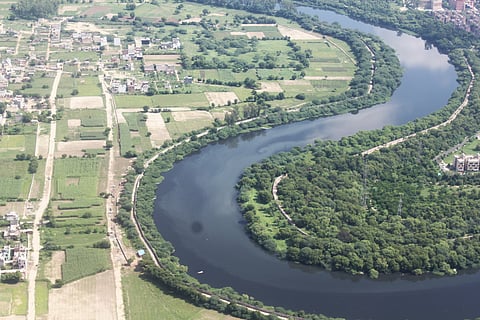
The National Green Tribunal (NGT) has mandated a fresh joint inspection to investigate alleged unauthorized constructions and encroachments on a tributary of the Najafgarh Drain in Goela Khurd village, southwest Delhi.
The NGT bench, led by Chairperson Justice Prakash Shrivastava, noted in an order dated November 27 that the previously appointed joint committee—comprising representatives from the Central Pollution Control Board (CPCB), Delhi Pollution Control Committee (DPCC), Delhi Jal Board (DJB), and the District Magistrate of southwest Delhi—had failed to file a single, comprehensive joint report, submitting separate reports instead.
The tribunal stressed that the committee "ought to have carried out a comprehensive joint exercise and filed the joint report on all the issues." Consequently, the NGT has directed the committee to revisit the site, conduct a proper joint inspection, and file a new comprehensive report within eight weeks. The case is scheduled for the next hearing on February 17. (The Print)
MGNREGA replacement bill ends right to work, shifts financial burden
The proposed Viksit Bharat-Guarantee for Rozgar and Ajeevika Mission (Gramin) Bill, 2025 (VB-G RAM G Bill) is facing strong opposition because it replaces the demand-driven, legal right to work under MGNREGA with a supply-driven, budget-capped scheme.
Critics warn the bill centralizes control by allowing the Union Government to determine state-wise funding allocations unilaterally. This change, combined with a revised 60:40 Centre-State cost-sharing formula (previously 90:10 nationwide), will place a heavy financial burden on states, potentially limiting the actual number of employment days provided.
Furthermore, the bill converts the universal guarantee into a discretionary scheme, restricts employment to only "notified" rural areas, and makes the use of potentially unreliable technology, like biometric authentication, mandatory. Labour groups are calling for the immediate withdrawal of the bill, arguing it is a significant rollback of workers' rights. (Down to Earth)
NGT panel recommends ₹5 lakh fine on BMC for Powai Lake pollution
A Joint Committee appointed by the NGT has recommended a steep penalty against the Brihanmumbai Municipal Corporation (BMC) for the continued discharge of untreated sewage into Powai Lake.
The committee's report states that the lake receives approximately 18 million litres per day (MLD) of untreated sewage through 19 culverts and two drains. It has requested the Tribunal to order compensation of ₹5 lakh per month per inlet, applicable retrospectively from February 2020, for any continuing discharge.
The panel highlighted that directions issued by the Maharashtra Pollution Control Board (MPCB) in 2021 to treat and divert sewage were not complied with by the BMC. The case began in March 2025 following a letter-petition by a Powai resident.
The BMC has proposed long-term steps, including laying new sewer lines and building a new 8 MLD sewage treatment plant, but these works have not yet started. As an interim measure, the committee advised the BMC to implement in-situ treatment (like microbial dosing) at all sewage entry points.
The NGT bench noted that the BMC failed to file its response to a September 2025 notice and has given the civic body two more weeks to submit its reply. The next hearing is scheduled for February 12, 2026. (Deccan Herald)
Defying NGT orders: Coastal Authority accused of inaction on illegal jetties
Despite clear directions from the NGT, the Goa Coastal Zone Management Authority (GCZMA) has failed to take timely action against unauthorised jetties operating along the state’s coastline, raising serious concerns about regulatory enforcement.
Petitioner Dikshay Phadte has once again approached the NGT, alleging continued non-compliance by the GCZMA with tribunal orders that mandated immediate action against illegal coastal structures. The tribunal had earlier directed the authority to act “forthwith” against jetties functioning without mandatory environmental clearances.
According to the petition, several jetties continue to operate in clear violation of the Coastal Regulation Zone (CRZ) norms, despite repeated warnings and explicit tribunal directions. The failure to act, the petitioner argues, undermines both the authority of the NGT and the integrity of coastal governance mechanisms.
The case highlights a pattern of regulatory inertia, with the GCZMA allegedly neither dismantling unauthorised structures nor ensuring compliance within stipulated timelines. The petitioner has urged the tribunal to issue stronger enforcement directions, including accountability measures, to prevent continued environmental damage to sensitive coastal and riverine ecosystems.
The matter has renewed debate over the effectiveness of coastal regulation enforcement and the growing gap between judicial orders and on-ground action. (The Times of India)
NGT orders probe into alleged biomedical and municipal waste violations in Sangrur
The NGT has sought a detailed report from Punjab authorities after taking cognisance of alleged violations in the handling and disposal of municipal solid waste and biomedical waste in Sangrur district.
The tribunal has issued notices to senior state officials and directed the Punjab Pollution Control Board (PPCB) to conduct an on-site inspection of the alleged locations. The PPCB has been instructed to file a comprehensive report before the tribunal’s next hearing.
The case was initiated following a petition supported by geo-tagged photographs and videos submitted in November and December this year. The complaint alleges systemic failures by the municipal council, civil hospital, and district administration to comply with the Solid Waste Management Rules, 2016, Biomedical Waste Management Rules, 2016, and provisions of the Water (Prevention and Control of Pollution) Act, 1974.
According to the petitioners, unsegregated waste has been dumped along major roads and near residential areas, while biomedical waste, including syringes, blood-soaked dressings, gloves, and other hazardous materials, has reportedly been mixed with regular garbage. The petition also claims that waste burning has been observed at multiple sites, contributing to environmental and public health risks.
The tribunal has directed all respondents to file their replies and affidavits and has asked the PPCB to verify compliance with waste segregation norms and assess environmental damage, if any. The matter will be reviewed at the next hearing. (The Times of India)
Right to breathe: NGT directs PMC to frame pollution norms for construction sites
In a landmark order expected to have broad implications, the Western Zone Bench of the NGT has directed the Pune Municipal Corporation (PMC) to establish specific guidelines and norms for controlling noise and dust pollution during all construction projects. This ruling stemmed from a petition filed by the Supreme Pallacio Cooperative Housing Society in Baner, which complained that a nearby IT Park construction site was causing significant noise and air pollution, impacting the residents' physical and mental health. The court noted a "vacuum in the law" and ordered the PMC to frame these guidelines to provide clarity on the measures builders must implement to control dust and noise.
The NGT upheld its earlier Friday order mandating that the construction company "does not proceed with the construction activities" until all necessary measures are adopted to bring dust and noise pollution within prescribed standards. The court observed that the construction site had failed to provide an adequate height acoustic barrier and was not taking necessary precautions, resulting in noise levels that were "on the higher side" of the standards. Additionally, the site lacked proper storage for materials, a fixed water sprinkling system, and was illegally dumping construction debris, which blocked storm water drains and caused flooding. The NGT has also directed the Maharashtra Pollution Control Board (MPCB) to impose penalties for these past violations.
This ruling is considered highly significant, especially in areas like Baner where numerous projects are underway alongside existing neighbourhoods. Residents of Supreme Pallacio reported that the noise and dust issues, including casting cement late at night, led them to first complain to the builder in May 2024 and eventually file an application with the NGT in May 2025 due to health hazards and a lack of positive response. The PMC guidelines are anticipated to alleviate the problems faced by residents in Pune, a city currently undergoing extensive construction activity. The builder's counsel stated they have taken required measures, but the MPCB will now take action in accordance with the law. (The Indian Express)
This is a roundup of policy updates from December 1, 2025 to December 15, 2025. Read our news updates here
