
- Topics
- Feature
- Opportunities & Events
- About
- Hindi Portal
- Data
- Topics
- Feature
- Opportunities & Events
- About
- Hindi Portal
- Data

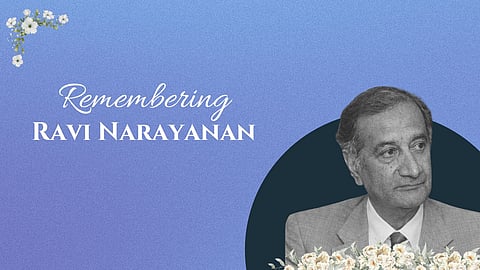
India’s water and sanitation community mourns the passing of Ravi Narayanan, a global water leader, mentor, and institution builder whose work shaped water policy and practice in India, Asia, and beyond. Known for his quiet authority, ethical clarity, and deep humanity, Ravi Narayanan leaves behind a legacy that continues to guide how water is understood, governed, and delivered to those most in need.
An engineer by training, Ravi Narayanan’s professional life bridged the corporate world and the not-for-profit sector with rare ease and credibility. He held senior leadership roles in international development organisations, serving as Asia Director at ActionAid and later as Chief Executive of WaterAid. Across these roles, his work consistently centred on equity, dignity, and the lived realities of communities without access to safe water and sanitation.
His influence extended far beyond organisational leadership. Ravi Narayanan served on the UN Millennium Task Force on Water and Sanitation, was a member of the World Panel on Financing Water Infrastructure (the Camdessus Panel), and played a key role in shaping global thinking on water governance and financing. In Asia, he was closely associated with the Asia Pacific Water Forum, first as Vice Chair and later as Chair of its Governing Council, and was instrumental in developing the Asian Water Development Outlook, a landmark assessment that continues to inform regional water policy. He also chaired the International Steering Committee of the Water Integrity Network and served as an International Mentor to the Japan Water Forum. In recognition of his contributions, the UK Government awarded him an honorary CBE in 2009 for services to water and sanitation for poor communities in Asia and Africa.
Ravi Narayanan joined Arghyam too as an advisor in 2005 upon returning to India when the organisation was still finding its footing. Arghyam is a Bengaluru-based public charitable foundation established in 2005 by Rohini Nilekani to advance safe and sustainable water and sanitation across India. Recalling those years, Sunita Nadhamuni, Arghyam’s first CEO, described him as a mentor who was deeply involved in everyday decisions. “He came into the office almost every day,” she wrote, “participating with great enthusiasm in everything from choosing office space and interviewing candidates to shaping strategy, partnerships, and programmes.”
For a young organisation, his presence was steadying. He offered clarity without dominance and guidance without prescription. Sunita described him as “a pillar of calm support”, someone whose work helped shape not just programmes but values, guided by “a compass of integrity, fairness, and kindness”. A natural teacher, Ravi’s mentoring extended beyond formal sessions to informal conversations. His terrace talks, Sunita recalled, were “wide-ranging conversations spanning history, literature, drama, and much more,” leaving a lasting imprint on many young professionals across the water sector.
His influence was equally strong globally. Dr Seetharam of the Asian Development Bank Institute, who worked with him for over two decades, called him “an exemplary professional, inspiring leader, and most cherished a loving personality.” Ravi co-chaired an independent panel reviewing ADB’s water policy, whose recommendations led to a doubling of water investments in Asia in 2006.
Despite his stature, Ravi remained deeply grounded. His legacy lives on through the institutions he shaped, the policies he influenced, and the many individuals he mentored across continents.