
- Topics
- Feature
- Opportunities & Events
- About
- Hindi Portal
- Data
- Topics
- Feature
- Opportunities & Events
- About
- Hindi Portal
- Data
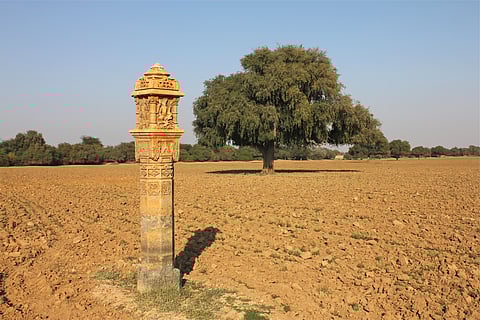
Goidhan (Goverdhan) at Derasar Khadeen
India Water Portal Flickr

Radiant Raindrops of Rajasthan (Rajasthan Ki Rajat Boondein) can be viewed as a rigorous argument against the dominant hydrological assumption that low rainfall necessarily implies water scarcity. The documentary demonstrates, through lived practice rather than abstract theory, that scarcity is socially produced when rainfall, land, and institutions are misaligned. This position closely echoes the central thesis of Rajasthan Ki Rajat Boondein, where Anupam Mishra argues that Rajasthan’s water crisis is not a failure of nature but a failure of memory—specifically, the erosion of knowledge systems that once converted erratic rainfall into reliable water security.
Watch on YouTube
The film by Amit Tiwari functions as a visual ethnography of that memory, documenting how desert communities historically transformed rainfall variability into predictability through social organisation, distributed storage, and ethical restraint. “When I first read Anupam Mishra’s book, I felt a strong urge to tell this story visually. That impulse took me across Rajasthan, following the same vision he described. Over the years, I travelled extensively to see and document as many water bodies as I could, trying to understand the land from a different perspective. I wanted the film to capture Rajasthan through its seasons. From the dry period before the monsoon to the rains and then the slow return to dryness after. I also followed the agricultural cycle, including khadeen, observing the land before sowing as it fills with life and as it matures towards harvest. Capturing these transitions was important to me,” said Amit Tiwari, speaking to India Water Portal.
A key analytical strength of the documentary lies in its articulation of a three-tier indigenous hydrological understanding: palar (surface rainwater), rejani pani (percolated water held above the deep saline aquifer), and patal pani (deep groundwater). This classification is not metaphorical; it reflects a functional understanding of subsurface geology, especially the role of gypsum and clay layers (locally referred to as Multani mitti) that prevent vertical mixing of waters. Rejani pani, trapped above saline groundwater, is recognised as high-quality, potable water, deliberately harvested through small-diameter wells (kuin or beri). From a contemporary hydrological perspective, this anticipates modern distinctions between soil moisture storage, perched aquifers, and deep groundwater systems.
The documentary demonstrates that pre-modern societies developed layered water-management strategies, relying instead on long-term observation and cumulative experience. This reinforces the arguments made by several works, which document how traditional water systems across India were based on cumulative ecological observation and local material conditions, rather than on generic engineering templates. The documentary thus positions indigenous knowledge not as anecdotal or symbolic but as empirically grounded and environmentally specific.
The film’s detailed treatment of kuins and kunds further strengthens this argument by illustrating how infrastructure was deliberately designed to match rainfall thresholds, evaporation rates, and household needs. Kuins, with their narrow circumference and great depth, minimise evaporation while targeting rejani pani, while kunds capture rooftop and courtyard runoff to meet year-long domestic and livestock requirements. These systems embody what modern literature would describe as low-energy, decentralised water infrastructure. These small-scale, locally adapted rainwater harvesting systems often outperform large supply-driven projects in arid and semi-arid regions because they internalise scarcity and reduce dependence on energy-intensive extraction. The documentary provides a lived illustration of this principle, showing households achieving complete water self-reliance from a single monsoon.
Equally significant is the documentary’s exploration of khadeen agriculture, which reframes floodwater not as a hazard but as a source of fertility. By slowing and spreading ephemeral runoff across fields, khadeens convert short-duration flows into long-lasting soil moisture, enabling rainfed cultivation without fertilisers or irrigation. This aligns with agro-ecological principles now widely advocated in climate-resilient agriculture, where water, sediment, and nutrients are managed together rather than in isolation. The documentary’s emphasis that khadeens function without urea or external inputs directly challenges modern input-intensive farming models, reinforcing arguments that traditional systems were inherently regenerative because they treated water management, soil fertility, and livestock as a single integrated system.
Beyond technology, the documentary’s most profound contribution lies in its portrayal of water as a moral economy rather than a public utility. Water works in the desert are shown not as employment or state service delivery but as a collective ethical obligation. Wells are named after individuals, yet access remains communal; prestige accrues not from ownership but from service. This social logic resonates strongly with ‘Taming the Anarchy’, which argues that groundwater governance in South Asia has failed largely because it has been detached from social norms and collective regulation. Where extraction becomes individualised and unaccountable, aquifers collapse. The documentary offers a contrasting model in which social oversight and moral responsibility act as regulatory mechanisms, reducing overuse without formal enforcement.
The film’s challenge to the proverb “still water is impure” is also analytically important. By demonstrating that still water remains potable when catchments are protected and access is socially regulated, the documentary anticipates modern water-quality thinking that prioritises source protection over end-of-pipe treatment. This insight is reinforced by field documentation compiled on the India Water Portal, which consistently shows that traditional water bodies in Rajasthan maintained quality precisely because they were embedded in social rules governing cleanliness, use, and maintenance.
In its final sections, the documentary turns decisively critical, linking the breakdown of traditional water cultures to urbanisation, land commodification, and infrastructure that severs hydrological connectivity. Ponds disappear not because rainfall has declined, but because catchments have been mined, paved, or fragmented. This diagnosis aligns closely with contemporary policy research showing that many so-called “water-scarce” regions suffer primarily from planning failures rather than absolute hydrological limits.
Taken together, Radiant Raindrops of Rajasthan present a coherent alternative framework for thinking about water security. It shows that resilience emerges from distributed storage, low-energy systems, collective norms, and ethical restraint, rather than from ever-larger transfers and deeper extraction. When read alongside Mishra’s historical narrative, the documentary stands not as nostalgia but as applied hydrological reasoning. Its central message is analytically clear: water security in arid landscapes is not a problem of insufficient rain but of insufficient respect for how rain, land, and society must work together.
“With limited resources, I tried my best to film these landscapes as truthfully and beautifully as possible, staying close to how they are described in the book. Most of what the book speaks about finds a place in the film, even though a few water bodies could not be covered. For me, this film is a tribute to the people of Rajasthan, to Anupam Mishra, and to everyone who has been working to preserve and share this traditional wisdom. While shooting, I also realised how disconnected many young people have become from this knowledge. Even basic terms like 'khadeen' were unfamiliar to many. I hope this film helps rekindle awareness and respect for India’s traditional systems of water management," says Tiwari.