
- Topics
- Feature
- Opportunities & Events
- About
- Hindi Portal
- Data
- Topics
- Feature
- Opportunities & Events
- About
- Hindi Portal
- Data

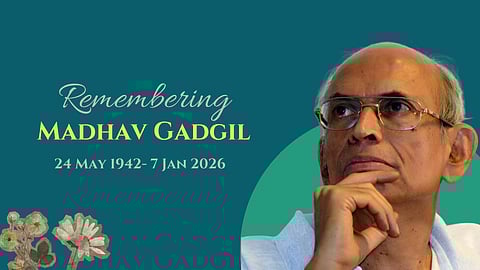
Renowned ecologist Dr Madhav Gadgil passed away at his residence in Pune on Wednesday (January 7, 2026), following a brief illness. At India Water Portal, we remember him as a thinker whose work consistently reminded us that water, land, forests, and biodiversity cannot be separated from questions of democracy, justice, and people’s rights. With his passing, India has lost one of the most influential thinkers and practitioners of environmental governance, a scientist who consistently argued that ecological protection, social justice, and democracy are inseparable.
Widely regarded as one of the architects of modern Indian environmentalism, Dr Gadgil believed deeply in combining scientific rigour with ethical responsibility and community wisdom. For him, environmental decision-making could never be the sole preserve of experts or institutions; it had to be rooted in the lived realities and knowledge systems of people who depend most closely on nature.
In 1983, Dr Gadgil founded the Centre for Ecological Sciences (CES) at the Indian Institute of Science (IISc), Bengaluru, an institution that would go on to shape generations of ecologists, conservation biologists, and policy thinkers in India. Under his leadership, CES emerged as one of the country’s foremost centres for interdisciplinary research in ecology, conservation biology, and environmental policy.
His academic work also took him beyond India, including visiting professorships at Stanford University and the University of California, Berkeley. Yet, colleagues and collaborators consistently recall that his scholarship never drifted away from the ground.
Dr Gurudas Nulkar, Director, Centre for Sustainable Development at the Gokhale Institute of Politics and Economics, Pune, remembers him as a researcher with his “feet firmly on the ground”.
“Dr Madhav Gadgil always confirmed facts by actually visiting the place before giving any opinion. He had a very good connection with the community and was completely at ease with people at the grassroots — tribal children from Nandurbar and Gadchiroli, and poor rural folk from marginalised communities,” says Nulkar.
According to him, Gadgil firmly believed that local communities were the true experts of their environment, far more than distant researchers or academicians, and that they needed to be empowered to take their own decisions.
“He strongly believed that human beings are a part of biodiversity and did not believe in development by exclusion,” Nulkar adds.
Nationally, Dr Gadgil is perhaps best known for chairing the Western Ghats Ecology Expert Panel (WGEEP), constituted by the Ministry of Environment and Forests in 2010. The panel’s report, popularly referred to as the Gadgil Report, identified the entire Western Ghats, a global biodiversity hotspot, as an Ecologically Sensitive Area.
The report recommended stringent regulation of mining, quarrying, large dams, and polluting industries to safeguard the fragile mountain ecosystem. While it triggered intense political and public debate, the report is widely regarded as a landmark in India’s environmental governance for placing ecological limits, people’s rights, and democratic decision-making at the centre of development planning.
For this work, Dr Gadgil was awarded the United Nations Environment Programme’s Champions of the Earth award in 2024 under the ‘Lifetime Achievement’ category.
K J Joy, founding member of SOPPECOM (Society for Promoting Participative Ecosystem Management), recalls a long association with Gadgil that spanned over two decades.
“All the meetings and discussions with him were deeply enriching. When the controversy broke out after the Gadgil Committee report was submitted, the Pani Dhoran Sangharsh Manch organised a large public meeting in Pune. He presented the gist of the report and responded very patiently to all the questions,” Joy recalls.
That meeting, he notes, played a critical role in helping the Pani Dhoran Sangharsh Manch formulate an appeal demanding the implementation of the report’s recommendations. Joy also remembers Gadgil as a strong supporter of the Forest Rights Act (FRA).
“He genuinely believed the FRA could be an important instrument for securing livelihoods of forest-dependent communities without compromising environmental concerns,” he says.
Those who worked closely with Dr Gadgil repeatedly emphasise that his commitments were not merely theoretical. Whether in research, policy, or practice, he consistently foregrounded the rights and voices of nature-dependent communities.
“He was always on the side of fishers, pastoralists, and other nature-dependent communities,” says Joy. “He believed conservation and livelihoods must go together, and that conservation should never come at the cost of people’s lives and dignity.”
Joy also recalls Gadgil’s rare ability to communicate complex scientific ideas in simple Marathi, often without using English terminology, a skill that made his work accessible far beyond academic circles.
“In one sentence, I would describe him as a researcher-activist of nature and nature-dependent communities,” he says.
While much of Dr Gadgil’s work focused on forests and biodiversity, his intellectual curiosity and ecological vision extended across domains.
Dr Himanshu Kulkarni, hydrogeologist and founder of ACWADAM (Advanced Center for Water Resources Development and Management), remembers how Gadgil frequently drew connections between different commons, including groundwater.
“Even though his primary work was on forests and the Western Ghats, he often made comparisons across commons. There were times when he disagreed with people’s views, but he always respected disagreements with remarkable openness,” Kulkarni notes.
He adds that Gadgil encouraged interdisciplinary thinking long before it became fashionable.
“When Maharashtra experienced floods and landslides in 2021, he urged us to study landslides in the Western Ghats and examine the links between groundwater and landslides. He always pushed us to look beyond silos.”
Beyond research and activism, Dr Gadgil played a pivotal role in shaping India’s environmental legal framework. He was a key architect of the Biological Diversity Act, 2002, which established mechanisms for biodiversity conservation and equitable benefit-sharing.
He also pioneered the idea of People’s Biodiversity Registers, an innovative attempt to enable local self-governing institutions such as gram panchayats to document, manage, and protect traditional ecological knowledge and biological resources.
Over his lifetime, Dr Gadgil received numerous national and international honours, including the Padma Shri (1981), Padma Bhushan (2006), the Tyler Prize for Environmental Achievement (2015), and the Volvo Environment Prize.
He authored several books, among them This Fissured Land (co-authored with Ramachandra Guha), Ecology and Equity, and his autobiography A Walk Up the Hill.
Dr Madhav Gadgil’s work continues to inspire students, researchers, activists, and practitioners across the world. Yet, for many who knew him personally, it is not only his ideas but his patience, humility, and unwavering ethical clarity that will be most deeply missed. With his passing, Indian environmentalism has lost not just a towering intellectual, but a compassionate and principled guide.