
- Topics
- Feature
- Opportunities & Events
- About
- Hindi Portal
- Data
- Topics
- Feature
- Opportunities & Events
- About
- Hindi Portal
- Data
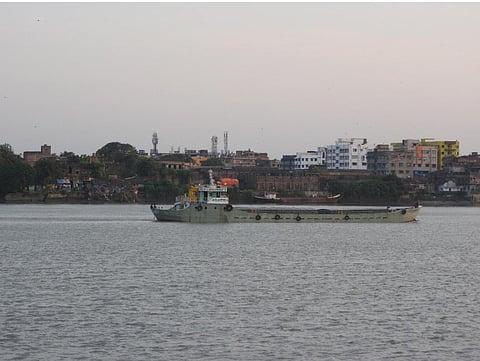
River Hooghly at Kolkata.
Yercaud-elango via Wikimedia Commons

India’s Union Budget 2026 has put rivers at the centre of its growth story by focusing on strengthening ports, inland waterways, domestic shipbuilding capacities, reducing logistic costs, cutting dependence on foreign shipping lines, and improving cargo movement through multimodal integration. The finance minister announced a ₹10,000 crore allocation for container manufacturing and inland and coastal waterways development, alongside plans to make 20 inland waterways operational over the coming years, a clear signal that river-based transport is part of India’s multimodal growth strategy.
The key steps that are planned to bring about this change include expanding national waterways, boosting coastal shipping, and supporting ship repair and manufacturing infrastructure. It is important that this development flows hand in hand with ecological safeguards to keep rivers resilient and communities secure.
Inland waterways are a network of navigable rivers, lakes, backwaters, and creeks, as well as man-made canals that can be used for the transportation of goods in addition to roads and rails. Rivers have served as effective waterways throughout the ages, carrying people and goods over long distances. Several large rivers in various parts of the world are used even now by barges and ships for transportation. The major rivers used for inland water transport worldwide are the Nile of Africa, Ganga of India, the Thames of Europe etc.
Rivers have been used as a means of transport since the Indus valley civilisation in India. Inland waterways were systematically developed during the British rule, and many canals were constructed, including the Buckingham Canal, which connected Chennai with Kolkata.
The journey to harness India's inland waterways involved these landmark developments:.
After independence, the development of inland waterways lagged behind till the 1950s when the Ganga-Brahmaputra Water Transport Board was formed, the first institutional establishment committed to developing major river systems for transportation in India.
The year 1969-70 led to the establishment of a dedicated Estimate Committee, indicating renewed interest after nearly two decades
The Inland Waterways Authority of India (IWAI) was established in 1986
The year 2021 led to the enactment of the Inland Vessels Act, aimed at boosting transportation through inland waterways
The year 2025 led to the introduction of the National Waterways (Construction of Jetties/Terminals) Regulations, the latest in this long sequence of institutional frameworks
India’s legal and policy framework for inland waterways centers on the:
The Inland Waterways Authority of India Act, 1985
The Inland Waterways Authority of India (IWAI) is an autonomous organisation under the Ministry of Ports, Shipping & Waterways constituted on 27th October, 1986 under the Inland Waterways Authority of India Act, 1985.
IWAI is mainly responsible for the development, maintenance and regulation of those waterways which have been declared as NWs under the National Waterways Act, 2016. The head office of IWAI is at Noida, UP. The policy guidelines and directions issued by the IWT Wing are implemented by the IWAI.
Inland Vessels Act of 2021
The Inland Vessels Act, 2021 (replacing the 1917 Act), provides a modern, uniform legal framework for inland water navigation in India, which deals with registration, safety standards, and operation of mechanised/non-mechanised vessels to promote safe, eco-friendly transport, with regulations under the Ministry of Ports, Shipping and Waterways.
The Inland Water Transport Policy 2001
The policy focuses on economic, fuel-efficient and environmentally friendly modes of transport and encourages large-scale private sector participation for the creation of infrastructure and fleet operations.
National Waterways Act 2016
The National Waterways Act, 2016, provides for the regulation and development of inland waterways for shipping and navigation. The Act repeals five existing Acts that declared national waterways, consolidating them under this new legislation. The Act has expanded the scope of national waterways by declaring an additional 106 inland waterways as national waterways to the pre-existing 5, bringing the total to 111.
Laws related to environmental and other impacts
Forest Act 1980,
Environmental Protection Act 1986 and various notifications under it, like EIA Notification 2006, CRZ Notification 2011.
The government initiatives for inland waterways focus on expanding infrastructure (National Waterways, Multimodal Terminals), promoting private investment (Jalvahak Scheme, Jal Samriddhi portal), boosting tourism (river cruises), and enhancing digital systems (Jalyan, Naudarshika) for efficient, green logistics and economic growth, integrating waterways with national projects like Gati Shakti and Sagarmala.
The details of the projects and schemes undertaken by the Government of India to develop and modernise inland waterways can be found here.
On 9th March 2016, the Parliament enacted The National Waterways Act, 2016, which came into force on 12 April 2017 as per the notification of the Government of India. This act has declared 111 rivers or river stretches, creeks, and estuaries as National (inland) Waterways. These waterways pass through 24 states and two union territories, with an approximate total length of 20274 km, and will include nearly 13811 river systems, creeks, estuaries and related canal systems of India.
Although 111 National Waterways have been declared (5 preexisting and 106 new), only 29 are operational as of May 2025 . The government has announced plans to develop 20 new waterway corridors over the next five years, and policy instruments such as the Coastal Cargo Promotion Scheme aim to raise the share of coastal shipping and inland waterways in the country’s freight mix from 6 percent to 12 percent by 2047.
Below is the list of the currently operational waterways in India:
Operational waterways in India
Government of India (2025). Ministry of Ports, Shipping and Waterways
India has approximately 14,500 km of navigable waterways (out of which about 5,200 km of the river and 4,000 km of canals can be used by mechanised crafts), but these inland waterways continue to be underutilised in India as compared to other countries. Around 60 % of the total cargo is carried by road in India, 28% by rail, 4% by airways, 4% by pipeline and only 4% by waterways. The modal share of waterways in India’s freight movement is about 2%, as compared to 4% for the USA, 14% for China, 48% for Vietnam, and 49% for the Netherlands. India aims to increase the modal share to 5% by 2030.
Five national waterways contribute to 80% of the total cargo movement in India. Gujarat Waterways and Maharashtra Waterways cover more than 75% of the overall IWT traffic, according to 2019-20 figures. At present, inland waterways account for about 3.5 percent of India’s trade. The budget push aims at changing this situation.
Inland water transport is considered to be a fuel-efficient, cost-effective and environment-friendly mode of transport for bulk goods, hazardous goods and heavy cargoes. It reduces time and the cost of transportation of goods and cargos, as well as congestion and accidents on highways. Inland Waterways also “help create seamless interconnectivity connecting hinterlands along navigable river coasts and coastal routes” and “are likely to play a crucial role in connecting the north-eastern states to the mainland.”
It is considered an already built infrastructure network, which does not require capital investment or greenfield investment, but only capex for improvement/upgradation.”
Inland Waterways can help ease the congestion on roads and are said to not involve challenges associated with land acquisition, which has always been a sensitive issue, causing time and cost overruns of numerous projects.
It is argued that the significant investment which India needs to build its roads/highways infrastructure network can be conserved through increased utilisation of the waterways. User charges can be levied to meet the expenses on maintenance of the waterways.
Experts however point to a number of challenges that need to be overcome to make inland waterways feasible and operational in India. Besides cost considerations and infrastructural challenges, many have raised environmental and livelihood concerns that point at the variable nature of riverine systems in India that would each present diverse challenges and require different modes of handling.
Rivers are not like roads. They flow, bend, and snake through different topographies and are living ecosystems that survive through a system of complex interdependencies among physical and natural worlds. Any intervention on the river flows and depths can have repercussions that can affect the very survival of rivers and the living organisms and communities that depend on the rivers to meet their food, water and livelihood needs.
The need for dredging to maintain viable inland waterways can destroy the ecological balance, negatively affect hydrology, biodiversity and the health of rivers and offset climate gains
Rivers need enough depth throughout the year to remain viable for a navigable inland waterway. However, many Indian rivers do not have that level of water for them to be useful as waterways around the seasons, thus needing extensive dredging. Moreover, Indian rivers (especially rivers in the northern plains) face severe problems of siltation round the year.
Dredging and channel modification can disrupt natural river flows, sediment transport, and floodplain dynamics of rivers. Dredging can also impact aquifers along the river, damaging the ability of water to percolate underground. In estuaries and creeks of rivers, the removal of riverbed material during dredging can result in the ingress of excess saline water into the creek or rivers. Changes in river morphology can affect aquifer recharge and soil moisture balance. Altered hydrology may increase flood vulnerability in downstream communities.
Dredging operations can damage riverbeds and can lead to changes in habitats for various aquatic flora and fauna. For example, it can negatively affect fish by destroying breeding/feeding habitats, increasing turbidity (cloudy water) that blocks light and harms gills, releasing toxins, altering natural flows, and impacting food webs (plankton, invertebrates) crucial for fish survival, leading to reduced populations, diversity, and reproductive success, especially for migratory species.
For example, recent studies show that maintenance dredging in the Ganga during the dry season to deepen channels is disturbing the habitats of the endangered river dolphins, affecting their survival. River dolphins need a combination of deep and shallow water areas in the river for resting, feeding, and other activities. Dredging and underwater noise can affect dolphin habitats both physically and acoustically. While noise levels due to dredging are relatively low and localised, they can still lead to stress among river dolphins by physical and biogeochemically disturbing riverbed sediment and impacting fish prey. Field observations reveal that dolphins show a three-fold increase in dive times during dredging indicating stress levels and the tendency to avoid dredged channels.
While waterways are more energy-efficient than trucks, ecological damage from dredging may offset climate gains.
Movement of barges in navigational channels can destroy aquatic ecosystems and harm aquatic life
Barge trafficking and navigation through water ways can cause deleterious impacts on chemical and biological components of the river ecosystem along with hydrodynamic alterations, habitat destruction, changes in water quality, reduction of fish catch and loss of production of larval and adult fish.
Intensive barge movement generates turbulence in the water, which causes disturbance like alluviation and loose soil formation along the shoreline of the rivers. Those loose soils are carried downstream by the river and increase the suspended sediment loads. This unconsolidated soil is also accompanied by tree roots and clumps of grass from collapsed riverbanks.
This eroded river bank causes low light permeability under water and prevents or limits photosynthesis and phytoplankton development as well as micro-zooplanktonic growth. Turbulence also triggers extracellular release of phytoplankton-derived organic matter and trace metals. This limiting factor damages the functionality of the primary producers, which play an important role in the aquatic food chain, the paper informs.
Studies show that noise pollution due to industrial transportation and recreational waterways over the Ganga can spell doom for dolphins by affecting their feeding habits and social behaviours. The study found that an increase in underwater noise due to motorised vessels resulted in major behavioural changes in the Gangetic dolphins and led to alterations in their responses to sounds, strong masking of the communication modes achieved through echolocation clicks, and high metabolic stress. Vessel noise impacts were the strongest at low water depths in the dry season due to increases in vessel traffic, and dolphins suffered from the dual impacts of high underwater noise and declining river discharge, leading to declines in fish prey availability.
Inland waterways construction can affect wetlands and riparian zones
Expansion of waterways risks encroachment on wetlands, mangroves, and biodiversity hotspots. Construction of jetties and river ports often necessitates removal of trees and mangrove forests in the area.
Waterways can compete with availability of water for other uses
Inland waterways don’t exist in isolation—they can compete with other critical uses of river water like drinking supply, irrigation, and power generation. To keep rivers navigable year-round, large volumes of water must be maintained at certain depths. This can mean curbing allocations for agriculture or hydropower, especially during lean seasons.
Oil spills, bilge discharge, and waste from inland waterways vessels can degrade river ecosystems in several ways:
Water contamination: Spilt oil and bilge water introduce hydrocarbons, heavy metals, and toxins that can harm fish, plankton, and aquatic plants.
Food chain disruption: Pollutants accumulate in sediments and enter the food web, reducing fish populations and impacting communities dependent on fishing.
Oxygen depletion: Waste discharge increases organic load, leading to eutrophication and lower dissolved oxygen levels, which suffocate aquatic life.
Community impact: Polluted rivers affect drinking water sources and livelihoods of riverside communities.
Ships can pollute air
Ships using conventional fuels contribute to local air pollution unless low-emission technologies are adopted.
Inland waterways can affect local communities
Construction of jetties, ports, and terminals often requires land acquisition, which can displace riverside communities. Large vessels navigating rivers may restrict or prohibit fisherfolk from accessing traditional fishing grounds. Nets can be torn apart by barges, and fishing jetties may need relocation. Declining fish populations due to dredging, pollution, and noise directly affect fisherfolk incomes and food security. Dredging and vessel traffic damage breeding and feeding grounds, reducing fish catch. Vessel noise interferes with fish behaviour and migratory species, while also affecting river dolphins—an indicator species tied to fish prey availability. Maintaining navigable depths for cargo transport may reduce water available for agriculture, irrigation, and fishing needs.
Experts recommend that inland waterways development thus needs to integrate:
Community consultation before projects begin.
Livelihood safeguards like alternative fishing zones, compensation, or co-managed jetties.
Environmental flow management to ensure rivers remain viable for both navigation and traditional uses.
This calls for a need to conduct:
Environmental Impact Assessments (EIAs) that are rigorous, transparent, and participatory.
Community Monitoring where local communities should be involved in tracking ecological changes.
Integrated Planning where waterway projects should align with river basin management, biodiversity conservation, and climate resilience strategies.
As India charts its course through Budget 2026, inland waterways emerge not just as a transport alternative but as a symbol of how the river economy can be reimagined at the policy level. The announcements signal ambition—new waterways, coastal cargo schemes, and repair hubs—and ensuring navigability, building resilient infrastructure, and safeguarding ecosystems can help in taking this momentum forward. If the government, industry, and communities can align, inland waterways could become the arteries of a greener, more connected India. Can we take this opportunity forward to let rivers carry not only cargo but also the promise of sustainable growth?