
- Topics
- Feature
- Opportunities & Events
- About
- Hindi Portal
- Data
- Topics
- Feature
- Opportunities & Events
- About
- Hindi Portal
- Data
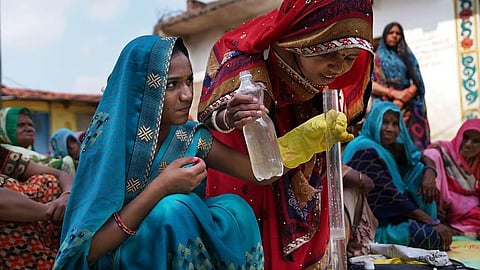
Women and youth are trained to lead the entire process of community water management—from planning to supply, operations, and maintenance—and to educate communities on water-quality issues.
WaterAid India/Ashima Narain

When India’s flagship Jal Jeevan Mission announces that millions of homes now have piped water connections, policymakers and citizens alike applaud the expansion of access. But a new nationwide study published late in 2025 tells a different and more complex story, one that begins not at treatment plants or taps, but at the kitchen counter. In households across India, families make daily decisions about whether and how to treat their drinking water. These decisions, the research shows, are shaped less by science and more by economic status, education, and long standing patterns of inequality. Millions of Indians continue to consume unsafe water, sometimes without knowing it and often because they have few viable alternatives.
The study, titled “Patterns and Predictors of Household Water Treatment in India” by Ritika Rajput and Aniket Kumar, analyses data from NFHS-5 (2019–2021), a national representative survey covering about 6.4 lakh households, to assess how Indians attempt to make their drinking water safe. It maps not only the prevalence of water treatment practices, but also the socio-economic and demographic factors that determine who treats water and who does not.
A household portrait of water safety
At a national level, the study’s findings are stark: only 41.7 per cent of Indian households report doing any form of water treatment at home. Even more concerning, only 28.3 per cent use methods generally considered effective, such as boiling, chlorination, filtration, solar disinfection, or electronic purifiers. The remainder either rely on minimal measures like cloth straining or simply do nothing at all.
These numbers are especially troubling given India’s growing water quality crisis. Across the country, groundwater — the main source of drinking water for over half a billion people — is contaminated with arsenic, fluoride, nitrate, and other toxins in many regions. Surface water, meanwhile, is under pressure from untreated sewage, agricultural runoff, and industrial pollution. In such a context, household water treatment can act as a last line of defence against waterborne disease. Yet, for most Indian families, it remains out of reach.
Regional patterns: More than geography
Geography matters, but only up to a point. In states like Nagaland and Kerala, over 95 per cent of households report treating their drinking water. Bihar, on the other hand, languishes with fewer than one in ten households doing so. Urbanised Union Territories such as Chandigarh also display high treatment rates.
But the reasons behind these patterns are not simply about water quality on the ground. In Kerala and the North-East, decades of investment in public health education, community mobilisation, and local governance have embedded water treatment as a cultural norm. In parts of eastern India, social and economic deprivation dampens both awareness and the ability to act.
Moreover, the study shows a counterintuitive behaviour: households using sources that are objectively riskier — such as unprotected wells or surface water — are more likely to treat water than those using so-called “improved sources” like handpumps or tubewells. This suggests that perception of risk — often visual clarity — influences behaviour more than actual scientific assessments of contamination.
Boiling, cloth, and technology: What households do
Among households that treat water, boiling is the most widespread method, used by about 38 per cent. Boiling is familiar and inexpensive, but it does not remove dissolved chemicals like arsenic or fluoride. Next most common is cloth straining (about 35.6 per cent), which can reduce some pathogens but offers no defence against chemical pollutants. Filters account for 16.7 per cent, chlorination 8.1 per cent, and electronic purifiers 3.3 per cent.
These choices reflect more than preference; they reflect affordability and access.
Cloth straining remains dominant in lower-income and rural areas because it requires nothing more than inexpensive material and basic time.
Boiling is widespread where firewood or LPG is accessible, often driven by habit rather than risk assessment.
Filters and RO purifiers are concentrated in wealthier, urban households.
Yet not all technology maybe great technology. Reverse osmosis (RO) purifiers, popular in many cities, remove both microbes and chemicals but waste significant amounts of water — often several litres for every litre of safe output. In a country where many regions already face water scarcity, this trade-off raises serious sustainability concerns.
Socio-economic inequality: The real narrative
The most powerful predictor of whether a household treats its water is wealth. Households in the richest wealth quintile are more than four times as likely to practise water treatment as those in the poorest quintile. Education follows closely: households headed by someone with higher education are nearly twice as likely to treat water as households where the head has no schooling.
Other structural indicators show similar divides. Households with pucca (permanent) housing, flush toilets, and improved sanitation are significantly more likely to treat water. Conversely, open defecation and substandard housing are associated with lower treatment rates. Rural households trail urban ones, even after accounting for source water quality.
The study also highlights disparities by social identity. Christian households report the highest prevalence of water treatment, while Muslim and Scheduled Caste households report lower rates. Interestingly, Scheduled Tribe households show relatively higher rates of treatment — largely because many tribal populations live in states like Nagaland and Meghalaya, where cultural norms and governance traditions support water safety practices. But outside those areas, tribal households often face the same access and quality challenges as other marginalised groups.
Gender interacts with water practices in less obvious ways. Women continue to bear the burden of water collection and management, but their responsibility does not always translate into control over treatment decisions or access to necessary resources.
Policy implications: Beyond infrastructure
The findings point to a fundamental policy disconnect. While India has made impressive strides in expanding water connections, water quality remains sidelined. A kitchen tap does not guarantee safe water — especially for families dealing with contaminated sources or intermittent supply.
Programmes like the Jal Jeevan Mission have focused intensely on coverage, but the study underscores the need to shift towards quality and safety. Regular water quality monitoring, transparent reporting, and community-level engagement could rebuild public trust in piped water systems and discourage excessive reliance on private RO systems that waste water.
Similarly, sanitation campaigns like Swachh Bharat Mission have improved toilet coverage, but the link between sanitation and water safety is still weakly integrated in policy design. The research suggests that better sanitation correlates with higher water treatment, implying a need for convergence between water, sanitation, and hygiene interventions.
Behaviour change: Not just awareness
For decades, government messaging on safe drinking water has leaned on slogans and awareness campaigns. But the new study shows awareness alone is insufficient. Knowledge that water may be unsafe does not automatically result in treatment — especially when households lack resources, time, or suitable technologies.
What’s required is a nuanced, context-specific approach. In regions afflicted by arsenic or fluoride, simple boiling or cloth straining is inadequate. Low-cost yet effective filtration options, community-based water treatment systems, and locally appropriate technologies could make treatment more accessible. Subsidies or micro-financing schemes for safe technology adoption targeted at low-income households, could reduce disparities.
Governments and NGOs also face the challenge of building trust in public systems. Many households invest in private purifiers because they distrust municipal supplies. Strengthening water quality testing protocols and communicating results transparently could restore confidence in tap water and rationalise private investment.
A mirror to India’s inequalities
The new research offers more than statistics; it holds a mirror to India’s enduring inequalities. The decision to treat water — a basic health protective practice — should not be conditioned by wealth, caste, or education. Yet for millions of Indians, it is. In states where water treatment is near universal, strong public health infrastructure, widespread literacy, and social norms create enabling environments. Where treatment is rare, systemic deprivation limits both access and agency.
The study’s authors argue that household water treatment, often dismissed as an individual choice, is actually a social equity issue. Without tackling the structural barriers that keep poor and marginalised households from treating water, broader goals of safe drinking water and public health will remain elusive. As India approaches its 2030 development goals, policymakers must look beyond coverage numbers and confront the complex realities inside homes — where water flows from a tap, but safety is anything but assured.