
- Topics
- Feature
- Opportunities & Events
- About
- Hindi Portal
- Data
- Topics
- Feature
- Opportunities & Events
- About
- Hindi Portal
- Data
Arghyam's Jal Soochak uses a simple WhatsApp photo and custom AI to turn rural water meter readings into tamper-proof, real-time data for better governance.
Arghyam

India's rural drinking water landscape has undergone a remarkable transformation in recent years. Since the launch of the Jal Jeevan Mission in 2019, household tap water coverage has expanded from 3.23 crore to 15.72 crore rural households by October 2025, bringing piped water infrastructure to millions of families that once depended on wells, handpumps and seasonal water sources. Yet as the programme moves beyond the challenge of providing connections, a more complex question has come into focus: how can the functionality of these systems be monitored and sustained over time?
A 2024 government-commissioned Functionality Assessment Survey found that only around 80 per cent of connected households were receiving water at the prescribed service norm. The finding highlights a critical shift in India's water sector, where success is increasingly measured not by the number of schemes constructed but by the reliability, quality and continuity of service delivered to households.
Addressing this challenge requires better visibility into how rural water systems function on a day-to-day basis. It is in this context that Arghyam has developed Jal Soochak, an artificial intelligence-enabled monitoring tool that uses WhatsApp to simplify the collection of operational data from water supply schemes. Designed for frontline workers managing rural water infrastructure, the platform seeks to strengthen transparency, accountability and timely decision-making by making reliable field-level information available to communities and government institutions alike.
From infrastructure creation to service delivery: The challenge of monitoring rural water systems
The gap between building water infrastructure and ensuring its long-term functionality has been a persistent challenge in India's rural water sector. Earlier programmes such as the Accelerated Rural Water Supply Programme and the National Rural Drinking Water Programme repeatedly revealed shortcomings in monitoring and maintenance, with successive reports by the Comptroller and Auditor General highlighting cases where completed schemes were inadequately tracked after construction.
At the heart of this challenge lies the availability of reliable data. A scheme may be listed as operational, and a household connection may be recorded on official dashboards, but without verified information from the field, it is often difficult to determine whether water is being supplied regularly, in sufficient quantity and at the required quality standards. Across thousands of villages, frontline workers continue to record bulk flow meter readings and operational information manually, a process that is labour-intensive, vulnerable to errors and difficult to verify at scale.
The absence of timely and trustworthy data limits the ability of both communities and government agencies to respond when problems arise. Without a clear picture of whether pumps are functioning or how much water is being delivered, identifying disruptions, planning maintenance and ensuring accountability become significantly more difficult.
Recognising this information gap, Arghyam, an organisation that has been applying technology grounded in science to address real-world water challenge developed Jal Soochak as a simple digital solution built around tools already familiar to rural water operators. By enabling pump operators to capture photographs of bulk flow metres through WhatsApp and automatically converting those images into usable digital records, the platform aims to transform routine data collection into a reliable source of evidence for monitoring service delivery. In doing so, it seeks to support the next stage of India's rural water journey: ensuring that every connection results in a dependable water service rather than remaining merely an infrastructure asset on paper.
Confronted with the scale of India's water crisis — the country holds roughly 18% of the world's population but only 4% of its freshwater, and a 2018 NITI Aayog report found over 600 million Indians living under extreme water stress — Arghyam’s leadership concluded that project-level philanthropy alone could not bend the curve fast enough. It repositioned itself as a knowledge partner and ecosystem enabler for government: co-designing digital public goods and embedding them inside large public missions rather than running parallel pilots. That repositioning placed Arghyam at the intersection of JJM's ambition and its structural blind spot around service delivery verification.
The Jal Jeevan Mission: Big numbers, bigger blind spots
JJM's scale is genuinely remarkable. With a total approved central outlay of ₹2.08 lakh crore and a Union Budget 2025-26 allocation of ₹67,000 crore, it represents the largest investment in rural water infrastructure in India's history. Eleven states and union territories, including Goa, Gujarat, Telangana, Haryana and Arunachal Pradesh, have reported 100% household coverage. The mission has also produced a governance dividend: 17,036 complaints processed, action against 2,397 officials, and multiple contractors blacklisted for poor performance.
But the Functionality Assessment Survey data exposes a persistent gap. While nearly 98% of surveyed households had a connection on paper, only around 83% had received water through it in the preceding seven days, and only 80% met the 55-lpcd standard. The problem is structural: the JJM dashboard excels at tracking connections commissioned but has no mechanism to independently verify daily scheme operation. That verification depends on frontline pump operators, Jal Mitras, manually logging bulk flow meter readings into government apps. In practice, poor app usability, intermittent connectivity, low digital literacy, and an absence of behavioural incentives meant that large numbers of schemes went unmonitored or were logged with back-dated, estimated, or fabricated readings.
The Jal Soochak solution: Meeting workers where they are
Arghyam's design insight was deliberately contrarian. Rather than building yet another government app and training operators to use it, the team asked: what if reporting happened inside the tool that pump operators already use every day?' The answer was WhatsApp, available on even basic Android handsets, familiar across rural India, and requiring no additional installation or account creation.
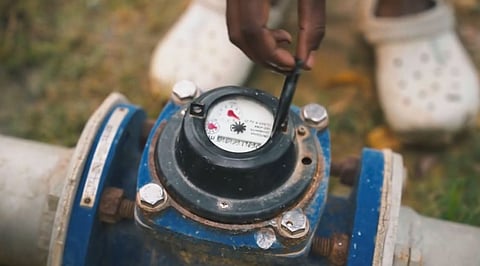
Working with Glific, an open-source WhatsApp chatbot platform purpose-built for social-impact organisations, Arghyam developed the Jal Soochak bot. The workflow is simple by design: each morning the bot sends a personalised nudge to each operator, who responds by photographing the bulk flow meter dial and sending it back. Within seconds, an AI pipeline processes the image, extracts the reading, validates it, and writes it to a scheme-level dashboard accessible to district engineers and state officials. Critically, the photograph creates an auditable, timestamped, geo-tagged record — a structural answer to the data-integrity problem that manual entry systems have never solved.
How the AI works: Inside the computer vision pipeline
Off-the-shelf optical character recognition (OCR) proved unreliable on real-world meter photographs — images taken at awkward angles, in poor light, or through dirty glass. Arghyam partnered with Sahaj Software to build a custom computer vision pipeline, delivered in under ten weeks, that now forms the technical backbone of Jal Soochak. The pipeline operates in five sequential stages:
Image Quality Classification: automatically flags blurry or unreadable photographs and prompts the operator to retake them before any further processing runs.
Image Enhancement: applies deblurring and contrast correction to improve dial readability.
Meter Detection using Oriented Bounding Boxes: detects and crops the meter dial using oriented bounding boxes to handle tilted or angled shots — one of the most common real-world failure modes.
Individual Digit Recognition: a deep-learning model fine-tuned on meter-specific fonts extracts each digit from the cropped dial.
Colour Classification: distinguishes the red decimal digit from the black integer digits using pixel-comparison heuristics and a classifier trained on 2,000 annotated samples.
The full pipeline runs at 1 to 1.5 seconds per image on CPU and approximately 600 milliseconds on GPU, achieving a reported reading accuracy of 97.7% — well above the 90% target Sahaj initially set. This places it in the same performance bracket as comparable smart metering systems developed in China and Morocco, while being engineered specifically for the low-connectivity, high-variance conditions of rural Indian field deployment.
Pilot evidence: What happened in Assam
The first structured test of Jal Soochak covered 150 piped water supply schemes and 150 pump operators in Assam over 15 days. The results shaped the subsequent scale-up strategy and attracted state-level attention. WhatsApp-based reporting generated more than 1,400 submissions across the pilot window. Usage of the official Jalmitra government app simultaneously rose from 500 to 960 reports — suggesting that the nudge-based mechanism lifted overall reporting behaviour, not just Jal Soochak usage. Most significantly, 42% of operators who had never submitted a reading before began doing so, and 39% went from zero submissions to four or more. The behavioural signal was unambiguous: the barrier to reporting had been friction and habit, not motivation. Many operators continued sending daily photographs after the pilot formally concluded, Arghyam had to notify them individually that the trial period had ended.
Scaling up: States, integration, and open architecture
Jal Soochak is designed as a modular digital public good, deployable in three configurations: WhatsApp-only, app-plus-WhatsApp hybrid, or as a backend API integrated into a state's own platform. This flexibility has enabled Arghyam to pursue integrations with multiple state systems simultaneously.
In Assam, the rollout is being extended across more than 27,000 piped water supply schemes statewide. Parallel discussions are under way with West Bengal's Jal Mitra MIS, which tracked 13.7 crore community activities and functionality assessments for 80.39 lakh households between April 2024 and August 2025, as well as Bihar's Avni and mGramSeva deployments. Integration with the Atal Bhujal Yojana groundwater monitoring stack is also being explored, which would extend Jal Soochak's data capture into groundwater-level tracking. The open-source architecture means the computer vision pipeline and chatbot framework are available for adaptation by other states and, in principle, by other countries with analogous last-mile water monitoring challenges.
“The effectiveness of JalSoochak as a system of record is in the design of the utility leveraging an ubiquitous technology (mobile phone) and a common skill (taking photographs), where technology meets where people are, and puts the complexity behind the device, and the near zero training and high rate of adoption speaks for itself,” says Mr. Kailash Karthik, Mission Director, Jal Jeevan Mission, Assam.
Why it matters: Governance, accountability, and the last mile
Jal Soochak operates at the intersection of three longstanding failures in rural water governance: data fabrication, institutional invisibility, and accountability asymmetry. Manual meter-reading systems have historically been vulnerable to all three: readings could be estimated, backdated, or simply not submitted, with no mechanism for the state to distinguish a functioning scheme from a non-functional one.
“JalSoochak is not just a technology platform. It is an attempt to strengthen service delivery to ensure that the investments made in rural water systems translate into reliable services for people. The journey from Assam to a national scale digital public good has been about one core idea: making data useful for action, where it matters most,” says Deepak Gupta, Director of Digital Infrastructure and Government Partnerships, Arghyam.
The photograph-first design structurally addresses each of these failures. A timestamped, geo-tagged image cannot be back-dated. A scheme that is not pumping cannot produce a reading consistent with prior days. And the daily nudge mechanism creates a continuous accountability loop between the operator, the scheme, and the state dashboard, one that functions even in low-digital-literacy environments because it requires no more than a smartphone camera and a WhatsApp account.
For policymakers, this translates into something JJM's central reporting infrastructure has so far lacked: independent, photo-verified, tamper-resistant evidence of daily service delivery, disaggregated to the scheme level. For Gram Panchayats and Village Water and Sanitation Committees, it converts an opaque pump house into a visible, auditable community asset. For the WHO, which estimates that JJM's eventual service-delivery dividend could save Indian women 5.5 crore hours of daily water-collection labour, Jal Soochak is a small but essential wager that those hours will not be forfeited because a meter went unread.
Conclusion
India has demonstrated, through the Jal Jeevan Mission, that it can connect hundreds of millions of rural households to piped water infrastructure at speed. The harder and less visible challenge — ensuring that water actually flows, every day, in every scheme — requires a different kind of ambition: the discipline to measure what matters at the point where measurement is hardest.
Jal Soochak is not a grand technological intervention. It is, deliberately, a minimal one — a daily photograph, a WhatsApp message, a computer vision model, and a dashboard. Its significance lies not in its complexity but in its restraint: the recognition that the most durable solution to a governance problem is often the one that asks the least of the person who has to use it and delivers the most to the institution that needs to see it. “"It's become part of my routine to use Jalsoochak. I take a photo, confirm it, and it's recorded. The data is clear, so there's no confusion or back-and-forth later. This can also help support any issues we report from the field," says Mr. Utpal Boro, Pump Operator for Kollapara NC scheme, Assam.
If it scales as the Assam pilot suggests it can, Jal Soochak may prove that the distance between a tap on paper and water in a glass can be closed, not by building more infrastructure but by finally knowing, in real time, whether the infrastructure that already exists is doing its job.