
- Topics
- Feature
- Opportunities & Events
- About
- Hindi Portal
- Data
- Topics
- Feature
- Opportunities & Events
- About
- Hindi Portal
- Data

In many rural parts of India, the decision to drink clean water is not always about taps, tanks, or technology. It can begin with something far more invisible. It begins in the mind. It lives in the values people inherit, the beliefs they carry, and the unwritten rules their communities follow. So when a new water purification system arrives in a village, the real question is not only whether it works. The real question is whether people believe it works. And why do they believe so?
A new study, “Cultural dynamics and endogeneity in psychological drivers of adoption of community-based water purification technology in rural India” by Mithun Raj, Saket Pande, and Maneesha Vinodini Ramesh on the adoption of Jivamritam, a decentralised community-based water purification system implemented across 300 rural communities, offers one of the most rigorous attempts yet to unravel the behavioural and cultural dynamics underlying this puzzle.
India has made steady progress under national programmes such as the Jal Jeevan Mission. Yet millions of rural families still struggle to access safe drinking water. Waterborne diseases continue to harm children and push families into cycles of illness and financial stress.
Community-based purification systems have emerged as an important solution, especially in places where piped water supply is unreliable or contaminated. But even when these systems are installed, adoption is not always assured. Some communities welcome them. Others hesitate. Many use them irregularly. This study examines a simple but often ignored question: Why do people choose to adopt or reject community-based water purification systems even when they are available, functional, and affordable?
The researchers behind the study begin from a point often overlooked in discussions about rural water systems: that behaviour is not simply an outcome of information, infrastructure or affordability. It is also shaped by how individuals perceive risk, how they weigh benefits, and how they read the actions of their peers. These perceptions, feelings and norms are not static. They evolve as people interact with technologies and as communities observe each other’s choices.
In the case of Jivamritam, this interplay creates a feedback loop so strong that it can blur the causal pathways that conventional behavioural models try to map. A technology may be adopted because people perceive it as beneficial or socially endorsed, but those perceptions themselves may have been shaped by prior exposure to the technology. As the researchers note, this two-way interaction introduces endogeneity—a methodological challenge where psychological determinants and adoption behaviour reinforce each other in ways that are difficult to separate statistically.
To understand how deeply this matters, the study draws attention to earlier behavioural models used in water, sanitation and hygiene (WASH) research, such as the RANAS model, the Health Belief Model and the IBM-WASH framework. These models identify variables like perceived vulnerability, perceived severity, perceived ease of access, cost-effectiveness and descriptive norms as strong predictors of whether a household will use a safe-water technology consistently.
But while such frameworks treat psychological determinants as cleanly independent variables, real-world interactions rarely fit such linear assumptions. The researchers argue that failing to recognise endogeneity leads to systematic underestimation or overestimation of what actually influences household decisions—a worrying prospect for policymakers designing interventions based on behavioural assumptions.
Jivamritam, the focus of the study, provides fertile ground for examining this complexity. Launched in 2017, the system seeks not only to provide safe drinking water through purification units deployed in rural communities but also to strengthen community participation in water governance. More than 10,000 communities were initially screened for water quality issues, with 300 chosen for deployment.
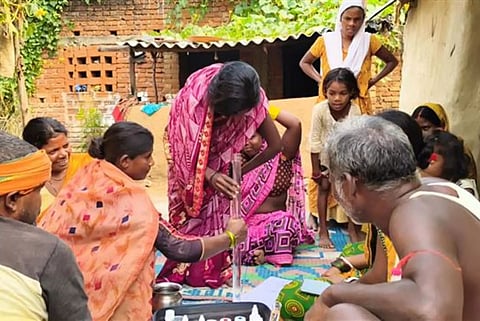
The study’s data come from 54 of these communities across six states, representing some of the country’s most diverse cultural and socio-environmental settings. Researchers interviewed 906 individuals—primarily women, who disproportionately shoulder water-collection responsibilities—to explore what drives or deters the use of the technology.
The findings reflect a contradictory reality. On one hand, the psychological factors traditionally associated with technology adoption do appear to play a major role. Higher perceived severity of waterborne disease, greater perceived benefits such as cost-effectiveness or ease of access, and stronger descriptive norms all correlate strongly with adoption. However, when the researchers controlled for endogeneity using a sophisticated two-stage regression technique, the magnitude of these effects changed dramatically.
The influence of perceived ease of access, initially estimated using standard regression, grew by more than 150 percent once endogeneity was corrected. The effect of descriptive norms increased by nearly 66 percent. What this means in practical terms is that communities might be far more sensitive to convenience and peer behaviours than earlier studies suggested. Underestimating such factors could lead to interventions that fail to create momentum for widespread adoption.
The study’s most striking contribution lies in its use of cultural variables to untangle this behavioural knot. Culture, the authors argue, is an underutilized but powerful analytical tool for water governance research. It is slow-moving and deeply embedded and influences psychological perceptions without being easily influenced by short-term behavioural changes. For analytical purposes, this makes culture an ideal instrumental variable—a statistical device that helps identify the true causal effect of psychological factors by breaking the loop of reverse causality. The cultural indicators the researchers selected draw from two well-established global frameworks: Hofstede’s cultural dimensions and the World Values Survey. These include traits such as generalised morality, trust in others, belief in the connection between hard work and success, personal sense of control, family ties and the degree of collectivism versus individualism.
These traits vary significantly across different rural Indian communities, even within the same state. They influence how people interpret risk, how much effort they are willing to expend to access a service, how receptive they are to new technologies and how responsive they are to community norms. Yet crucially, they do not directly affect whether a household chooses to adopt Jivamritam. Instead, they operate through the channel of psychological perceptions, making them statistically powerful instruments for isolating the true causal effects of those perceptions.
Using this approach, the researchers identified cultural factors that strongly shape psychological drivers. Generalised morality and collectivism proved to be strong predictors of descriptive norms. In communities where people value cooperation, social cohesion and respect for collective welfare, individuals are more likely to perceive that “everyone is using the system” and thus feel compelled to conform.
Similarly, respondents with stronger beliefs in personal control or the value of hard work were more likely to perceive the technology as accessible—perhaps because they see challenges as surmountable and feel empowered to invest effort in using communal infrastructure. These cultural influences operate subtly, often unnoticed, but they structure the behavioural environment in which technology adoption unfolds.
The implications of these findings stretch far beyond statistical nuance. For one, they challenge the prevalent practice of designing behavioural interventions that assume psychological variables are fixed and independent. In reality, these variables shift as communities experience a new technology.
When households begin using a system like Jivamritam, they may revise their beliefs about its benefits, reshape norms by influencing peers or strengthen their perceptions of safety and trust. These shifts feed back into the behavioural ecosystem, amplifying or dampening adoption over time. Interventions that fail to account for such feedback risk misdiagnosing the true barriers to sustained use.
The findings also underscore a broader truth: water technologies are never purely technical artefacts. They are embedded in cultural settings that shape what people believe, how they interpret change and how they navigate collective decisions. In collectivist communities, diffusion of technology may spread more rapidly, because individuals place a high value on community-approved practices.
In communities where personal control is perceived as low, adoption may lag even when the technology is available, because people feel disempowered or disengaged. Trust in institutions—local governments, implementing agencies or village committees—also plays a pivotal role, especially when water systems require ongoing maintenance and collective stewardship. These nuances matter deeply in a country as culturally diverse as India, where the drivers of adoption in rural Himachal Pradesh may differ substantially from those in coastal Kerala or tribal Odisha.
The study highlights real examples that illustrate these dynamics. In one Kerala community, high adoption in a single ward created sufficient social momentum that neighbouring households requested the technology for their own ward. This ripple effect demonstrates the reinforcing loop between descriptive norms and behaviour: as more people adopt, norms strengthen, and as norms strengthen, adoption accelerates. But such positive loops can also stall. In communities where early adoption is weak—perhaps due to perceptions of inconvenience, limited trust or cultural hesitation—norms may fail to develop, causing the technology to stagnate even when it is technically functional.
If culture influences behaviour indirectly through psychological pathways, then interventions must be culturally sensitive rather than one-size-fits-all. For collectivist communities, group-based campaigns, social endorsement by respected leaders or participatory decision-making may hold greater sway than individual appeals. In communities where personal agency is low, building confidence and empowering households may be just as important as improving technical reliability. Cultural traits cannot be altered easily, but interventions that align with cultural values have a far greater chance of success.
The study’s cross-sectional nature limits its ability to track how cultural and psychological dynamics shift over time, but its methodological innovation—bringing instrumental variable techniques into WASH behaviour research—marks an important step forward. It demonstrates that behavioural models must evolve to reflect real-world complexity and that cultural variables are not peripheral curiosities but central elements of community behaviour.
As India continues its push towards universal safe drinking water access, the lessons from this research are timely. Community-based purification technologies like Jivamritam will only succeed where behavioural, social and cultural conditions are understood and integrated into programme design. The future of rural water security depends not only on the quality of hardware but also on the subtle, interconnected software of human psychology and culture. In rural India’s complex social landscapes, technology adoption is as much about hearts and minds as it is about pipes and filters—and understanding that reality may be the key to advancing public health for millions.