
- Topics
- Feature
- Opportunities & Events
- About
- Hindi Portal
- Data
- Topics
- Feature
- Opportunities & Events
- About
- Hindi Portal
- Data
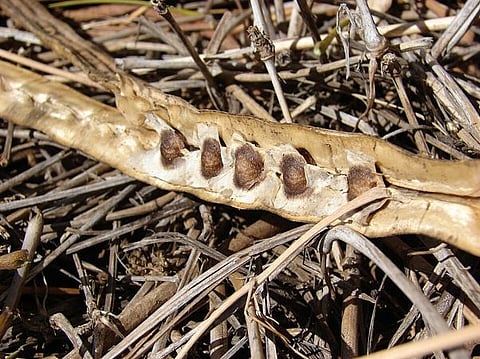
Moringa oleifera (pods and seeds on ground)
Starr, Wikimedia Commons

Clean drinking water is often taken for granted until it is no longer available. For millions of people, however, finding water that is both accessible and safe remains a daily challenge. Contaminated water continues to contribute to disease and premature deaths, particularly in low-income countries where treatment infrastructure is limited and households may depend on polluted surface or groundwater.
Much of the world's water-treatment infrastructure relies on chemical coagulants such as aluminium sulphate, commonly known as alum, and ferric chloride. These chemicals are effective: under suitable conditions, they can rapidly destabilise suspended particles and remove more than 95% of turbidity. But they also come with costs. Treatment plants need reliable chemical supply chains, accurate dosing and pH management, while coagulation generates sludge that must be collected and disposed of.
This has prompted interest in a rather unlikely water-treatment agent: the humble Moringa oleifera tree.
Better known in India as the drumstick tree, moringa grows widely across tropical and subtropical regions. Its leaves and pods are familiar as food, while its seeds have long been used to help clarify dirty water. A recent review by Shama Kakkar, Nagaraju Dharavat and S.V.N. Pammi, published in Results in Engineering, examines how this traditional application is being translated into modern water-treatment technology. The review covers research, biochemical mechanisms and patents developed between 2016 and 2024.
The attraction is straightforward. Moringa seeds contain naturally occurring proteins that can act as coagulants. Rather than adding an industrial chemical to destabilise particles, the process uses a plant-derived protein to make suspended particles clump together and settle.
That does not mean moringa is ready to replace alum in every treatment plant. Its more immediate potential may lie in decentralised systems, rural water supplies and situations where conventional chemical supply chains are difficult to maintain.
The science behind moringa's water-treatment properties is relatively simple. Turbid water contains tiny suspended particles that are often too small to settle naturally. Many carry a negative surface charge. Because particles with similar charges repel one another, they remain dispersed rather than coming together.
Moringa seeds contain water-soluble, positively charged proteins. When a suitably prepared extract is added to turbid water, these proteins interact with negatively charged particles and reduce the forces keeping them apart. The process then moves into flocculation. Protein molecules can attach to several particles, effectively creating bridges between them. Small particles form larger aggregates, or flocs, which can then settle.
The review identifies cationic proteins as the principal agents responsible for this coagulation. Their chemical characteristics allow them to interact with negatively charged colloids in water. There are potential advantages beyond particle removal. Moringa-based coagulation can work across a relatively broad pH range, reducing the need for some pH correction. Studies have also reported lower sludge production in certain applications. Because the coagulant is plant-derived, the resulting organic residue may be more biodegradable than metal-based sludge.
But "natural" should not be confused with "automatically safe". Moringa also introduces organic matter into water. If dosing and subsequent treatment are poorly controlled, this could increase the organic load and encourage microbial growth. Moringa therefore needs to be treated as a water-treatment technology requiring proper dosing, monitoring and downstream treatment.
Most importantly, clarification is not the same as purification. Moringa may help remove suspended material and some microorganisms, but it cannot be expected to remove every pathogen, pesticide, pharmaceutical or dissolved contaminant.
The most interesting development may not be the use of moringa seed powder itself, but the effort to isolate and standardise the active protein.
Early applications were simple: crush the seeds, prepare an extract and add it to turbid water. The problem is consistency. Protein content can vary between seeds, while storage and processing conditions can affect performance. Crude extracts also contain substances that do not contribute directly to coagulation.
The patent landscape reviewed by Kakkar and colleagues shows researchers attempting to overcome these limitations.
One approach is to combine moringa with other treatment materials. Patents have explored formulations containing activated carbon, chitosan, clay, lignin and other plant-derived materials. The objective is not to make moringa perform every treatment function but to combine different materials so that each addresses a particular contaminant.
Other innovations focus on concentrating the active proteins. Supercritical carbon dioxide processing, for example, has been investigated for removing oil from moringa seed material before extracting the coagulant proteins. Further processing can produce a more concentrated product, potentially reducing the quantity required for treatment.
This is important because crude moringa powder can require relatively high doses. Large quantities of seed material may make treatment less economical and add unnecessary organic matter to the water.
The direction of research is therefore towards a standardised biological coagulant rather than simply a bag of ground seeds.
An even more ambitious possibility is biological production. Patent US20210087090A1 describes the expression of the moringa coagulant protein in bacterial hosts such as Bacillus. In principle, this could allow the active protein to be manufactured through fermentation rather than depending entirely on harvesting moringa trees.
That changes the scale of the proposition. The question is no longer simply how many trees are available but how efficiently the active protein can be produced, purified and formulated.
If such systems prove economically viable and meet safety requirements, moringa-based coagulation could eventually become less dependent on the geography and seasonality of the crop itself.
Laboratory results are useful, but water treatment ultimately has to work under real-world conditions.
The studies reviewed in the paper cover several applications. Research in Tunisia examined moringa from local cultivars for clarification of raw and treated urban wastewater. In Malaysia, moringa seed cake was tested against polluted water associated with industrial and landfill environments. Research on textile wastewater in India has also investigated moringa seed powder for reducing colour and chemical oxygen demand.
Interestingly, some studies suggest that finer powder is not necessarily always better. Coarser material can perform effectively because treatment involves both chemical interactions and physical settling.
Such findings demonstrate the versatility of moringa, but they should not be interpreted as evidence that the plant can treat every type of contaminated water.
Coagulation is primarily a clarification process. It targets suspended and colloidal material and may contribute to the removal of some microorganisms and other contaminants, depending on water chemistry and treatment conditions. Dissolved salts, many pesticides, pharmaceutical residues and other persistent pollutants require different treatment processes.
This is why moringa's strongest future may be in multi-barrier treatment systems rather than as a standalone replacement for conventional treatment. A rural water system, for example, could use moringa for initial coagulation and clarification, followed by filtration and disinfection. Activated carbon could be incorporated where adsorption of particular organic contaminants is required, while ceramic or membrane filtration could provide additional barriers against pathogens and fine particles.
The value of moringa in such a system is not that it does everything. It is that it could perform one important treatment function using a potentially locally available biological material.
Transitioning moringa-based coagulants from laboratory success to viable public infrastructure requires standardisation, quality control, and cost verification. Scaling up successfully hinges on addressing key technical, safety, and logistical demands:
Consistent dosing and extraction: Because seed composition varies naturally with climate, soil, and maturity, commercial products require standardised active protein concentrations. Advanced or salt-assisted extractions can boost recovery, but processing costs must be economically justified by performance gains.
Shelf stability: Fresh extracts degrade rapidly. Developing dry formulations and moisture-resistant packaging that withstand hot, humid climates is essential for storage and transport.
Quality assurance: Natural origin does not guarantee safety. Strict controls are necessary to prevent microbial contamination and chemical impurities so treated water reliably meets drinking-water standards.
Circular economy integration: Utilising post-oil extractioUltimately, moringa offers a sustainable, biodegradable tool for water treatment.
Rather than replacing conventional coagulants like alum in large metropolitan plants, moringa’s immediate potential lies in decentralised applications—such as remote villages, emergency shelters, and small community water schemes where chemical transport and storage are challenging. However, moringa acts as a clarifying agent rather than a standalone steriliser and must remain part of a broader multi-stage treatment chain.
Ultimately, moringa offers a sustainable, biodegradable tool for water treatment. The priority now is to refine extraction techniques, establish safety standards, and determine where and under what operational conditions it can compete with conventional chemicals on safety, performance, and cost.