
- Topics
- Feature
- Opportunities & Events
- About
- Hindi Portal
- Data
- Topics
- Feature
- Opportunities & Events
- About
- Hindi Portal
- Data
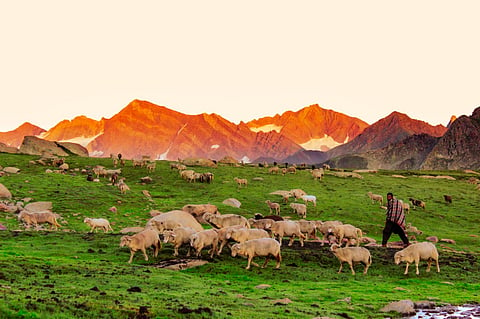
Bakarwals of Kashmir and their flock of grazing sheep. Image Source: Saveem Saif

On a night in May this year, lightning struck a flock grazing at Dhana Dok, a high pasture above Kangan in Ganderbal district of Jammu and Kashmir, India. By morning some ninety sheep and goats lay dead across the meadow. They belonged to Mohammad Yaseen Bijran and Abdul Majeed Bijran, brothers from Sunderbani block in Rajouri, who had walked their animals over the Pir Panjal a few weeks earlier as part of the bi-annual seasonal migration.
Three months later, on 4 August, the Ministry of Home Affairs told the Lok Sabha that lightning and heatwaves had been added to the list of notified natural calamities for the 2026-31 award period. The 16th Finance Commission had recommended it, and the change is welcome. But it is worth asking a simple question. If the notification had come three months earlier, what would the Bijrans have received?
The Bijrans are Bakarwal nomadic pastoralists, a Scheduled Tribe, and goat and sheep keepers found across Jammu and Kashmir. Twice a year they walk their herds over the Pir Panjal and Chenab valley, wintering in the low-lying plains of Jammu and summering in the high pastures of Kashmir. For most Bakarwal households, the herd is the household economy. There is little land to fall back on, and the animals supply meat, wool and milk, along with the income that buys everything else. The migration itself, on foot, over passes, through weather, is not incidental to this life. It is how the herd finds grass and water through a full year, and it is the reason there is a flock to lose at all.
Herders who follow the seasons. Image Source: Priya Rajput
Extreme weather along this route is no longer occasional. In our interviews across Rajouri district, thirty-four of forty respondents said hailstorms had grown more frequent and severe, and thirty-six said the same of erratic rainfall. “It was a steady temperature when I was younger,” one herder told us. “The summer season, which used to start in late April, now begins in early March.” Slow shifts like these compound with sudden ones, a hailstorm, a cloudburst, a lightning strike, so that every migration season now carries some risk of the kind that killed the Bijrans’ flock.
Putting a hazard on the list decides which events a state may spend disaster money on. It does not decide how much that money is worth to the family that lost something. That is set by a separate document, the schedule of items and norms attached to the disaster response funds.
Under the Items and Norms applicable for 2022-26, a dead sheep or goat carries relief assistance of Rs 4,000. The same schedule caps assistance at 30 small animals per household, regardless of how many the household has lost. A family that loses 90 animals is therefore eligible for a third of them.
What such animals are worth is a different figure. For our study in GeoJournal, we obtained the Rajouri district record of livestock killed by extreme weather in 2022-23. It lists 914 animals, 694 of them goats and sheep, valued at Rs 1.42 crore. The compensation paid came to Rs 86.8 lakh.
Police and local officials did reach Dhana Dok to assess the damage. The norms require that the loss be certified by the competent authority designated by the state government. But the Bijrans are residents of Sunderbani in Rajouri district, and their animals died in Ganderbal, on the far side of the mountains.
Our study found persistent divisions between districts in how loss and damage is reported during the biannual migration, and that the compensation procedure itself was hard for mobile pastoralists to use. The gap the Bijrans fell into is not unusual.
Sunderbani, where the Bijrans live, is one of the four blocks in which we have surveyed Bakarwal households. The ninety animals at Dhana Dok are the kind of loss a disaster system is built to see. The rest of what these households lose divides into economic and non-economic damage. Extreme weather takes animals; slower change takes the migration itself, and the ledger has no column for that.
That slower loss is the one we followed in Regional Environmental Change through 100 interviews and 4 focus groups in Rajouri. Ninety per cent reported a change in herd size and eighty per cent a shift in fodder sources, from grazing to purchase. Fifty-four per cent had a family member working elsewhere for wages. Only five per cent had settled.
One man traced his family’s herd across three generations. His grandfather kept 150 sheep and 75 goats; his father inherited 100, and he has 30. Some were lost to crises on the migration, some to disease, and the rest sold because feeding them had become unaffordable.
A household buying fodder it once grazed has less in reserve when the lightning comes. A night like the one at Dhana Dok then pushes it further along the same road. We read these as one process rather than two, and our study attributes the shifts to institutional constraints such as grazing bans and land encroachment as much as to slow-onset change.
The economic half of this at least gets written down. The non-economic half is not recorded anywhere, and neither the National Action Plan on Climate Change nor the state action plan refers to loss and damage. No central system exists through which departments report it. A loss nobody counts cannot become a line in any budget.
That five per cent figure matters more than it looks. Whatever the paperwork suggests, seasonal movement is not a weakness these households are waiting to escape. It is how a family finds pasture, water and bearable temperatures across a season, and it is the reason there is a flock to lose at all. A system that treats it as an obstacle works against the thing keeping these households going.
Bakarwals on the move with their sheep. Image Source: Tahir Mehmood
Some of the machinery for doing better is already in place. The Tribal Affairs Department’s first Survey of Transhumance, in 2021, recorded 6.12 lakh transhumant people and geo-tagged more than 75,000 locations, including highland pastures and the dhoks where families camp. During COVID-19 pandemic, the department has run a transport service for the twice-yearly migration through the district administrations. Mobile Veterinary Units (MVUs), Mobile Medical Patrols, and Mobile Schools are another set of measures; therefore, the department holds a spatial record of where these families move and camp.
That data could be joined to disaster assessment, and the step is a short one. Deputy Commissioners oversee the migration service, and under the Disaster Management Act the same officer chairs the district disaster management authority. A district authority in Ganderbal that recorded the Bijrans’ losses and sent the record to Rajouri would spare a household the journey between two administrations.
The difficulty is not only that the assistance rate may be too low. It is that the administrative map and the pastoral map do not align, and relief is written for the former.
Veterinary teams, by the same logic, belong in the first response after a storm rather than in a programme that arrives weeks later. In Kalakote, the Rajouri tehsil with the highest share of migrating Bakarwal households, mobile veterinary services are negligible.
The items and norms schedule also falls due for revision in this cycle. That is the moment to ask whether a per-household ceiling written for settled smallholders can hold a herder who lost ninety animals in a night.
This is the International Year of Rangelands and Pastoralists, declared by the UN General Assembly in 2022 and officially launched by the FAO, its lead agency, on 2 December 2025. Its agenda is not celebratory. It asks governments to secure pastoralists’ access to land and natural resources, support mobility, and invest in animal health services. Set against the Indian record, it reads more like a checklist than a tribute.
Recognition on those terms is not praise for traditional knowledge, nor a place on a list of vulnerable groups. It is pasture, water, routes, a vet who arrives in time, and a relief schedule that a flock can see.
A dead animal is easy to count. A shrinking herd, a lost migration route, or a livelihood that slowly becomes unsustainable is much harder to see.
The ninety animals at Dhana Dok can be recorded in an assessment. But the disaster assessment will not tell us whether the Bijrans are still herding in the next three years. The system needs to be urgently setup to find that out.
Disclaimer: The views expressed are those of the authors and do not necessarily represent the views of India Water Portal.