
- Topics
- Feature
- Opportunities & Events
- About
- Hindi Portal
- Data
- Topics
- Feature
- Opportunities & Events
- About
- Hindi Portal
- Data
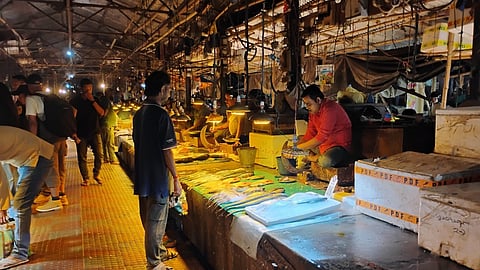
The famous Lake Chowmani fish market in Agartala city, where Hilsa is placed on an ice tray and displayed on the right under a special light.
Image: Thomas Malsom

Every year, long before a hilsa reaches a kitchen in Agartala, its story begins in water. Born in the Bay of Bengal, the fish follows ancient migratory routes through rivers, estuaries and tidal channels that connect landscapes, ecosystems and communities across South Asia. By the time it arrives in Tripura's markets, hilsa carries far more than commercial value. It carries memories, identities and a connection to river systems that have long linked present-day India and Bangladesh.
Before sunrise, the fish markets of Battala, Golbazar and Lake Chowmuhani begin to stir. Traders arrange their catch while customers move between baskets and ice boxes searching for something more than food. Amid the familiar bustle, one question returns every season: Has the hilsa arrived?
In Tripura, hilsa, or ilish, is never merely a fish. For many households, it is a taste of home, a seasonal ritual, a family memory and a marker of identity. Its arrival evokes stories of migration, belonging and shared histories shaped by rivers. The fish continues to connect generations whose lives and cultures have been influenced by water.
For decades, the celebrated Padma ilish from Bangladesh's Padma-Meghna river system occupied a special place in Agartala's imagination. During Durga Puja, Poila Boishakh, Jamai Sasthi and other celebrations, the gleaming silver fish brought excitement to local markets. Until around 2012, vendors proudly displayed hilsa beneath brightly illuminated lights while customers debated freshness, weight and quality. Stories of hurried deliveries, secret consignments and last-minute arrivals only added to its mystique.
Today, hilsa still reaches Agartala, but the conversation surrounding it has changed. Earlier discussions focused largely on price and availability. Now, a more unsettling question dominates market conversations: Does the authentic Padma hilsa still reach Agartala, and where does it actually come from?
The uncertainty reflects changes unfolding far beyond the marketplace. Border politics, shifting trade policies and mounting ecological pressures have complicated the fish's journey from river to plate. In 2025, hilsa consignments entered Tripura through the Akhaura Integrated Check Post, but volumes remained limited. Retail prices frequently ranged from ₹1,800 to ₹2,000 per kilogram, making the fish beyond the reach of many households.
A fish seller carefully sets imported hilsa on an illuminated, ice-lined tray at Lake Chowmani Market.
Image: Thomas Malsom
fish to shrinking ecological spaces and making a once-predictablethe fish to shrinking ecological spaces and making a once predictable migration increasingly uncertain.
What once arrived in abundance as a seasonal certainty now appears only intermittently. The fish that once moved freely through interconnected river systems has become a symbol of mounting ecological pressure. Its journey has shortened, its struggle has intensified, and its presence in markets now carries both desire and loss.
These ecological changes are visible far beyond the river. During fieldwork in Agartala, several fish sellers explained that they were unable to bring hilsa to market regularly, while others could secure only limited quantities. The challenge extends beyond rising prices. Limited availability, transportation constraints and restrictions associated with official consignments have made hilsa harder to procure than ever before.
The uncertainty surrounding hilsa in Agartala is, therefore, not merely a market story. It is a story of rivers under stress, disrupted ecological connections and changing relationships between water and people. Long before hilsa reaches a market stall, its story begins in water. When those waters change, the effects are felt all the way to the plate.
Behind every debate about authenticity lies a deeper story about water. It is a story of rivers under pressure, changing ecological systems, contested borders and cultural memories that continue to flow across them.
The author is in conversation with the fish vendor about the pricing and quality of the fish that has arrived at the market.
Image: Thomas Malsom
In Agartala, the anticipation of hilsa often begins long before the fish arrives. News of a fresh consignment travels through tea stalls, neighbourhood gatherings, morning walks and market lanes, spreading faster than any official announcement. Conversations about hilsa continue even when the fish is absent from market stalls.
During fieldwork, one fish seller reassured anxious customers searching for hilsa: “You do not need to worry. Come tomorrow morning and you will surely get it." His confidence reflected a larger reality. In Agartala, hilsa is not simply bought and sold. It is awaited, discussed, compared and remembered.
Price chart of different kinds of fish sold in Agartala city.
Image: Thomas Malsom
This attachment is deeply rooted in Tripura's Bengali social and cultural landscape, where food carries memories of place, family and tradition. Hilsa marks both seasonal and ritual time. It appears during Poila Boishakh, Durga Puja, Jamai Sasthi, family gatherings and other celebrations. It is commonly prepared with mustard, poppy seeds, salt and oil, allowing its distinctive flavour to take centre stage. Serving hilsa remains an expression of hospitality and continuity with a riverine heritage passed down through generations.
Like the rivers that sustain it, hilsa follows a seasonal rhythm. During the monsoon months before October, supplies are relatively stable and prices generally range between ₹1,500 and ₹1,800 per kilogram, depending on size and source. After October, availability declines sharply and the fish gradually disappears from regular markets. What remains becomes increasingly scarce and expensive, often selling for more than ₹2,000 per kilogram.
Yet scarcity does little to diminish demand. As Gunjan Paul explained, "We Bengalis love ilish, and during festive occasions such as Poila Boishakh, the demand for ilish increases significantly. Most consumers prefer bigger or larger hilsa because size is often associated with prestige and quality. At that time, many families do not pay much attention to authenticity because the ilish dish must be prepared as part of the celebration."
Independent sociology researcher Antarlina Bhattacharjee emphasised the ecological significance behind this cultural attachment: "Hilsa during Durga Puja signals the end of the monsoon and the beginning of winter. It occupies a very specific ecological window. But climate change, habitat loss and river degradation have severely affected its availability."
Her observation highlights how deeply hilsa remains connected to seasonal cycles, river ecology and cultural practices. Every successful purchase now feels like a small victory over scarcity, while every missed season serves as a reminder of rivers in flux and growing ecological uncertainty.
Hilsa fish arrives at the Agartala fish market in different sizes and prices, and these small ones in the extreme right corner are priced at ₹800 per kg.
Image: Thomas Malsom
Long before hilsa reaches a plate in Agartala, its journey is shaped by rivers, regulations, borders and markets.
Bangladesh permits hilsa exports only during specific periods and under regulated quotas linked to breeding bans and conservation measures. Diplomatic relations, trade regulations and border controls further influence how much fish eventually reaches Tripura.
At the same time, declining catches in Bangladesh and currency fluctuations, particularly the strengthening of the United States dollar, have pushed wholesale prices upward throughout the supply chain. Some fish sellers also speak quietly about informal channels through which small quantities continue to enter local markets.
Fish seller Litan Sah described the changing routes of supply: "We receive consignments only twice a year, mainly during festive occasions such as Durga Puja. Because of this limited supply, the fish now reaches Agartala through different routes. Sometimes the same Padma ilish from Bangladeshi waters comes to Agartala via Kolkata. People often ask whether it is really from Bangladesh. From what we receive and sell, yes, it is authentic ilish.”
Padma Hilsa fish wrapped in a plastic cover.
Image: Thomas Malsom
Yet public scepticism persists. As hilsa from Indian rivers and coastal waters appears more frequently in Agartala's markets, many consumers continue to question whether fish sold as Padma ilish is truly sourced from Bangladesh's celebrated river systems.
This debate becomes most visible during festival seasons. On 18 September 2025, Tripura received its first Durga Puja consignment of 2,000 kilograms of hilsa from Bangladesh as part of a government-approved export of 12 tonnes. The fish was priced at USD 9 per kilogram, approximately ₹1,125, but eventually sold in local markets for between ₹1,800 and ₹2,000 per kilogram.
Subhash Das, Secretary of the Battala Wholesale Fish Market Committee, confirmed the arrival of the consignment but cautioned that reduced production in Bangladesh and currency pressures had pushed prices upward. He added that costs could ease if additional consignments arrived later in the season.
As Bangladeshi hilsa becomes increasingly scarce, alternative sources have quietly filled the gap. Hilsa arriving through Kolkata and other Indian markets, now appears more regularly in Agartala. While these fish may not carry the same cultural prestige associated with Padma hilsa, many consumers find them more affordable and, in some cases, comparable in taste.
Different sizes of Hilsa fish at the Agartala fish market.
Image: Thomas Malsom
In Agartala today, authenticity has become almost as important as availability. Hotel owner Sumit Saha voiced a concern shared by many consumers: "Almost all the hilsa fish that we cook in my hotel today are not authentic."
By "authentic", he refers specifically to hilsa from Bangladeshi waters, which he believes possesses a richer and more refined flavour than fish sourced from Indian rivers or coastal waters. Fish seller Litan Sah shares a similar view. According to him, Padma hilsa carries a distinctly delicate richness that is difficult to replicate elsewhere. Yet authenticity is far more complex than geography alone.
For many consumers, authentic Padma hilsa represents a combination of ecology, seasonality, migratory history and sensory experience. Equally important is memory. The idea of the original hilsa is deeply connected to family traditions, childhood meals and cultural imagination.
Gunjan Paul described how she identifies what she considers genuine Padma hilsa: "The authentic Padma ilish has a mouthfeel that is almost radish-like in texture, fibrous yet delicate, and it dissolves with a distinct richness." She also described the fish as soft, oily and layered with fine bones, qualities that distinguish it from hilsa arriving through Kolkata markets or from Indian coastal waters.
For consumers such as Paul, authenticity emerges through a combination of ecological conditions, migratory patterns, freshness, fat content, handling practices and cultural memory. What they recognise as authentic is the result of an entire journey through rivers, seasons and markets.
A fish seller and customer interacting at the Tripura Fish Festival in Agartala City.
Image: Thomas Malsom
As supplies have become increasingly unpredictable, genuine Padma hilsa now appears most prominently during festivals and special occasions. Fish vendor Tapas Paul remains optimistic: "If you want real hilsa, come during Poila Boishakh. " You will get it," he says. Even so, such assurances are increasingly tied to festive seasons rather than everyday market availability.
Nanigopal Das of the Golbazar Matsya Babasaye Samity observed that steady domestic supplies have reduced Tripura's dependence on Bangladesh. Yet this shift has also altered the meaning of hilsa consumption. What was once a shared cultural ritual connected to a particular river system is increasingly becoming a negotiation between identity, affordability and access.
At market stalls across the city, opinions remain divided. Some traders insist that genuine Padma hilsa still reaches Agartala, although in much smaller quantities than before. Others openly acknowledge that much of the fish now comes from Indian waters.
Several fish sellers explained that supplies arrive through a combination of official consignments and less visible routes that consumers often find difficult to verify. The uncertainty itself has become part of the hilsa story.
Labels such as "Padma ilish" carry enormous cultural and commercial value, yet they are frequently used as shorthand for quality without fully explaining what makes the fish distinctive. Authenticity is often reduced to a place of origin, but such an understanding overlooks the broader ecological realities that shape the fish. True authenticity cannot rest solely on geography. It must also account for migratory patterns, ecological conditions, freshness, fat content and handling throughout the supply chain.
Shorshe ilish is a popular Bengali fish preparation. This dish is cooked in mustard paste with spices.
Image: Wikimedia Commons CC BY-SA 4.0
The story of hilsa in Agartala today is ultimately a water story. It is a story of rivers that cross borders, of people who carry tastes and memories across generations, and of a city that remains emotionally connected to waterways far beyond its geographical limits. Although Agartala is landlocked, its relationship with hilsa reveals a deep riverine imagination shaped by migration, culture, memory and shared histories between India and Bangladesh.
Trade restrictions, ecological disruption, shifting market networks and changing river systems have altered the fish's journey from water to plate. Yet demand remains strong. Even during periods when the Government of India restricts imports from Bangladesh, hilsa often remains exempt because of its cultural significance and enduring popularity. As a result, the fish continues to enter Agartala through official consignments and, according to traders, sometimes through less visible routes as well.
The prized Padma hilsa still reaches Agartala, but its arrival is no longer predictable. Supplies are limited, prices remain high and access is uneven. The fish often reaches those who can afford the premium, those who know trusted vendors and those who arrive early enough to secure a purchase before stocks disappear. For many others, hilsa survives through substitutes, memories and stories passed from one generation to the next.
With every season, the same question returns to market conversations, dining tables and family gatherings: Is this really Padma hilsa? It is a question that rarely receives a clear answer.
Fried hilsa in a simple curry preparation.
Image. Thomas Malsom
Part of the uncertainty lies in the complexity of the fish's journey. From the moment hilsa begins its migration through rivers and estuaries, every stage shapes what eventually reaches consumers. Catching, transporting, storing and selling all influence quality, flavour and perception. Authenticity therefore cannot be reduced to a simple label or claim of origin. It emerges through ecology, migratory history, seasonality, freshness, fat content, handling practices and cultural memory.
The story of the hilsa is not merely about a fish. It is about the rivers that sustain it and the people who depend on those rivers. It is about changing ecologies, shifting borders, evolving markets and cultural identities that continue to flow across political boundaries. What many consumers recognise as authentic is shaped as much by memory and cultural imagination as by geography alone.
Long before hilsa appears beneath the bright lights of a market stall in Agartala, its story begins in water. The future of this celebrated fish, and of the traditions built around it, will depend not only on trade agreements, border policies and market networks but also on the health of the rivers that sustain its remarkable migration.
In the end, the future of hilsa will be decided not in the marketplace but in the waters through which it swims. The future of those waters will determine whether future generations inherit only the memory of Padma hilsa or continue to experience its journey from river to plate.
This story is produced as part of the India Water Portal Regional Story Fellowship 2025.