
- Topics
- Feature
- Opportunities & Events
- About
- Hindi Portal
- Data
- Topics
- Feature
- Opportunities & Events
- About
- Hindi Portal
- Data
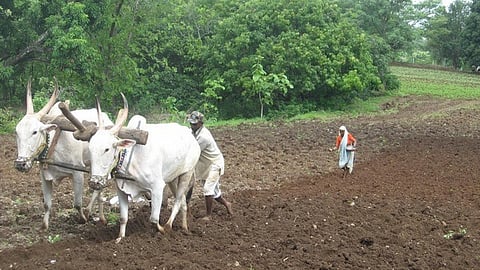
By declaring 2014 as the International Year of Family Farming, a lot of attention was focussed on the contribution of small farms, and the role of the families involved in it in eradicating hunger and poverty. Small farms play a crucial role in ensuring food security, nutrition, improving livelihoods, and managing natural resources, apart from protecting the environment and achieving sustainable development, in rural areas.
The paper titled '2014 International Year of Family Farming: A boost to evergreen revolution' published in the journal Current Science, states that placing small farms at the fore is a welcome move. This should be taken seriously by a country like India where small farm holders are gradually being forced out of their traditional occupations, seen largely as a result of rapid urbanisation, neglect at the policy level, and increased emphasis on corporate farming.
By comparing corporate farming with family farming, the paper highlights the advantages of the latter by stating that corporate farms practice mono-cropping with intensification of inputs that are largely chemically derived. Family farms on the other hand tend to be more diversified.
Corporate farming uses high-yielding crop varieties and looks to improve yields by applying huge amounts of inorganic chemical fertilizers. In addition, they also tend to exploit groundwater resources and fossil fuels to the maximum. Manpower is drastically reduced in corporate farms, promoting jobless economic growth in rural pockets.
The paper argues that though smallholder family farms are inherently eco-friendly and socially equitable, they need to keep pace with advancing technologies as well as changes in the market and policy environment.
Several cattle breeds have already been lost over the years in small farms, and attention now needs to be given to conserve precious animal genetic resources. Incentives and support should be provided to small family farms that own and conserve endangered animal breeds. Family farmers should also be sensitized about community-centric rainwater harvesting, conservation and efficient water use.
Family farms have traditionally placed a heavy workload and responsibility on the shoulders of the women who have no right over the land they work on. Women-managed small family farms are usually handicapped for credit as well as technological support. Support systems should be put in place to ensure women-run farms do not lag behind in the race.
One of the major disadvantages of the smallholder farms is the lack of power of economy of scale. This can be solved by encouraging the formation of cooperatives, which can pool the produce from individual family farms and manage marketing of produce.
The paper ends by arguing that family farming has several principles and practices in common with the evergreen revolution. Small farms should have all the technological, financial, policy and market support so that food and nutrition security can be ensured in the future. Farmers need to be placed at the centre of this movement and be provided with support and opportunities for assured and remunerative marketing.
A pro-small farmer and pro-women orientation will go a long way in sustaining the farmers’ interest in family farming.